
Which one of the following minerals is NOT a naturally occurring silicate?
- (a)Feldspar
- (b)Zeolite
- (c)Mica
- (d)Bauxite
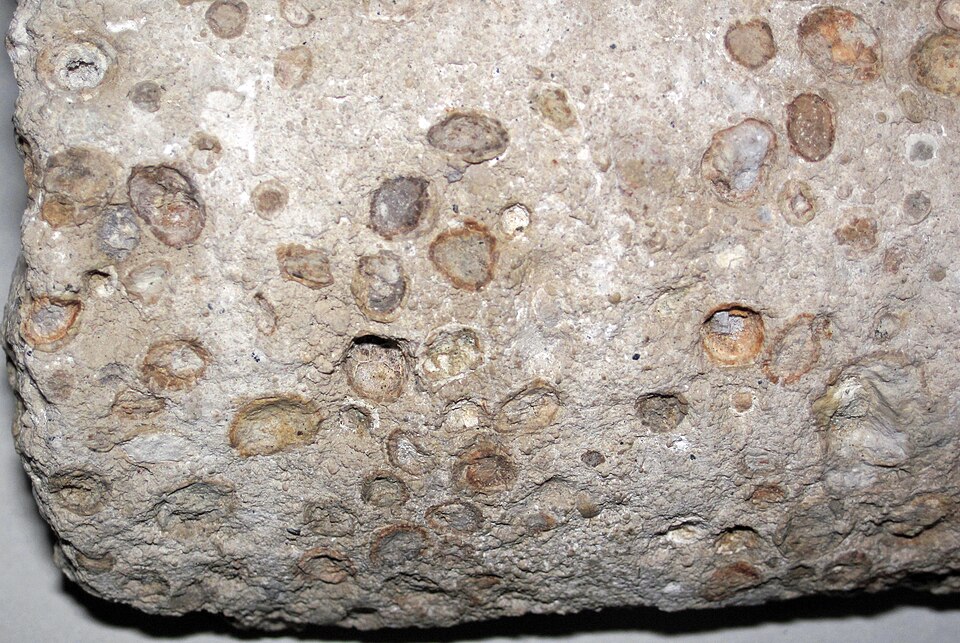
Correct — D, Bauxite. Bauxite is not a single mineral but a rock made mostly of aluminium hydroxide minerals such as gibbsite, boehmite and diaspore, together with iron oxides and clay. It contains no silicate framework and is the ore from which aluminium is won. Feldspar, zeolite and mica are all built on linked silicon-oxygen tetrahedra and are silicates in the strict sense.
- (a)Feldspar — Feldspar is an aluminosilicate of potassium, sodium or calcium, and it is the commonest mineral group in the Earth's crust.
- (b)Zeolite — Zeolites are framework aluminosilicates with open cages of channels, occurring naturally in volcanic rocks and used industrially as molecular sieves and ion exchangers.
- (c)Mica — Mica is a sheet silicate, which is precisely why it splits into thin flexible flakes along one plane.
The silicate minerals are built from the SiO4 tetrahedron, and how those tetrahedra are joined defines the family — isolated in olivine, in chains in pyroxene, in sheets in mica and clay, and in a three-dimensional framework in quartz, feldspar and zeolite. Silicates make up the overwhelming majority of the Earth's crust. Oxide and hydroxide ores such as bauxite, haematite and magnetite sit outside the group entirely.
Bauxite forms by intense chemical weathering in hot wet climates, a process called lateritisation, in which silica and the more soluble bases are leached away and aluminium and iron oxides are left behind. So bauxite is in a real sense what remains after the silicate content has been stripped out of a rock, which is a memorable way to hold the answer. India's main bauxite reserves lie in Odisha, Andhra Pradesh, Gujarat, Jharkhand, Maharashtra and Chhattisgarh, and aluminium is obtained from it by the Bayer process followed by electrolysis of the purified alumina.
- Bauxite is a rock of aluminium hydroxide minerals — gibbsite, boehmite and diaspore — and is the principal ore of aluminium.
- Feldspar, mica, zeolite, quartz, olivine and pyroxene are all silicates built on the SiO4 tetrahedron.
- Feldspars are the most abundant mineral group in the Earth's crust.
- Bauxite forms by lateritic weathering in hot humid climates, which leaches silica away and concentrates aluminium and iron oxides.
- Aluminium is produced from bauxite through the Bayer process and then electrolysis of alumina dissolved in molten cryolite.
- Assuming any rock-forming mineral must be a silicate.
- Treating bauxite as a single mineral rather than a mixture of hydroxide minerals.
- Confusing mica's sheet structure with the framework structure of feldspar and zeolite.
An odd-one-out over mineral chemistry. Sorting each name into silicate or oxide before reading the options is faster than testing them one by one.
Which one of the following is a non-metallic mineral?
- (a) Iron
- (b) Mica
- (c) Copper
- (d) Bauxite
Answer(b) Mica
The same four-mineral spread sorted on a different criterion. Mica reappears as the non-metallic mineral there and as a silicate here, while bauxite sits on the metallic ore side of both divisions.
Aluminium is manufactured from
- (a) Copper ore
- (b) Bauxite ore
- (c) Mica ore
- (d) Manganese ore
Answer(b) Bauxite ore
The industrial half of the same fact. Bauxite being the source of aluminium is why it is an oxide and hydroxide ore rather than a silicate — the silica has been weathered away.
- practice — not a real PYQ
The mineral that splits readily into thin flexible sheets because of its layered silicate structure is
- (a)Quartz
- (b)Mica
- (c)Bauxite
- (d)Haematite
Answer(b) Mica — its silicate tetrahedra are linked into sheets that are weakly bound to one another.
- practice — not a real PYQ
Bauxite deposits typically form as a result of
- (a)volcanic eruption
- (b)intense chemical weathering in hot humid climates
- (c)glacial deposition
- (d)evaporation of sea water
Answer(b) intense chemical weathering in hot humid climates — lateritisation leaches out silica and leaves aluminium and iron oxides behind.