
Which one of the following statements about the Harappan script is NOT correct?
- (a)It has about four hundred signs
- (b)It was written from right to left
- (c)It has been found on bone rods and jewellery
- (d)It refers to the people of Meluhha
Correct — D, It refers to the people of Meluhha. Meluhha is not something the Harappan script says; it is what Mesopotamian scribes called a distant land they traded with, and it appears in their cuneiform records, not in the Indus signs. Since the Harappan script has never been deciphered, no claim about what it refers to can be made at all, which is precisely why this statement is the one that fails. The other three are the standard descriptive facts about the script: it runs to roughly four hundred signs, it was generally written from right to left, and it is found on a wide range of objects including bone rods and jewellery as well as seals, copper tools, terracotta tablets and the large signboard from Dholavira.
- (a)It has about four hundred signs — Correct as stated. The usual count given is between 375 and 400 signs, which is too many for an alphabet and too few for a fully logographic system — one of the reasons decipherment has resisted every attempt.
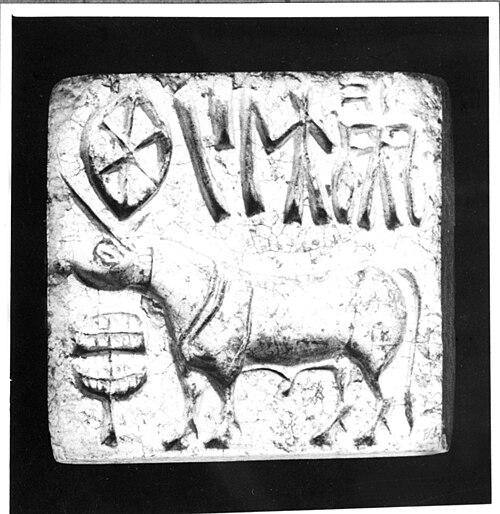
- (b)It was written from right to left — Correct as stated. The evidence is the spacing on seals, where the signs are wide and evenly set on the right and cramped together on the left, as though the writer was running out of room.
- (c)It has been found on bone rods and jewellery — Correct as stated. The script turns up on seals, copper tools, the rims of jars, copper and terracotta tablets, jewellery and bone rods, which is what makes the failure to read it so frustrating.
Everything known about the Harappan script is external to its meaning. Its sign count, its direction, the objects it appears on and the average length of an inscription — usually under a dozen signs — are all measurable; the content is not. That short average length is itself an obstacle, because it leaves no long passage for a decipherer to work against, and there is no bilingual text of the kind that unlocked Egyptian hieroglyphs.
The trap in this item is that Meluhha is a real and relevant term, so the statement sounds informed. What it gets wrong is the direction of evidence. Mesopotamian cuneiform tablets mention trade with Dilmun, Magan and Meluhha, and Meluhha is generally identified with the Indus region; the identification is made by modern scholars reading Mesopotamian sources, and the Harappans left no readable statement about who they were. Keeping straight which civilisation's writing supplies a name is the discipline this question is testing.
- The Harappan script has roughly 375 to 400 signs and remains undeciphered.
- It was generally written from right to left, as the cramped left-hand spacing on seals shows.
- It occurs on seals, copper tools, jar rims, copper and terracotta tablets, jewellery and bone rods.
- Meluhha is a Mesopotamian term, known from cuneiform records, generally identified with the Indus region.
- Mesopotamian texts name Dilmun, Magan and Meluhha as trading partners, usually read as Bahrain, Oman and the Indus.
- Assuming an undeciphered script can be said to refer to anything.
- Attributing a Mesopotamian place name to Indus sources.
- Quibbling over the sign count; 375 to 400 is the accepted range and 'about four hundred' sits inside it.
Asked as a NOT-correct item where the false statement is the only one that makes a claim about meaning rather than about form.
Match List-I with List-II and select the correct answer using the code given below the Lists: List-I (Harappan Site) A. Nageshwar B. Alamgirpur C. Kalibangan D. Rakhigarhi List-II (Location) 1. Uttar Pradesh 2. Rajasthan 3. Saurashtra 4. Haryana Code:
- (a) A-3, B-1, C-2, D-4
- (b) A-4, B-2, C-1, D-3
- (c) A-4, B-1, C-2, D-3
- (d) A-3, B-2, C-1, D-4
Answer(a) A-3, B-1, C-2, D-4
CAPF's other Harappan item, from the geography side. The sites listed there are where the seals and tablets carrying this script were excavated.
- practice — not a real PYQ
In Mesopotamian records, the land generally identified with the Indus region was called
- (a)Dilmun
- (b)Magan
- (c)Meluhha
- (d)Elam
Answer(c) Meluhha — Dilmun is usually read as Bahrain and Magan as Oman.
- practice — not a real PYQ
The famous Harappan 'signboard', a large inscription of ten signs, was found at
- (a)Lothal
- (b)Dholavira
- (c)Kalibangan
- (d)Banawali
Answer(b) Dholavira — in the Rann of Kachchh, Gujarat.