
Consider the following statements about the Treaty of Amritsar (1809): 1. The Treaty fixed the Sutlej as the boundary between the Punjab and British India 2. It was after this treaty that Maharaja Ranjit Singh was able to annex Jammu, Multan and Kashmir to his domains Which of the statements given above is/are correct?
- (a)1 only
- (b)2 only
- (c)Both 1 and 2
- (d)Neither 1 nor 2
Correct — C, Both 1 and 2. The Treaty of Amritsar was signed on 25 April 1809 between Ranjit Singh and Charles Metcalfe, sent by Lord Minto. Statement 1 is right: Ranjit Singh gave up his claims over the Sikh chiefships east of the Sutlej, which passed under British protection, and the river became the recognised line between his Punjab and the Company's territory. Statement 2 is right as a consequence of the first: shut out of the cis-Sutlej country, Ranjit Singh turned his army north and west instead. Multan fell in 1818, Kashmir in 1819, and Peshawar was taken in 1834, while Jammu was granted to Gulab Singh in the early 1820s. Neither statement fails, so the answer accepts both.
- (a)1 only — It rejects the consequence that historians treat as the treaty's main result. Blocked eastward by the Sutlej line, Ranjit Singh spent the next quarter century expanding in the opposite direction.
- (b)2 only — It rejects the treaty's central term. Fixing the Sutlej as the boundary and putting the cis-Sutlej chiefs under British protection is what the document was written to do.
- (d)Neither 1 nor 2 — Both statements are standard textbook history. There is no reading of 1809 on which the Sutlej line was not settled and the north-westward expansion did not follow.
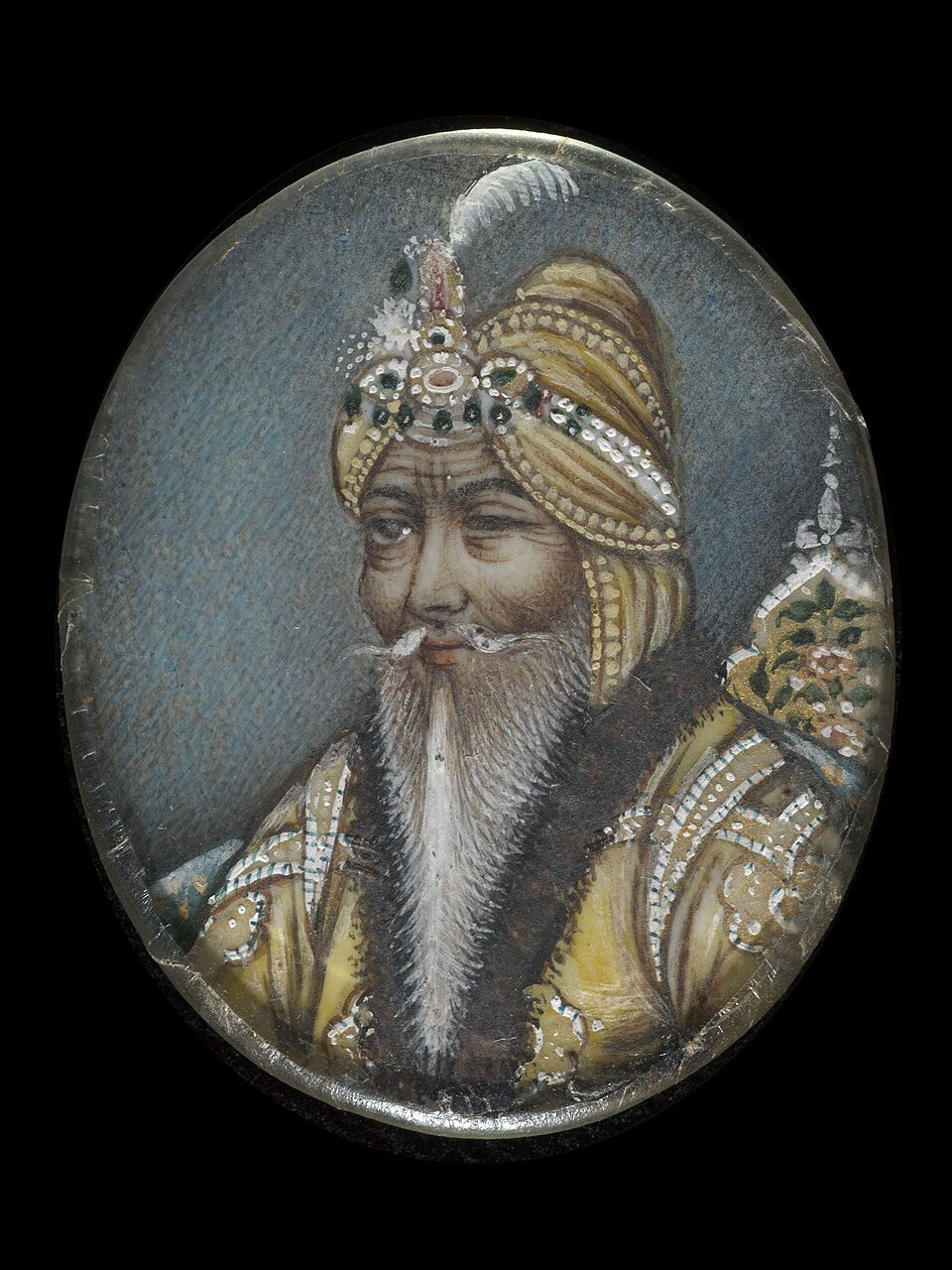
Ranjit Singh took Lahore in 1799 and was proclaimed Maharaja of the Punjab in 1801, building a state that ran from the Sutlej to the Khyber. The Company's motive in 1809 was defensive: Napoleon's understanding with Russia had raised the fear of a European advance on India through Persia and Afghanistan, and London wanted a settled north-western frontier and a friendly Sikh state rather than a war. Ranjit Singh, unwilling to fight the Company, took the bargain and redirected his ambition.
The two statements are cause and effect, which is why an item like this usually resolves to 'both'. What makes it worth learning is the shape of the outcome: a treaty that looks like a limit turns out to be the making of the Sikh empire, because it converted an eastward ambition into a north-western one and gave Ranjit Singh three decades of security on that flank. The Sutlej line held until the First Anglo-Sikh War of 1845, six years after his death, and the whole Punjab was annexed in 1849.
- The Treaty of Amritsar was signed on 25 April 1809 between Ranjit Singh and Charles Metcalfe for Lord Minto.
- It fixed the Sutlej as the boundary and placed the cis-Sutlej Sikh chiefs under British protection.
- Ranjit Singh then expanded north and west: Multan in 1818, Kashmir in 1819, Peshawar in 1834.
- Jammu was granted to Gulab Singh in the early 1820s, the beginning of the Dogra house there.
- The Sutlej frontier lasted until the First Anglo-Sikh War of 1845; the Punjab was annexed in 1849.
- Confusing the 1809 treaty with the 1846 Treaty of Amritsar that transferred Kashmir to Gulab Singh.
- Assuming a boundary treaty must have checked Ranjit Singh's power, when it redirected it.
- Placing Multan, Kashmir and Peshawar before 1809 rather than after.
Asked as a two-statement item where the statements are cause and consequence, so recognising the link is faster than recalling either date.
Which one of the following statements is NOT correct?
- (a) Ali Mardan Khan introduced the system of revenue farming in Bengal
- (b) Maharaja Ranjit Singh set up modern foundries to manufacture cannons at Lahore
- (c) Sawai Jai Singh of Amber had Euclid’s ‘Elements of Geometry’ translated into Sanskrit
- (d) Sultan Tipu of Mysore gave money for the construction of the idol of Goddess Sarda in the Sringeri temple
Answer(a) Ali Mardan Khan introduced the system of revenue farming in Bengal
Its option (b) is the other half of the Ranjit Singh story — the gun foundries at Lahore that paid for the north-westward expansion this item describes.
- practice — not a real PYQ
The Treaty of Amritsar of 1809 fixed which river as the boundary between Ranjit Singh's Punjab and British India?
- (a)Ravi
- (b)Beas
- (c)Sutlej
- (d)Jhelum
Answer(c) Sutlej — the cis-Sutlej Sikh chiefs passed under British protection.
- practice — not a real PYQ
Ranjit Singh annexed Kashmir to his dominions in
- (a)1809
- (b)1818
- (c)1819
- (d)1834
Answer(c) 1819 — a year after Multan and fifteen years before Peshawar.