
Which of the following is not associated with Chandragupta Maurya ?
- (a)Junagadh inscription of Rudradaman
- (b)Vishnugupta
- (c)Sanchi
- (d)Susima
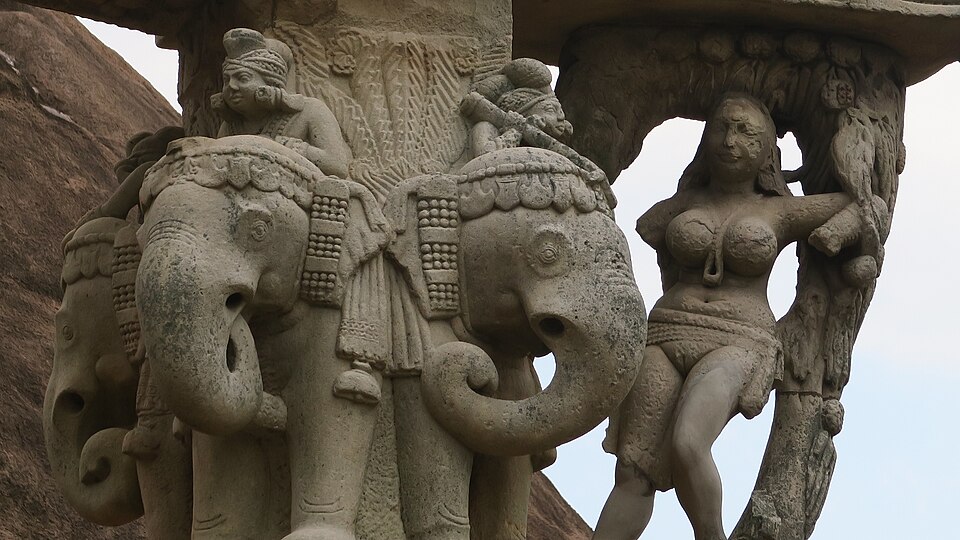
Correct — C, Sanchi. Read the stem carefully first: the word 'not' is set in bold italic in the booklet, so this is a negative question and the answer is the odd one out, not the best match. Three of the four options attach to Chandragupta Maurya and one does not. Sanchi does not. The Great Stupa at Sanchi, on its hilltop in Raisen district of Madhya Pradesh about 46 km north-east of Bhopal, was originally commissioned by Ashoka in the third century BCE as a hemispherical brick structure over relics of the Buddha, later encased in stone and given its carved gateways generations afterwards; the site's other Mauryan remains, the pillar with its lion capital and the earliest phase of Temple 40, are Ashokan too. Nothing at Sanchi is attributed to Ashoka's grandfather, and Chandragupta's name does not appear in the site's record at all. By contrast (a) the Junagadh rock inscription of Rudradaman I, cut shortly after 150 CE at the foot of Girnar, states in line 8 that the Sudarshana lake was made 'by the Vaishya Pushyagupta, the provincial governor of the Maurya king Chandragupta', and adorned with conduits under Ashoka by the Yavana governor Tushaspha — it is the single most important epigraphic record naming Chandragupta Maurya. (b) Vishnugupta is the personal name under which the Arthashastra's last verse identifies its author, conventionally the same person as Chanakya and Kautilya, Chandragupta's mentor and minister. (d) Susima was Bindusara's eldest son, and therefore Chandragupta's own grandson. Sanchi is the only option with no thread to him at all.
- (a)Junagadh inscription of Rudradaman — Associated, and in the most direct way any option here is. Its first eight lines are a history of the Sudarshana reservoir near Girnar in Gujarat from Chandragupta Maurya's reign down to Rudradaman's own repairs around 150 CE, naming Chandragupta's governor Pushyagupta as the builder. The inscription is also the first long record in more or less standard Sanskrit, which is why it is separately famous — and why a candidate may file it under 'Western Satraps' and forget the Mauryan opening.
- (b)Vishnugupta — Associated. Vishnugupta is one of the three names of Chandragupta's Brahmin mentor and minister — Chanakya in the narrative sources, Kautilya as the clan name used throughout the Arthashastra, Vishnugupta in the single verse where the text gives a personal name. The trap is that Vishnugupta is also the name of a late Gupta emperor of the sixth century CE, and 'gupta' in a Mauryan question invites exactly that confusion.
- (d)Susima — Associated, though less tightly than the other two, and this is where the question is weak. Susima was the eldest son and heir-apparent of Bindusara, hence Chandragupta's grandson, and he lost the succession struggle to his half-brother Ashoka. He belongs to Chandragupta's dynasty and family but appears in no episode of Chandragupta's own reign, so a candidate can argue he is unassociated too — the only reading that leaves the item a single answer is the one that counts a documented blood relationship as association and Sanchi's complete silence as none.
Almost everything known about Chandragupta Maurya comes from sources written long after him, which is why questions about him are really questions about which source says what. He rose in the disturbance after Alexander's death, overthrew the Nandas of Magadha around 322–319 BCE with Chanakya's help, and by about 305–303 BCE had concluded a marriage alliance with Seleucus I Nicator that brought him territory in the north-west and Megasthenes to his court at Pataliputra. The evidence divides into four streams. Greek and Roman authors — Megasthenes through Strabo, Arrian and others — call him Sandrokottos and give the outside view. Sanskrit drama, above all Vishakhadatta's Mudrarakshasa, dramatises the court intrigue between Chanakya and the Nanda minister Rakshasa. Jain tradition, in Hemachandra's twelfth-century Parishishtaparvan and the Digambara inscriptions at Shravanabelagola, has him abdicate, follow Bhadrabahu to Karnataka and die by sallekhana — a tradition disputed by Svetambara Jains and by several modern historians. And there is exactly one contemporary-adjacent epigraph that names him: Rudradaman's Junagadh inscription, written more than four centuries later but recording an administrative fact from his reign.
Negative questions punish speed, so slow down twice: once to register the 'not', and once to check every option rather than stopping at the first that looks unconnected. Here the fastest safe route is to test each option for a named link and see which one produces nothing. Junagadh produces Pushyagupta and the Sudarshana lake; Vishnugupta produces the Arthashastra and Chanakya; Susima produces Bindusara and the Ashokan succession. Sanchi produces Ashoka and nothing earlier, which is the answer. The generational map is the thing actually being tested and it is worth carrying whole: Chandragupta, then Bindusara, then Ashoka, and the great Buddhist monuments — Sanchi, Sarnath, the rock and pillar edicts — all belong to the third of those three, not the first. It is also worth naming the item's flaw honestly, because it teaches something about this paper. Susima can be argued to be unassociated with Chandragupta personally, and there is no 'more than one of the above' escape offered on this question, so the setter has left the candidate with two defensible answers and a single mark. Our derivation names Sanchi because a blood relationship is still a relationship and a monument built by a later ruler is not, but it recorded the doubt rather than hiding it.
- The Junagadh rock inscription of Rudradaman I, near Girnar in Gujarat and dated shortly after 150 CE, records the Sudarshana lake as built by the Vaishya Pushyagupta, provincial governor of the Maurya king Chandragupta, and later fitted with conduits under Ashoka by the Yavana governor Tushaspha.
- The same rock carries three inscriptions of different eras — one of Ashoka's major rock edicts, Rudradaman's, and one of the Gupta emperor Skandagupta; Rudradaman's is the first long inscription in fairly standard Sanskrit.
- The Arthashastra names its author as Kautilya throughout and as Vishnugupta in a single verse; the Panchatantra of about the second century CE is among the earliest texts to identify Chanakya with Vishnugupta explicitly.
- Susima was Bindusara's eldest son and heir-apparent, defeated in the succession conflict by his half-brother Ashoka — placing him one generation below Chandragupta's son and two below Chandragupta himself.
- The Great Stupa at Sanchi, in Raisen district of Madhya Pradesh, was commissioned by Ashoka in the third century BCE over relics of the Buddha; the complex spans the Mauryan period to about the twelfth century CE and is a UNESCO World Heritage Site.
- Missing the 'not'. It is printed in bold italic in the booklet but stored here as plain text, so the emphasis the Commission gave it is invisible on screen — the question asks for the odd one out.
- Filing the Junagadh inscription under Rudradaman only. It is a Western Satrap record, but its opening lines are the chief epigraphic evidence for Chandragupta Maurya's administration in Gujarat.
- Confusing the two Vishnuguptas — Chandragupta Maurya's minister, and the sixth-century Gupta emperor of the same name — or reading 'Chandragupta' as Chandragupta I or II of the Gupta dynasty.
BPSC likes the odd-one-out around a single named figure, which rewards breadth over depth: you need one link for each of three options rather than a full account of any. UPSC prefers to isolate one association and test whether you have it exactly, as with its 2019 question on which relief inscription carries the portrait of Ashoka, where Sanchi is offered as the plausible wrong answer for the same reason it is the answer here.
The ancient Indian play Mudrarakshasa of Visakhadutt has its subject on
- (a) a conflict between Gods and Demons of ancient Hindu lore
- (b) a romantic story of an Aryan prince and a tribal woman
- (c) the story of the power struggle between two Aryan tribes
- (d) the court intrigues at the time of Chandragupta Maurya
Answer(d) the court intrigues at the time of Chandragupta Maurya
The positive form of this card's question — is this thing associated with Chandragupta Maurya or not. It also supplies the source behind option (b) here, since the Mudrarakshasa is the drama that fixed Chanakya, also called Vishnugupta, in the popular memory as the architect of Chandragupta's rise.
In which of the following relief sculpture inscriptions is 'Ranyo Ashoka' (King Ashoka) mentioned along with the stone portrait of Ashoka?
- (a) Kanganahalli
- (b) Sanchi
- (c) Shahbazgarhi
- (d) Sohgaura
Answer(a) Kanganahalli
Sanchi as a distractor rather than an answer, and for the same reason it is the answer here — knowing exactly which Mauryan ruler each site belongs to, and resisting the pull of the most famous name on the list.
Match List I with List II List-I List-II Event/Place Connected with Person a) Chola Gangam Lake 1) Chandragupta Maurya b) Appointment of Dharma Mahamatra 2) Harshavardhan c) Assembly at Prayag 3) Rajendra I d) Sudarshan Lake 4) Ashoka Select the correct answer using the codes given below : a b c d
- (a) 3 4 2 1
- (b) 1 4 2 3
- (c) 3 4 1 2
- (d) 2 3 1 4
Answer(a) 3 4 2 1
The Commission asked the very same association again on the 71st CCE later in 2025, and there the pairing that carries the mark is Sudarshan Lake with Chandragupta Maurya — the Junagadh inscription fact that makes option (a) on this card an association rather than the answer.
- practice — not a real PYQ
According to the Junagadh rock inscription of Rudradaman I, the Sudarshana lake was originally constructed during the reign of
- (a)Ashoka
- (b)Chandragupta Maurya
- (c)Rudradaman I
- (d)Skandagupta
Answer(b) Chandragupta Maurya — built by his provincial governor Pushyagupta; conduits were added under Ashoka by the Yavana governor Tushaspha, and Skandagupta's own inscription on the same rock records a later repair.
- practice — not a real PYQ
Susima, who was defeated in the Mauryan succession struggle by Ashoka, was the eldest son of
- (a)Chandragupta Maurya
- (b)Bindusara
- (c)Dasharatha Maurya
- (d)Brihadratha
Answer(b) Bindusara — Susima was the crown prince and heir-apparent, making him Chandragupta Maurya's grandson and Ashoka's elder half-brother.