
Who among the following is not associated with Azad Hind Fauz (INA) ?
- (a)Shahnawaz Khan
- (b)General Mohan Singh
- (c)Prem Singh Sehgal
- (d)S. A. Dange
Correct — D, S. A. Dange. Note the negation before anything else: the booklet sets 'not' in bold italics and the plain text you see here loses that emphasis, so the question asks who does *not* belong. Three of the four names are core Azad Hind Fauj figures and the fourth belongs to an entirely different political tradition. Shripad Amrit Dange was a founder of the Communist Party of India, an accused in the Kanpur Bolshevik Conspiracy Case of 1924 and the Meerut Conspiracy Case of 1929, and a leading figure of the All India Trade Union Congress. He had no connection with the INA whatever, and the disconnection was ideological as well as biographical: after Germany invaded the Soviet Union in June 1941 the Communist Party adopted the 'People's War' line, supported the Allied war effort, stood aside from the Quit India movement of 1942, and was hostile to an army raised with Japanese assistance. The other three are all documented INA men. General Mohan Singh raised the first Indian National Army at Singapore in 1942 from Indian prisoners of war, before it was dissolved in December that year over disputes with the Japanese. Shah Nawaz Khan and Prem Kumar Sahgal were senior officers of the reconstituted INA under Subhas Chandra Bose, and were two of the three defendants — with Gurbaksh Singh Dhillon — in the Red Fort trials of 1945-46, a fact UPSC has itself keyed. On any reading, Dange is the outsider.
- (a)Shahnawaz Khan — Associated, so not the answer. Shah Nawaz Khan was a senior INA officer and one of the three tried together at the Red Fort in 1945-46 — the trial deliberately staged against a Muslim, a Hindu and a Sikh, which turned it into a national cause and produced the defence team of Bhulabhai Desai, Tej Bahadur Sapru, Asaf Ali and Jawaharlal Nehru. He later served as a Union minister.
- (b)General Mohan Singh — Associated, and in fact the man who began it. He raised the first Indian National Army at Singapore in 1942 out of Indian prisoners taken after the fall of Malaya and Singapore, with Japanese encouragement. The first INA was dissolved in December 1942 after he fell out with the Japanese over the force's autonomy, and the army was revived under Subhas Chandra Bose in July 1943.
- (c)Prem Singh Sehgal — Associated. Prem Kumar Sahgal was an INA officer and the second of the three Red Fort defendants; UPSC named him alongside Shah Nawaz Khan and Gurbaksh Singh Dhillon in a 2021 question and keyed all three as officers of the Indian National Army. He later married Lakshmi Swaminathan, who had commanded the INA's Rani of Jhansi Regiment.
The Azad Hind Fauj had two lives. The first was raised at Singapore in 1942 by Mohan Singh from among the tens of thousands of Indian soldiers taken prisoner when Malaya and Singapore fell, with Japanese sponsorship arranged through the Fujiwara Kikan; it collapsed in December 1942 when its Indian leadership concluded that the Japanese meant to use it as an auxiliary rather than treat it as the army of an allied nation. The second was built by Subhas Chandra Bose, who reached Singapore in July 1943, took command, and proclaimed the Provisional Government of Azad Hind on 21 October 1943 — a government recognised by several Axis and Axis-aligned states, with its own currency, court and women's regiment, the Rani of Jhansi Regiment under Lakshmi Sahgal. Its campaign came with the Japanese into Manipur and Nagaland in 1944, and at Moirang, Colonel Shaukat Malik hoisted the Tricolour on Indian soil on 14 April 1944. Militarily the offensive failed at Imphal and Kohima. Politically the INA had its greatest effect after the war, when the Red Fort trials of 1945-46 turned the defendants into national heroes, produced mass demonstrations, and contributed to British doubts about the reliability of the Indian armed forces.
Odd-one-out questions on the national movement are best solved by sorting names into political streams rather than by recalling biographies. The Indian freedom struggle ran through several distinct traditions — the Congress mainstream, the revolutionary underground, the communists and the trade unions, the socialists, the Muslim League, and the INA's armed nationalism abroad — and a name usually belongs firmly to one of them. Here three names sit in the INA stream and one sits in the communist and trade-union stream, which is enough. The ideological detail makes it stronger rather than merely mnemonic: the Communist Party's People's War line after June 1941 put it on the opposite side of the war from the INA, so a founder of the CPI is not simply unconnected with the Azad Hind Fauj but was politically opposed to it. And read the negation twice. Q71 and Q92 on this same paper turn on the same word, printed with an emphasis that does not survive into the text a candidate revises from.
- The first Indian National Army was raised at Singapore in 1942 by General Mohan Singh from Indian prisoners of war, and was dissolved in December 1942 after disputes with the Japanese.
- Subhas Chandra Bose took command of the reconstituted INA in July 1943 at Singapore and proclaimed the Provisional Government of Azad Hind on 21 October 1943.
- Shah Nawaz Khan, Prem Kumar Sahgal and Gurbaksh Singh Dhillon were the three INA officers tried at the Red Fort in 1945-46 — a Muslim, a Hindu and a Sikh — and the trials became a national political event.
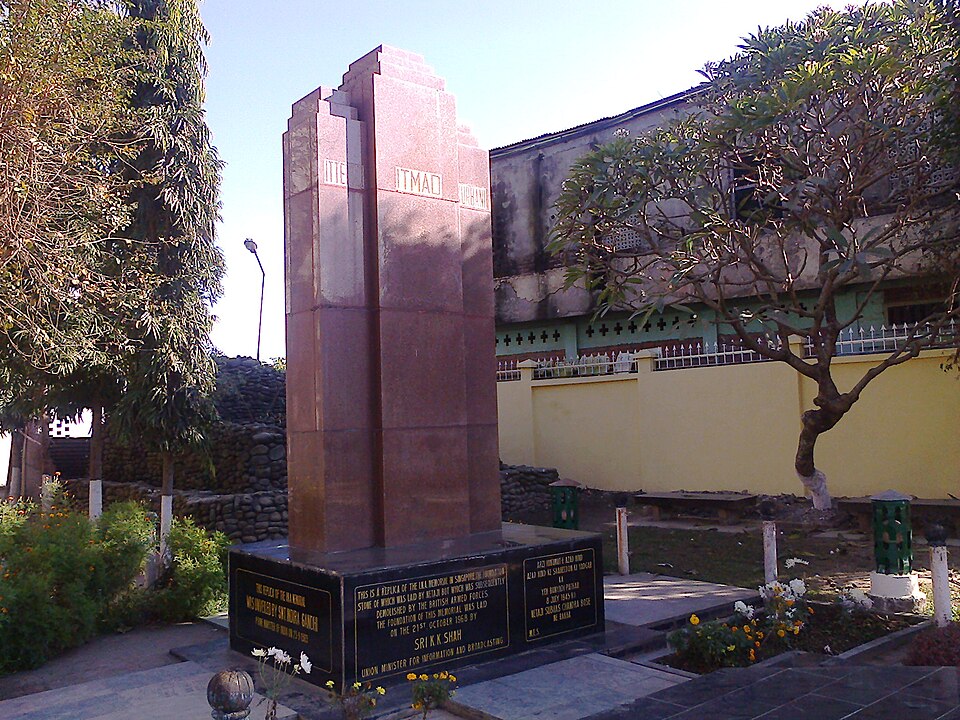
- Colonel Shaukat Malik of the INA hoisted the Tricolour on Indian soil for the first time at Moirang in Manipur on 14 April 1944; the INA Martyrs' Memorial Complex and War Museum stand there.
- S. A. Dange was a founder of the Communist Party of India, an accused in the Kanpur Bolshevik Conspiracy Case (1924) and the Meerut Conspiracy Case (1929), and a leader of the All India Trade Union Congress — a stream that took the 'People's War' line after June 1941 and had no INA connection.
- Missing the negation. The stem asks who is NOT associated, and the booklet's bold-italic emphasis on that word is invisible in plain text.
- Assuming every prominent nationalist of the 1940s touched the INA. The communist stream was on the other side of the war after June 1941 and stood apart from both the INA and Quit India.
- Confusing the two INAs. Mohan Singh raised the first in 1942; Bose commanded the second from July 1943, and the Provisional Government dates from 21 October 1943.
BPSC asks the freedom struggle through its people and prefers the negative form — who is not associated, which pair is not correctly matched — as the 70th CCE paper of December 2024 also did with the parallel governments of the Quit India movement. UPSC asks the same INA material by naming the three Red Fort defendants and asking what they are remembered as, or by asking where and when the army came into existence.
In the context of Colonial India, Shah Nawaz Khan, Prem Kumar Sehgal and Gurbaksh Singh Dhillon are remembered as
- (a) leaders of Swadeshi and Boycott Movement
- (b) members of the Interim Government in 1946
- (c) members of the Drafting Committee in the Constituent Assembly
- (d) officers of the Indian National Army
Answer(d) officers of the Indian National Army
Names two of this question's options directly and keys them as INA officers — which settles half the elimination here from a published UPSC answer, and adds the third Red Fort defendant, Gurbaksh Singh Dhillon, to the set.
The Indian National Army (INA) came into existence in 1943 in
- (a) Japan
- (b) Burma
- (c) Singapore
- (d) Malaya
Answer(c) Singapore
Fixes the place and the year of the reconstituted army under Bose. Reading it alongside Mohan Singh's first INA of 1942, also at Singapore, is the way to keep the two phases of the Azad Hind Fauj apart.
During the Quit India Movement parallel ‘National Government’ was established at many places. Which of the following is not correctly matched ?
- (a) Prati Sarkar – Satara (Maharashtra)
- (b) Raiyati Sarkar – Kheda (Gujarat)
- (c) Jatiy Sarkar – Tamluk (Bengal)
- (d) Praja Mandal – Talchar (Orissa)
Answer(b) Raiyati Sarkar – Kheda (Gujarat)
The 70th CCE paper of December 2024 used the same negative construction on the same period of the freedom struggle. Both questions reward sorting the 1942-46 landscape into its separate streams — the Quit India underground at home, and the Azad Hind Fauj abroad.
- practice — not a real PYQ
The Provisional Government of Azad Hind was proclaimed by Subhas Chandra Bose in October 1943 at
- (a)Tokyo
- (b)Rangoon
- (c)Singapore
- (d)Port Blair
Answer(c) Singapore — proclaimed on 21 October 1943. Bose later hoisted the flag at Port Blair in December 1943 and moved the government's headquarters to Rangoon in 1944.
- practice — not a real PYQ
The Tricolour was hoisted on Indian soil for the first time by the Indian National Army on 14 April 1944 at
- (a)Kohima
- (b)Moirang
- (c)Imphal
- (d)Aizawl
Answer(b) Moirang in Manipur, by Colonel Shaukat Malik — the site of the INA Martyrs' Memorial Complex and War Museum today.