
The temple at Deogarh near Jhansi and the sculptures in the temple at Garhwa near Allahabad are important remains of
- (a)Maurya art
- (b)Rashtrakuta art
- (c)Gupta art
- (d)None of the above
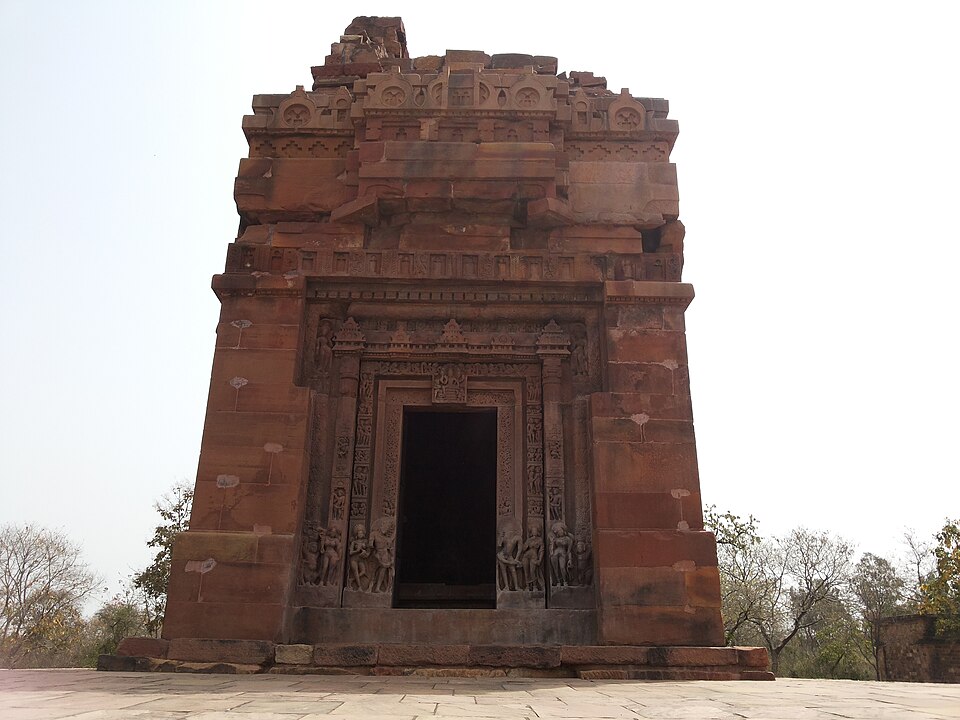
Correct — C, Gupta art. Both sites named in the stem belong to the Gupta period, and both are standard illustrations of it in every account of Indian art. The Dashavatara temple at Deogarh, in Lalitpur district of Uttar Pradesh near Jhansi, dates from the early sixth century CE and is the single most important surviving example of Gupta temple architecture. It is a stone temple raised on a high plinth with a flight of steps, and it carried a shikhara — a tower over the sanctum — which makes it one of the earliest structural temples to show the feature that would define the whole later Nagara style. Its sculpted panels on the three outer walls are as famous as the building: the Sheshashayi Vishnu, showing the god reclining on the coils of the serpent Ananta with Brahma seated on a lotus rising from his navel, together with the Nara-Narayana panel and the Gajendra-moksha panel, are among the finest reliefs of the period. Garhwa, near Prayagraj, is the second site the stem names — a walled enclosure with a group of Gupta-period sculptured panels and pillars, less complete than Deogarh but from the same tradition and the same centuries. What makes both unmistakably Gupta is the combination: structural stone temples rather than rock-cut caves, a sanctum with an image, restrained and idealised figure sculpture, and a Vaishnava iconography that had by then become fully worked out. Since (c) is correct, the escape option (d) cannot stand.
- (a)Maurya art — Eight centuries too early and a completely different repertoire. Mauryan art of the third century BCE means the monolithic sandstone pillars with their animal capitals and mirror polish, the rock-cut Barabar caves in Bihar granted to the Ajivikas, the rock-cut elephant at Dhauli and free-standing figures such as the Didarganj Yakshi from Patna. There are no structural stone temples of the Mauryan period at all.
- (b)Rashtrakuta art — Wrong period and wrong region. The Rashtrakutas ruled the Deccan from the eighth to the tenth centuries, and their monument is the Kailasa temple at Ellora, cut downward out of a single hillside on the orders of Krishna I — a rock-cut monolith in Maharashtra, at the opposite end of the country from Deogarh and Garhwa and two to four centuries later.
- (d)None of the above — Fails because Gupta art is on the list and is exactly right for both sites. The escape option only wins when all three named alternatives can be shown to fail, and here the second of them is the standard attribution in every survey of Indian art history.
The Gupta period, roughly the fourth to sixth centuries CE, is where the Hindu temple as a building type takes shape. Before it, sacred architecture in India meant stupas and rock-cut caves; the Guptas produced free-standing structural temples in dressed stone, and the sequence of their development is a standard examination topic — from flat-roofed square shrines with a shallow porch, such as Temple 17 at Sanchi, to temples on a raised plinth with a covered ambulatory, to Deogarh with its tower. Gupta sculpture is equally distinctive: figures are idealised rather than individual, the modelling is restrained, drapery clings and is indicated by fine parallel lines rather than heavy folds, and the halo behind a head is elaborately carved. The Buddha images from Sarnath and Mathura are the type specimens. The same centuries produced the Ajanta murals in their finest phase, the Udayagiri caves near Vidisha with their great Varaha panel, and the iron pillar now at Delhi.
Period-attribution questions are answered from the KIND of monument, not from the name of the place, and that is the transferable skill here. Ask what technology the object represents. A polished monolithic pillar or a cave cut into living rock, with no structural building at all, is Mauryan. A free-standing stone temple with a sanctum and the beginnings of a tower is Gupta. A vast rock-cut monolith carved downward in the Deccan is Rashtrakuta. A soaring curvilinear tower in Odisha or Khajuraho is early medieval Nagara, later than all three. Applied to this stem, 'the temple at Deogarh' with 'sculptures in the temple at Garhwa' announces structural temples with figure sculpture, which places them in the Gupta window without any need to have visited either site. The one genuine trap is regional: both places are in the Ganga-Yamuna belt, which was Mauryan heartland too, so a candidate reasoning from geography alone rather than from monument type can be pulled towards option (a).
- The Dashavatara temple at Deogarh, Lalitpur district, Uttar Pradesh, dates from the early sixth century CE and is the classic surviving example of Gupta temple architecture, with a high plinth and an early shikhara.
- Its best-known relief is the Sheshashayi Vishnu — the god reclining on the serpent Ananta — alongside the Nara-Narayana and Gajendra-moksha panels.
- Garhwa, near Prayagraj, preserves a group of Gupta-period sculptured panels and pillars within a stone enclosure.
- Mauryan art means monolithic polished pillars with animal capitals, the Barabar rock-cut caves in Bihar granted to the Ajivikas, the Dhauli elephant and the Didarganj Yakshi — no structural stone temples.
- Rashtrakuta art means the Kailasa temple at Ellora, cut downward from a single hillside under Krishna I in the eighth century, in the Deccan.
- Reasoning from region rather than from monument type. Deogarh and Garhwa lie in the Mauryan heartland, but a structural stone temple is not a Mauryan form.
- Confusing Deogarh in Uttar Pradesh with Deoghar in Jharkhand. The Gupta temple is at Deogarh, Lalitpur district, near Jhansi.
- Placing the Rashtrakutas in the north. Their monuments are Deccan rock-cut work, above all the Kailasa temple at Ellora.
BPSC names one or two sites and asks for the period, which rewards a candidate who has attached a period to every famous monument. UPSC asks the same material as a chronology — which of these was made earliest — or as a statement list about who built what for whom, so knowing the period is only the first half; the sequence and the patron matter as much.
With reference to the art and archaeological history of India, which one among the following was made earliest?
- (a) Lingaraja Temple at Bhubaneswar
- (b) Rock-cut Elephant at Dhauli
- (c) Rock-cut Monuments at Mahabalipuram
- (d) Varaha Image at Udayagiri
Answer(b) Rock-cut Elephant at Dhauli
The same periods, ordered instead of named. The Dhauli elephant is Mauryan and therefore earliest; the Varaha image at Udayagiri is Gupta, from the same century and the same sculptural tradition as Deogarh; and the Lingaraja temple is early medieval Nagara, centuries later.
With reference to the history of Indian rock-cut architecture, consider the following statements: 1. The caves at Badami are the oldest surviving rock-cut caves in India. 2. The Barabar rock-cut caves were originally made for Ajivikas by Emperor Chandragupta Maurya. 3. At Ellora, caves were made for different faiths. Which of the statements given above is/are correct?
- (a) 1 only
- (b) 2 and 3 only
- (c) 3 only
- (d) 1, 2 and 3
Answer(c) 3 only
The rock-cut tradition against which Gupta structural building has to be set. Its second statement covers the Barabar caves of Bihar — the Mauryan monument type — and its third covers Ellora, where the Rashtrakutas cut the Kailasa temple. Both are the alternatives offered on this BPSC page, and neither is a structural temple.
The painting of ‘Bodhisattva Padmapani’ is located at
- (a) Bagh
- (b) Ellora
- (c) Ajanta
- (d) Badami
Answer(c) Ajanta
The 69th CCE asked the same kind of site-identification question about the painting side of the same period. The Padmapani mural at Ajanta belongs to the Gupta centuries, so the two questions between them cover the sculpture and the painting of a single artistic age.
- practice — not a real PYQ
The Sheshashayi Vishnu panel, showing the god reclining on the serpent Ananta, is found on which temple ?
- (a)Kailasa temple at Ellora
- (b)Dashavatara temple at Deogarh
- (c)Lingaraja temple at Bhubaneswar
- (d)Kandariya Mahadeva temple at Khajuraho
Answer(b) Dashavatara temple at Deogarh — the most famous of its three outer wall panels, and one of the finest reliefs of the Gupta period.
- practice — not a real PYQ
The Barabar caves in Bihar, the earliest surviving rock-cut caves in India, were originally granted to which sect ?
- (a)Jainas
- (b)Ajivikas
- (c)Theravada Buddhists
- (d)Pashupatas
Answer(b) Ajivikas — the order founded by Makkhali Gosala, whose central doctrine was niyati or fate. The caves were cut in the Mauryan period and are famous for the mirror polish of their interior walls.