
The script written on Ashoka's Pillars is
- (a)Pali
- (b)Sanskrit
- (c)Samaritan
- (d)Brahmi
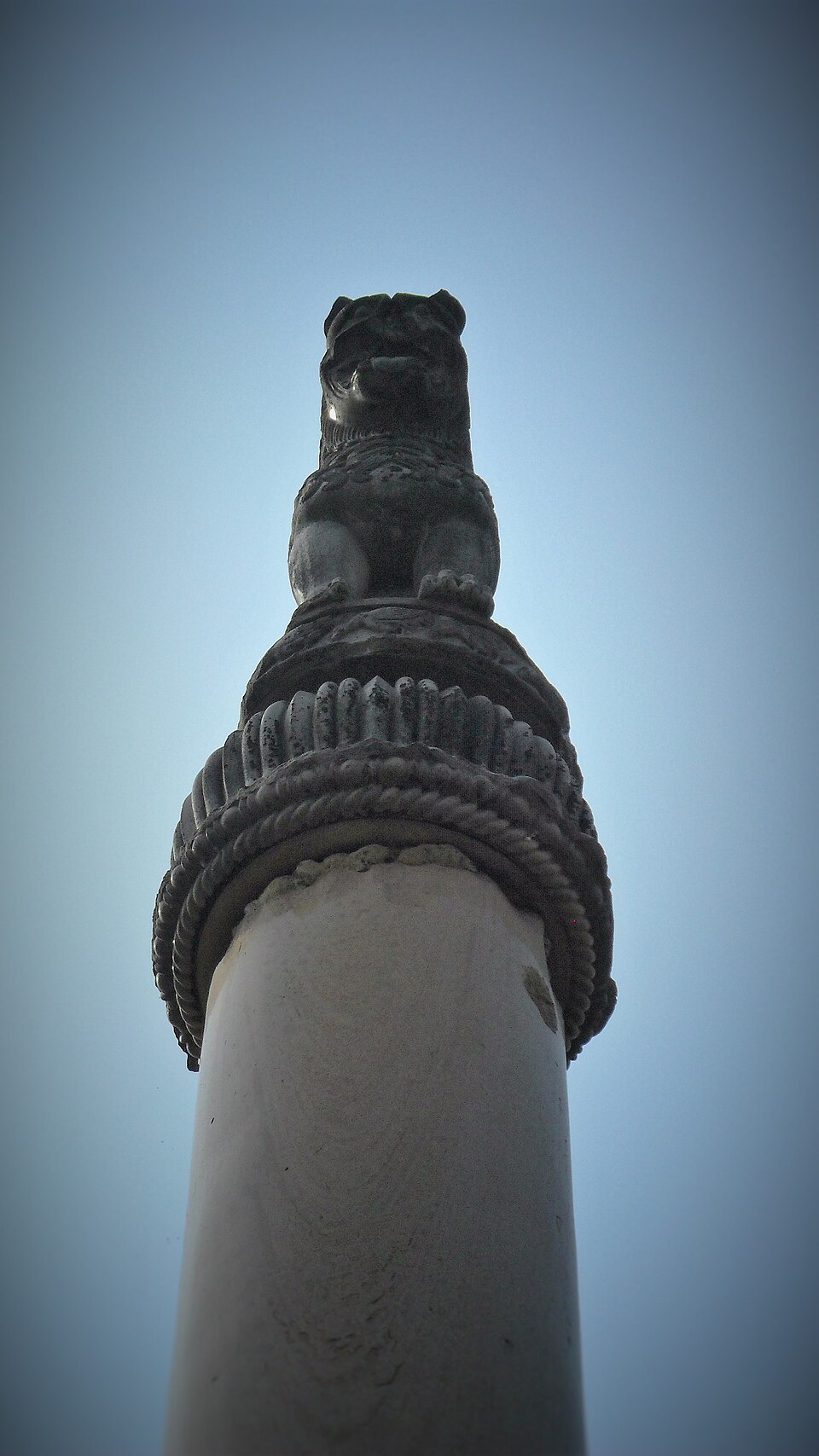
Correct — D, Brahmi. Ashoka's pillar edicts are engraved in the Brahmi script, and their language is Prakrit — specifically the Magadhi Prakrit of the imperial chancery at Pataliputra. Keeping script and language apart is the entire question, and it is the distinction two of the four options are designed to blur. A script is a system of written signs; a language is what those signs record. Brahmi is a script, written from left to right, and it is the ancestor of almost every writing system used in India today as well as of the Sinhala, Burmese, Thai and Tibetan scripts. Prakrit is the language, and Prakrit written in Brahmi is what stands on the pillars. Ashoka did use other scripts, but only on the fringes of his empire and never on the pillars of the Indian heartland: the rock edicts at Shahbazgarhi and Mansehra in the north-west are in Kharoshthi, which runs right to left, and the Kandahar edicts are in Greek and Aramaic for the Hellenised and Persian populations of the far west. The pillars themselves are a distinct class of Ashokan monument — single shafts of polished sandstone quarried at Chunar near Varanasi, generally twelve to fifteen metres tall and weighing tens of tonnes, transported hundreds of kilometres and set up without any joint or foundation, each crowned by an animal capital. Bihar carries more of them than any other State: the pillars at Lauriya Nandangarh and Lauriya Areraj in Champaran, at Rampurva, and the lion pillar at Kolhua near Vaishali all still stand. The script on all of them stayed unread for nearly two thousand years until James Prinsep deciphered Brahmi in 1837, and with it recovered an emperor whose name Indian tradition had forgotten.
- (a)Pali — The trap the question is built around, and the answer most candidates give. Pali is a LANGUAGE, not a script — the Middle Indo-Aryan language in which the Buddhist Tipitaka is preserved, and it has been written in Brahmi, Sinhala, Burmese, Thai, Khmer and Roman letters at different times and places. Ashoka's edicts are not even in Pali; they are in regional Prakrits closely related to it.
- (b)Sanskrit — Also a language rather than a script, and the wrong language as well. The Mauryan chancery deliberately used Prakrit, the spoken vernacular, rather than Sanskrit, the language of learning — a choice that made the edicts intelligible to ordinary subjects. The earliest substantial royal inscription in Sanskrit comes centuries later, with Rudradaman's Junagadh rock inscription of about 150 CE.
- (c)Samaritan — The only genuine script on the list apart from Brahmi, and it belongs to a different world entirely. The Samaritan script is a West Semitic writing system descended from the Palaeo-Hebrew alphabet and used in Palestine; it has no Indian connection whatever. It is on the paper to give the option set a fourth entry, and can be struck out on sight.
Ashoka's inscriptions fall into three groups and it is worth holding them apart. The MAJOR ROCK EDICTS, fourteen in number, are cut on natural rock faces around the frontiers of the empire — Girnar, Dhauli, Jaugada, Kalsi, Shahbazgarhi, Mansehra, Sopara, Yerragudi. The PILLAR EDICTS, seven in number, are engraved on the free-standing monolithic columns of the Gangetic heartland. Alongside these are the MINOR rock and pillar edicts, including the Maski and Gujarra inscriptions — the ones that give Ashoka's personal name rather than only his titles Devanampiya Piyadasi — and the Rummindei pillar at Lumbini recording his visit to the Buddha's birthplace and his reduction of that village's tax to one-eighth. What the edicts communicate is dhamma: non-violence, respect for elders and teachers, truthfulness, tolerance between sects, care for animals and provision of wells, rest houses and medical care for men and beasts. They are administrative proclamations, not scripture, and they were placed where people passed — on trade routes, near towns and at pilgrimage sites.
This question is answered by a single test, and it is worth applying to every options list of this kind: sort the options into scripts and languages before doing anything else. Pali and Sanskrit are languages; Brahmi and Samaritan are scripts; and since the stem asks for a script, the field is halved at once. Then ask which of the two scripts is Indian, and the answer stands alone. That is faster and safer than trying to recall which edict is at which site. The second thing worth carrying is the language–script grid for ancient India, because both commissions build questions from it: Brahmi is left to right and Kharoshthi right to left; Ashoka's edicts are in Prakrit, Rudradaman's Junagadh inscription of about 150 CE is the first long royal inscription in Sanskrit; and the Gupta records that follow are Sanskrit in a late Brahmi. Note finally the significance of what Prinsep's decipherment recovered — before 1837, Indian tradition remembered a king called Ashoka from Buddhist texts, but nobody knew that the Devanampiya Piyadasi of the inscriptions was the same man.
- The pillar edicts are inscribed in the Brahmi script and in Prakrit; the north-western rock edicts at Shahbazgarhi and Mansehra use Kharoshthi, and the Kandahar edicts are in Greek and Aramaic.
- Ashokan pillars are monolithic shafts of polished sandstone quarried at Chunar near Varanasi, generally twelve to fifteen metres tall, each with an animal capital and set up without foundation or joint.
- Bihar carries several surviving pillars — Lauriya Nandangarh and Lauriya Areraj in Champaran, Rampurva, and the lion pillar at Kolhua near Vaishali.
- The Lion Capital from Sarnath was adopted as the State Emblem of India on 26 January 1950; the wheel from its abacus is the Ashoka Chakra on the national flag.
- James Prinsep deciphered Brahmi in 1837, which is how the Devanampiya Piyadasi of the inscriptions was identified with the Ashoka of Buddhist tradition; the Maski minor rock edict gives his personal name directly.
- Answering 'Pali' because it sounds ancient and Buddhist. Pali is a language, and the stem asks for a script.
- Assuming all Ashokan inscriptions use one script. The pillars are Brahmi, but the north-western rock edicts are in Kharoshthi and the Kandahar edicts in Greek and Aramaic.
- Confusing the pillars with the rock edicts. They are separate classes of inscription in separate parts of the empire, and BPSC has asked about both.
BPSC asks Mauryan material with a Bihar bias — the founder of the dynasty, the capital, the pillars that stand in Champaran and Vaishali — and often reduces it to a one-word identification like this. UPSC pushes the same material one level finer: which edict names Ashoka personally, which script runs right to left, which edicts mention the Sangam kingdoms. The distinction between script and language is what both are actually testing.
Which one of the following scripts of ancient India was written from right to left?
- (a) Brahmi
- (b) Nandnagari
- (c) Sharada
- (d) Kharosthi
Answer(d) Kharosthi
The same subject with all four options kept honestly in the same category — every one of them is a script. Kharoshthi, written right to left, is the script of Ashoka's north-western rock edicts, while Brahmi, written left to right, is the script of the pillars.
Which one of the following edicts mentions the personal name of Asoka?
- (a) Kalsi
- (b) Rummindei
- (c) Special Kalinga Edict
- (d) Maski
Answer(d) Maski
One level finer on the same inscriptions. Most edicts call the emperor only Devanampiya Piyadasi; the Maski minor rock edict gives the name Ashoka itself, which is how the inscriptions were tied to the king Buddhist tradition remembered.
Match List I with List II List-I List-II Event/Place Connected with Person a) Chola Gangam Lake 1) Chandragupta Maurya b) Appointment of Dharma Mahamatra 2) Harshavardhan c) Assembly at Prayag 3) Rajendra I d) Sudarshan Lake 4) Ashoka Select the correct answer using the codes given below : a b c d
- (a) 3 4 2 1
- (b) 1 4 2 3
- (c) 3 4 1 2
- (d) 2 3 1 4
Answer(a) 3 4 2 1
The 71st CCE tested Ashoka through his administration rather than his script, pairing him with the Dhamma Mahamattas — the officers appointed to propagate the dhamma that the pillar edicts proclaim. Its fourth item, the Sudarshan lake, points at the other great epigraphic landmark of this topic: Rudradaman's Junagadh inscription, the first long royal record in Sanskrit rather than Prakrit.
- practice — not a real PYQ
The language of Ashoka's inscriptions in the Gangetic heartland is
- (a)Sanskrit
- (b)Prakrit
- (c)Pali
- (d)Apabhramsha
Answer(b) Prakrit — the spoken Middle Indo-Aryan vernacular of the Mauryan chancery, written in the Brahmi script. Sanskrit appears in long royal inscriptions only from Rudradaman's Junagadh record of about 150 CE.
- practice — not a real PYQ
Which one of the following Ashokan pillars stands in Bihar ?
- (a)Sarnath
- (b)Sanchi
- (c)Lauriya Nandangarh
- (d)Topra
Answer(c) Lauriya Nandangarh — in West Champaran district, one of several Ashokan pillars still standing in Bihar along with Lauriya Areraj, Rampurva and the lion pillar at Kolhua near Vaishali. Sarnath and Sanchi are in Uttar Pradesh and Madhya Pradesh; the Topra pillar was moved to Delhi by Firuz Shah Tughlaq.