
Which is the oldest mountain of South America continent ?
- (a)Andese Mountain
- (b)Brazil Mountain
- (c)Turmuc-Humuk
- (d)Pacaraima
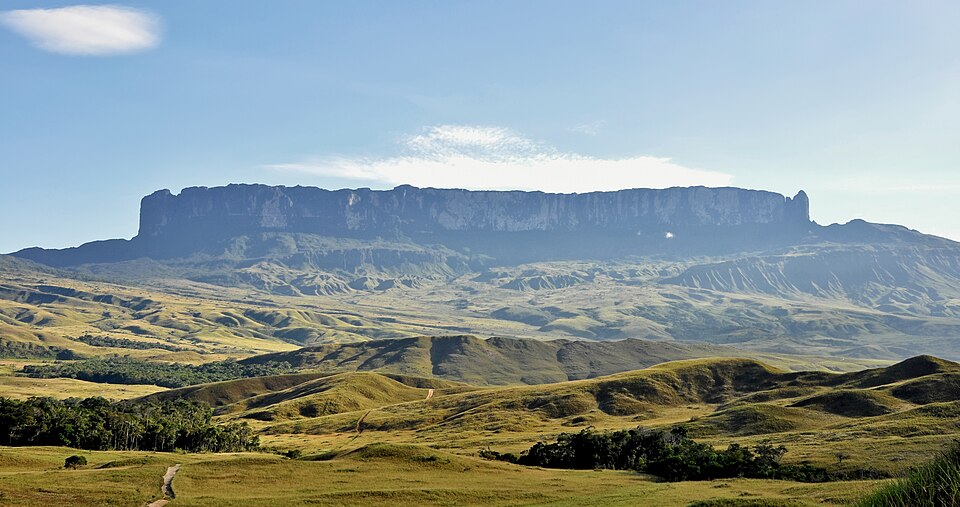
Correct — D, Pacaraima. The Pacaraima or Pakaraima Mountains run for over 800 kilometres from west to east across southern Venezuela, northern Brazil and southwestern Guyana, forming the watershed between the Orinoco basin to the north and the Amazon basin to the south and marking long stretches of the Brazil–Venezuela and Brazil–Guyana borders. Geologically they sit on the Guiana Shield, one of the three cratons of the South American Plate and a Precambrian formation about 1.7 billion years old. The range itself is a sandstone plateau resting on horizontal Precambrian strata — the Roraima Supergroup, whose quartz sandstones, quartzites and conglomerates are dated to roughly 1.8 to 1.4 billion years — and its oldest basement rocks are older still, the Archean gneisses of the Imataca Complex. Erosion of that sandstone has carved the plateau into the flat-topped table mountains the region is famous for, the tepuis, of which Mount Roraima at 2,810 metres, ringed by 300-metre cliffs and standing at the tri-point of Brazil, Guyana and Venezuela, is the best known. Nothing else on this page is remotely as old. The Andes, printed here as 'Andese Mountain', are the youngest large range on the continent — an active fold belt still being pushed up by the subduction of the Nazca plate, with most of its uplift belonging to the Cenozoic, the last few tens of millions of years. Set 50 million years beside 1,700 million and the comparison is not close. Note the honest limit of this answer. The Tumucumaque uplands, printed here as 'Turmuc-Humuk', sit on the same Guiana Shield and share its Precambrian basement, so they cannot be excluded on the age of the rock alone; they are excluded because they are a low eastern extension with no comparable claim attached to them, while it is Pacaraima and Roraima that geological and reference sources single out for extreme antiquity.
- (a)Andese Mountain — The Andes — printed here with the Commission's own spelling — are the obvious answer and the wrong one, because they are the continent's YOUNGEST major range, not its oldest. They run some 7,000 kilometres down the western edge of South America and are still rising, thrown up by the subduction of the oceanic Nazca plate beneath the South American plate; the belt is seismically and volcanically active along most of its length. Size and fame are not age.
- (b)Brazil Mountain — The Brazilian Highlands do rest on ancient cratonic basement — the Brazilian Shield is the second of the continent's three cratons — but they are described in physical geography as a plateau rather than as a mountain range, and their present relief owes much to Mesozoic basaltic outpourings and later uplift and erosion. The option is also a loose name rather than a recognised range.
- (c)Turmuc-Humuk — The genuine near-miss, and the reason this answer is argued rather than asserted. The Tumucumaque range, printed here as the Commission spells it, lies on the same Guiana Shield along the Brazil–Suriname and Brazil–French Guiana border and shares the same Precambrian basement. It is excluded not on rock age but because it is a low eastern extension of the uplands with no documented claim to being the continent's oldest range, while the Pacaraimas carry that claim through the Roraima Supergroup and the tepuis.
South America divides into four great physical regions, and holding them is worth more than any single fact about them. In the west run the Andes, a young Cenozoic fold belt raised by plate subduction. In the north-east lies the Guiana Shield, with its higher ground the Guiana Highlands, a 1.7-billion-year-old Precambrian craton carrying the Pacaraima Mountains, the Tumucumaque uplands and the tepuis. In the east and south-east lies the Brazilian Shield, the second ancient craton, surfacing as the Brazilian Highlands. Between the two shields lies the Amazon basin, a vast sedimentary trough drained by the world's largest river by volume. The Guiana Highlands are also the source of some of the world's most famous waterfalls — Angel Falls in Venezuela, the highest uninterrupted waterfall on Earth, and Kaieteur Falls in Guyana, which drops from the Pacaraima plateau itself.
Questions about the oldest or youngest mountains anywhere are really questions about plate tectonics, and one rule answers most of them: young mountains are fold mountains at active plate margins, old mountains are the worn-down remnants of shields and cratons in continental interiors. Apply it and the Andes are disqualified in a sentence, because a range that is still rising and still shaken by earthquakes cannot be an ancient one. The same rule works in India — the Himalaya are the young fold range at the Indian plate's collision boundary, while the Aravalli, worn to stumps in the interior of the peninsular block, are among the oldest ranges on Earth. Once the Andes are out, the remaining three options all sit on Precambrian shields and the question becomes genuinely hard, which is why our answer here is argued rather than asserted: no source was found that ranks Pacaraima against Tumucumaque by age, and the case for Pacaraima rests on the documented antiquity of the Roraima Supergroup and its tepuis. A candidate meeting this in the hall should note the honest position — the Andes are certainly wrong, and among the shield ranges Pacaraima is the one the sources single out.
- The Guiana Shield is one of the three cratons of the South American Plate, a Precambrian formation about 1.7 billion years old; its oldest rocks are the Archean gneisses of the Imataca Complex.
- The Pacaraima (Pakaraima) Mountains extend over 800 km west to east across Venezuela, Brazil and Guyana, and form the divide between the Orinoco valley and the Amazon basin as well as long sections of two international borders.
- They are a sandstone plateau built on the Roraima Supergroup, whose quartz sandstones, quartzites and conglomerates are dated to roughly 1.8 to 1.4 billion years.
- Mount Roraima, at 2,810 metres, is the range's highest point — a tepui ringed by cliffs about 300 metres high, standing where Brazil, Guyana and Venezuela meet, and first climbed in 1884 by a party led by Everard im Thurn.
- The Andes, by contrast, form an active fold belt raised by subduction of the Nazca plate, with most of their uplift in the Cenozoic — the youngest major mountain system on the continent.
- Assuming the biggest or most famous range must be the oldest. The Andes are the continent's largest range and its youngest.
- Treating a plateau as a mountain range. The Brazilian Highlands rest on ancient basement but are classified as a plateau.
- Reading the Commission's spellings as errors to be corrected. 'Andese Mountain' and 'Turmuc-Humuk' are printed exactly as the booklet has them, and the answer must be judged on the options as they appear.
BPSC asks world physical geography as a one-line superlative — the oldest mountain, the longest range, the highest waterfall — and does not shrink from unfamiliar spellings, so a candidate has to recognise a range from a garbled transliteration. UPSC prefers to test the same regions positionally, by asking which physical region is marked on a map or which river rises where, so the four great divisions of South America have to be held as a mental map rather than as a list of names.
The physical regions marked as 1, 2, 3 and 4 on the given map are respectively
- (a) Andes, Brazilian Shield, Guyana Highlands and Amazon Basin
- (b) Andes, Guyana Highlands, Brazilian Shield and Amazon Basin
- (c) Amazon Basin, Guyana Highlands, Brazilian Shield and Andes
- (d) Guyana Highlands, Brazilian Shield, Andes and Amazon Basin
Answer(a) Andes, Brazilian Shield, Guyana Highlands and Amazon Basin
The exact four regions this question is built on, asked as a map. Knowing that the Guiana Highlands are a distinct ancient shield in the north-east — not part of the Andes and not part of the Brazilian Shield — is what makes the Pacaraima answer intelligible rather than a guess between unfamiliar names.
The approximate age of the Aravalli’s range is
- (a) 370 million years
- (b) 470 million years
- (c) 570 million years
- (d) 670 million years
Answer(a) 370 million years
The same question about the Indian equivalent — which range is the ancient one, and how ancient. The Aravalli is India's worn-down old block range as the Guiana Highlands are South America's, and in both cases the young folded belt at the plate margin, Himalaya or Andes, is the one to eliminate first.
Following are the mountain ranges of India 1. Garo Hills 2. Nandadevi 3. Kamet 4. K2 Which of the following is their correct sequence from east to west ?
- (a) 4 3 1 2
- (b) 3 4 2 1
- (c) 1 2 3 4
- (d) 2 1 4 3
Answer(c) 1 2 3 4
The 70th CCE paper of December 2024 asked the same family of question — place named mountains relative to one another — three weeks before this sitting, and it too fell at question 18. BPSC treats mountain identification as a standing item, Indian in one paper and world in the next.
- practice — not a real PYQ
The Andes mountains of South America were formed mainly by
- (a)erosion of an ancient Precambrian shield
- (b)subduction of the Nazca plate beneath the South American plate
- (c)volcanic outpourings during the Mesozoic era
- (d)collision of the African and South American plates
Answer(b) subduction of the Nazca plate beneath the South American plate — an active convergent margin, which is why the Andes are still rising and still volcanically and seismically active, and why they are the continent's youngest major range.
- practice — not a real PYQ
Angel Falls, the world's highest uninterrupted waterfall, is located in which physical region ?
- (a)The Andes
- (b)The Brazilian Highlands
- (c)The Guiana Highlands
- (d)The Patagonian plateau
Answer(c) The Guiana Highlands — it plunges from a tepui in the Canaima area of Venezuela, on the same ancient sandstone plateau system that carries the Pacaraima Mountains and Mount Roraima.