
If triangle represents Men, rectangle represents Businessman and circle represents Millionaire, then which number represents Men that are both Businessman and Millionaire ?
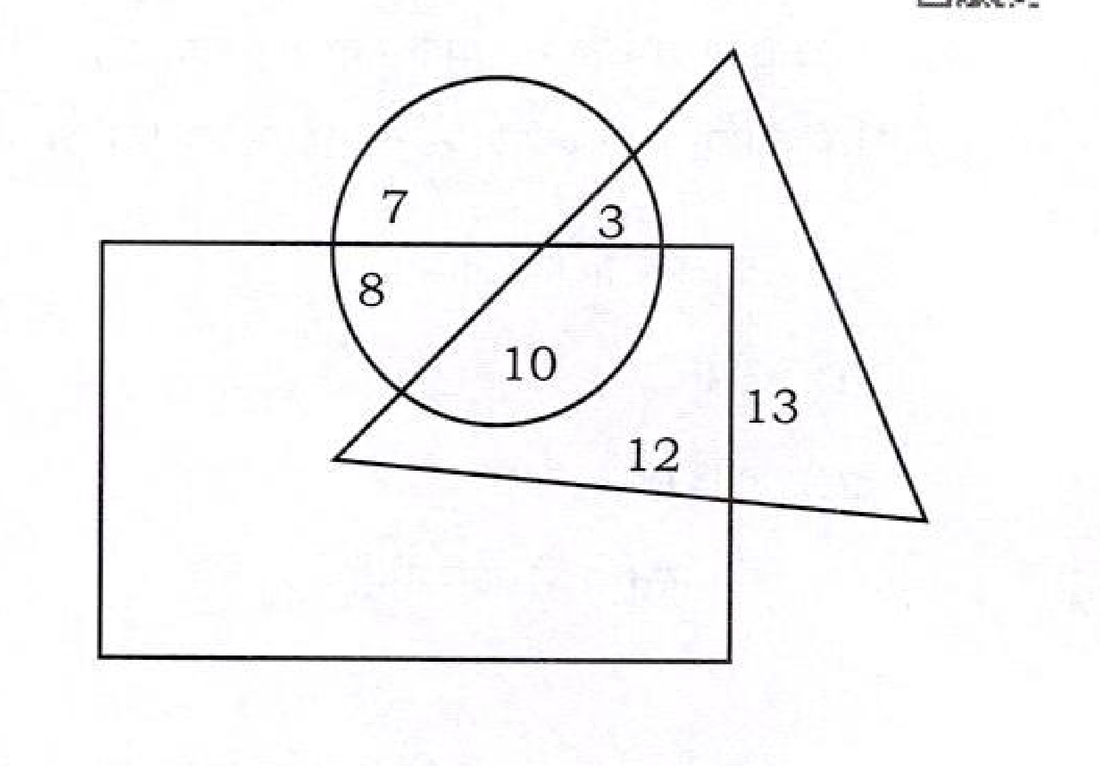
- (a)10
- (b)3
- (c)13
- (d)12
Correct — A, 10. Translate the sentence before looking at the figure. 'Men that are both Businessman and Millionaire' imposes three conditions at once — the person must be a Man, a Businessman and a Millionaire — so the number wanted must lie inside the triangle, inside the rectangle and inside the circle simultaneously. There is exactly one such region on the page, and 10 is printed in it. Now read the figure region by region, which is the only reliable way to do these and takes about twenty seconds. Six numbers are printed and each sits in a different region. 7 lies in the upper-left of the circle, above the rectangle's top edge and to the left of the triangle's slanting side: circle only, so Millionaire and nothing else. 3 lies in the circle's upper-right lens, still above the rectangle's top edge but now to the right of the triangle's side: circle and triangle, so Millionaire and Man, but not a Businessman. 8 lies in the circle's lower-left, below the rectangle's top edge but still left of the triangle: circle and rectangle, so Millionaire and Businessman, but not a Man. 10 lies in the circle's lower-right, below the rectangle's edge and right of the triangle's side and above the triangle's base — inside all three. 12 lies inside the rectangle and inside the triangle but below the circle, so Businessman and Man without being a Millionaire. 13 lies to the right of the rectangle's edge and outside the circle, inside the triangle alone: a Man only. Written as a table of ticks, only 10 carries three ticks, and it is option (a). Notice how the option set is built: each of the three wrong numbers satisfies exactly two of the three conditions and fails one — 3 is not a Businessman, 12 is not a Millionaire, 13 is neither. That is the standard construction for this question type, and it means a candidate who misjudges a single boundary of the figure will land on a wrong option that feels entirely reasonable.
- (b)3 — Sits in the circle and inside the triangle, so a Millionaire and a Man — but it lies above the rectangle's top edge, outside the Businessman shape. It answers the question 'Men who are Millionaires', dropping the businessman condition. It is the trap for a reader who spots the circle–triangle overlap first and stops there.
- (c)13 — Lies inside the triangle alone, to the right of the rectangle's edge and clear of the circle — a Man who is neither a Businessman nor a Millionaire. It is offered because the sentence begins with the word 'Men', and a candidate reading the grammatical subject rather than the whole condition will take the Men-only region.
- (d)12 — Inside the rectangle and inside the triangle but below the circle, so a Man who is a Businessman and not a Millionaire. Two conditions out of three, and the missing one is the hardest to see, because 12 sits close under the circle's lower edge — this is the option a hurried eye picks.
A figure like this is a Venn diagram drawn with different outlines instead of three circles, and nothing about the reasoning changes because the shapes differ. Each closed shape is a set; a point either lies inside it or does not; and every region of the picture is defined by which shapes contain it. With three overlapping sets there can be at most seven bounded regions inside the union — three regions belonging to one set alone, three to each pair, and one to all three — plus the outside. This figure prints six of them: the three-way region, two of the three pair regions, and one single-set region. The vocabulary that maps sentences onto regions is small and fixed. 'And', 'both' and 'who are also' mean intersection, so add a shape. 'But not' and 'only' mean exclusion, so remove a shape. 'Or' means union. The number of shapes named in the phrase is the number of ticks the region must carry, which is the single fastest check available.
Do the reading before the question, not after. Go through every printed number once and write down its signature — for this figure, 7 is C, 3 is C+T, 8 is C+R, 10 is C+R+T, 12 is R+T, 13 is T. That takes one pass. Then convert the question into a signature: 'Men that are both Businessman and Millionaire' names all three shapes, so the target is C+R+T, and the lookup is instant. The alternative — hunting for the region while re-reading the sentence — is where errors come from, because the eye finds a plausible overlap and the mind stops. Two habits protect the mark. First, count the shapes named in the question; three named shapes can only mean the triple region. Second, sanity-check by asking what each wrong option would be the answer to, which on this figure gives clean sentences — 3 answers 'Men who are Millionaires', 12 answers 'Men who are Businessmen', 13 answers 'Men who are neither'. If every distractor has a clean sentence of its own, the reading is right. It is also worth noticing that 7 and 8 are printed in the figure but not offered as options at all: both lie outside the triangle, and the setter has quietly signalled that the triangle is the boundary the candidate is expected to get right.
- The region wanted lies inside all three shapes at once — triangle (Men), rectangle (Businessman) and circle (Millionaire) — and only the number 10 does
- Region signatures in this figure: 7 = circle only; 3 = circle + triangle; 8 = circle + rectangle; 10 = all three; 12 = rectangle + triangle; 13 = triangle only
- Three overlapping sets create at most seven bounded regions — three singles, three pairs and one triple — and this figure prints six of them
- Each wrong option satisfies exactly two of the three conditions: 3 is not a Businessman, 12 is not a Millionaire, 13 is only a Man
- The numbers 7 and 8 appear in the figure but in no option; both lie outside the triangle, so neither can describe 'Men' of any kind
The question names three shapes, so the answer must carry three ticks. Only 10 does — option (a). Each wrong option is short by exactly one condition.
- Answering the grammatical subject: the sentence starts with 'Men', but the region asked for is not the Men-only region
- Stopping at the first overlap the eye finds, which on this figure gives 3 or 12 — each short by one condition
- Assuming a Venn question always uses circles; here two of the three sets are a rectangle and a triangle, and the boundaries that matter are a straight edge and a slanting side
BPSC prints the figure and asks for one region in a single sentence, so the whole mark turns on reading the picture correctly under time pressure — and the paper carries two figure questions of different kinds, this one and a count-the-triangles item. UPSC has set the identical format for decades, usually labelling regions with letters rather than numbers and adding an explicit exclusion such as 'but not coaches', which makes the sentence harder to translate but the figure no harder to read.
In the given figure, the triangle represents girls, the square represents sportspersons and the circle represents coaches. The portion in the figure which represents girls who are sportspersons but not coaches is the one labelled
- (a) A
- (b) B
- (c) D
- (d) E
Answer(b) B
The same question with the labels changed — a triangle, a quadrilateral and a circle standing for three overlapping groups, and one region to be identified. UPSC adds an exclusion ('but not coaches') where BPSC piles up three inclusions, but the region-signature method answers both.
In the given diagram, circle A represents teachers who can teach Physics, circle B represents teachers who can teach Chemistry and circle C represents those who can teach Mathematics. Among the regions marked p, q, r, s, t, u and v, the one which represents teachers who can teach Physics and Mathematics but not Chemistry, is
- (a) v
- (b) u
- (c) s
- (d) t
Answer(b) u
Three sets, seven labelled regions, and a phrase to be turned into a signature — two shapes in and one shape out. It shows the full seven-region layout that this BPSC figure only partly prints.
How many triangles are there in the following figure PQRS ? [FIGURE: rectangle PQRS (P top-left, Q top-right, S bottom-left, R bottom-right) with both diagonals PR and QS drawn, plus a horizontal segment from the midpoint of side PS to the centre and a vertical segment from the centre down to side SR]
- (a) 10
- (b) 16
- (c) 12
- (d) 18
Answer(c) 12
The 70th CCE paper of December 2024 carried the other kind of figure question, and the shared demand is the same one candidates underrate: neither item can be answered from the words, and both are won by working through the drawing systematically instead of eyeballing it.
- practice — not a real PYQ
In the same figure — triangle for Men, rectangle for Businessman, circle for Millionaire — which number represents Businessmen who are Millionaires but not Men ?
- (a)7
- (b)8
- (c)10
- (d)12
Answer(b) 8 — it lies inside the circle and inside the rectangle but to the left of the triangle's slanting side, so it is outside the Men set.
- practice — not a real PYQ
In a figure of three overlapping sets, at most how many distinct bounded regions can be formed inside the union of the three shapes ?
- (a)Five
- (b)Six
- (c)Seven
- (d)Eight
Answer(c) Seven — three regions belonging to one set alone, three to each pair of sets, and one common to all three.