
Quinine is a common drug for malaria that is obtained from a plant. Which part of the plant yields this drug ?
- (a)Stem bark
- (b)Leaves
- (c)Root
- (d)None of the above
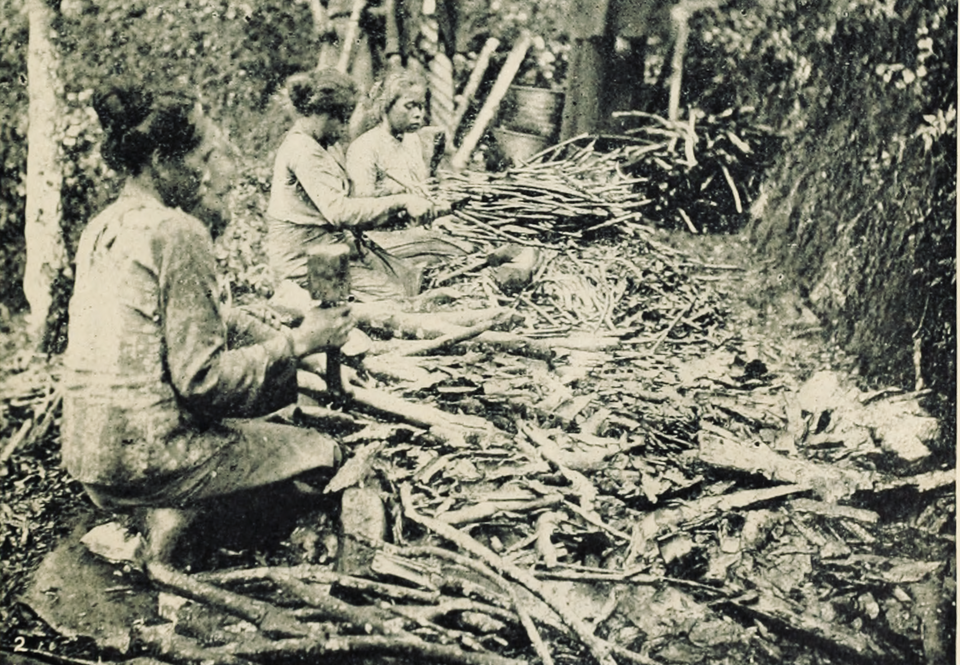
Correct — A, Stem bark. Quinine is an alkaloid of the cinchona tree, a genus of the family Rubiaceae native to the tropical Andean forests of western South America, and the part of the tree that is harvested, dried, powdered and extracted is the bark of the trunk and branches — the material the old trade called Peruvian bark or Jesuit's bark. The pharmacopoeial drug is literally 'cinchona bark': strips are peeled from the standing trunk or from felled stems, dried, and worked up for their alkaloid content. Two French chemists, Pierre Joseph Pelletier and Joseph Bienaimé Caventou, first isolated pure quinine from that bark in 1820, and the same bark yields three more alkaloids of the same family — quinidine, cinchonine and cinchonidine — which is why the whole class is called the cinchona alkaloids. Cinchona remains the only economically practical source of quinine; two centuries of chemistry have not produced a synthesis that can compete with a tree, and the commercially decisive species, Cinchona ledgeriana, carries roughly 8 to 13 per cent quinine in its bark. The species matters less than the tissue: what the bark carries in double-digit percentages, the leaves do not, which is exactly what the question is testing. Since option (a) is right, option (d) 'None of the above' cannot be. Note the wording the Commission chose — 'stem bark' rather than a bare 'bark' — and it is the precise term, because bark in the botanical sense is everything outside the vascular cambium and it can be taken from stem or root; the drug of commerce comes from the stem.
- (b)Leaves — Leaves are the default guess for any plant-derived substance, because that is where photosynthesis happens and where the familiar plant drugs of everyday life — tea, tobacco, mint — come from. Cinchona leaves are not the drug source; the alkaloid is concentrated in the bark, and no pharmacopoeia lists a leaf preparation of cinchona.
- (c)Root — The near-miss, and worth understanding rather than merely rejecting. Cinchona root bark does contain alkaloids and was traded in small quantities in the nineteenth century, but the root as such is not the source, and the medicinal material of commerce and of the pharmacopoeias is the bark of the stem and branches. An option that says 'Root' — not 'root bark' — names the wrong organ and the wrong tissue at once.
- (d)None of the above — This escape option is only correct when all three named choices fail, and here the first one succeeds outright: cinchona stem bark is the source of quinine. Reach for a 'None of the above' only after you can say specifically why each of the other three is false — on this question you cannot, because (a) is true.
Plant-derived drugs are classified by the organ they are extracted from, and examiners test exactly that pairing. Quinine belongs to the alkaloids — nitrogen-containing, bitter, physiologically potent plant compounds, the group that also contains morphine, nicotine, caffeine and reserpine. In cinchona the alkaloids accumulate in the bark, the tissue outside the vascular cambium, which is why the tree is stripped rather than uprooted or defoliated. Cinchona species are shrubs or small trees five to fifteen metres tall with opposite leaves and white, pink or red flowers in terminal panicles; Europeans called them fever trees for what the bark did. The bark was in use against fevers in the Andes before European contact, reached Europe with Jesuit missionaries in the 1630s, and entered the London Pharmacopoeia as Cortex Peruanus in 1677. It is the first case in history of a chemical compound being used to treat an infectious disease.
The reasoning route is to ask what part of the plant the trade actually harvests, because the commodity name usually gives it away. Cinchona is bought and sold as 'bark' exactly as cinnamon is bark, opium is latex from the poppy capsule, and rubber is latex from the trunk of Hevea. When a question offers stem, leaf and root for a known plant drug, recall the commodity rather than the plant. The single discriminating fact here is that quinine is quantified as a percentage of bark — the Ledger cinchona was prized for yielding 8 to 13 per cent quinine in its bark, and that figure is quoted for no other tissue. A second habit worth building is to keep the drug, the plant and the disease together as a triple: quinine — cinchona bark — malaria; artemisinin — Artemisia annua — malaria; taxol — the Himalayan yew, Taxus — cancer; reserpine — sarpagandha, Rauvolfia serpentina — hypertension. Each of those has been asked as a two-way match at some point, and holding the triple protects against a question that comes at it from either end.
- Quinine was first isolated from cinchona bark in 1820 by Pierre Joseph Pelletier and Joseph Bienaimé Caventou; its molecular formula was established by Adolph Strecker in 1854
- Cinchona is a genus of at least 23 species of trees and shrubs in the family Rubiaceae, native to the tropical Andean forests of western South America, and is the only economically practical source of quinine
- The bark also yields quinidine, cinchonine and cinchonidine — collectively the cinchona alkaloids; Cinchona ledgeriana bark carries about 8 to 13 per cent quinine
- Cinchona was introduced into cultivation in Asia in the 1850s and 1860s — into Java by the Dutch from 1854, and into Sri Lanka and the Nilgiris of southern India by Clements Markham in 1860
- Quinine is on the World Health Organization's Model List of Essential Medicines, but since 2006 WHO no longer recommends it as first-line treatment for malaria, reserving it for cases where artemisinin-based therapy is unavailable
- Quinine's bitterness is why it flavours tonic water; the gin-and-tonic began as a way of making an antimalarial dose palatable in the tropics
- Answering 'leaves' by reflex because leaves are the visible, active part of a plant — the drug organ is often bark, root, latex or seed instead
- Confusing quinine with artemisinin: both treat malaria, but artemisinin comes from the leaves of the sweet wormwood Artemisia annua, and that difference is exactly what a paired question would test
- Treating 'None of the above' as a safe answer when you are unsure of the detail; here the first option is plainly right, and the escape option costs a third of a mark
BPSC asks this as a one-step recall pairing — name the plant part, the district, the year — and the whole item is decided by a single noun. UPSC almost never asks the bare pairing; it wraps the same fact in a statement set (the Taxus question is typical: three statements about habitat, Red Data Book status and what the drug treats, of which only some are true), so a BPSC aspirant should memorise the pairing and a UPSC aspirant should be able to defend each half of it separately.
Consider the following statements: 1. The Taxus tree naturally found in the Himalayas. 2. The Taxus tree is listed in the Red Data Book. 3. A drug called “taxol” is obtained from Taxus tree is effective against Parkinson’s disease. Which of the statements given above is/are correct?
- (a) 1 only
- (b) 1 and 2 only
- (c) 2 and 3 only
- (d) 1, 2 and 3
Answer(b) 1 and 2 only
The same tree-to-drug pairing, and the same tissue: taxol is taken from the bark of the Himalayan yew as quinine is taken from the bark of cinchona. UPSC wraps it in statements and makes the disease the discriminator — taxol is an anticancer drug, not a Parkinson's drug.
Recently, there was a growing awareness in our country about the importance of Himalayan nettle (Girardinia diversifolia) because it is found to be a sustainable source of
- (a) anti-malarial drug
- (b) biodiesel
- (c) pulp for paper industry
- (d) textile fibre
Answer(d) textile fibre
The mirror image of this question — UPSC names the plant and asks what it yields, and offers 'anti-malarial drug' as the trap. Knowing that the antimalarial of plant origin is cinchona bark, not a Himalayan nettle, is what kills option (a) there and settles the answer here.
- practice — not a real PYQ
The antimalarial drug artemisinin is obtained from which plant ?
- (a)Cinchona ledgeriana
- (b)Artemisia annua
- (c)Rauvolfia serpentina
- (d)Taxus wallichiana
Answer(b) Artemisia annua — sweet wormwood, from whose leaves artemisinin is extracted; cinchona gives quinine, Rauvolfia gives reserpine and Taxus gives taxol.
- practice — not a real PYQ
The drug reserpine, used to lower blood pressure, is obtained from which part of Rauvolfia serpentina ?
- (a)Flower
- (b)Leaf
- (c)Root
- (d)Fruit
Answer(c) Root — sarpagandha is harvested for its root, in contrast to cinchona, where the bark of the stem is the drug material.