
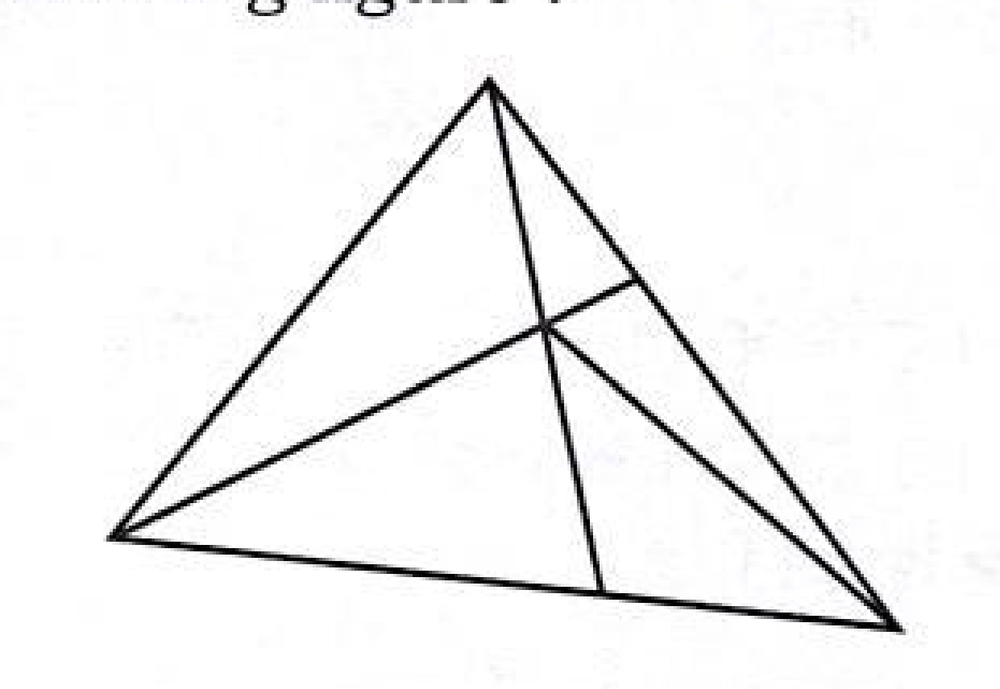
How many triangles are there in the following figure ?
- (a)10
- (b)8
- (c)14
- (d)12
Correct — B, 8. Name the figure to count it. Call the apex A, the bottom-left vertex B and the bottom-right vertex C. One inner line runs from A to a point D on the base BC, the other from B to a point E on the right-hand side AC, and the two cross at an interior point F. Now count by LINES rather than by regions, because regions are where miscounts come from. Exactly five straight lines are drawn: AB, BC, CA, AD and BE. Any triangle in the picture must be bounded by three of them, and three lines chosen from five can be picked in 5 × 4 × 3 ÷ 6 = 10 ways. Two of those ten choices fail, and both fail for the same reason — the three lines pass through a single point instead of enclosing an area. AB, CA and AD all meet at A; AB, BC and BE all meet at B. Every one of the remaining eight triples does bound a genuine triangle, and they are: ABC, the whole figure; ABD and ADC, the two halves made by the cevian AD; ABE and BCE, the two halves made by the cevian BE; and the three small ones round the crossing point — ABF on the base line AB, BDF in the bottom-right corner and AEF in the upper-right corner. Eight in all. The strongest thing about this method is what it does not need: nowhere did the position of D or of E enter the count. Slide either foot along its side and the same five lines still meet in the same pattern, so the answer stays 8. A line drawn from a vertex to the opposite side is called a cevian, and the general rule worth carrying out of this question is that TWO CEVIANS FROM TWO DIFFERENT VERTICES ALWAYS PRODUCE 8 TRIANGLES — which is exactly why this question was answerable even though the booklet printed no labels inside the figure at all.
- (a)10 — The count you get from the raw combinatorics without removing the degenerate cases — three lines chosen from five give ten triples, and a candidate who stops there answers 10. The two triples that must be struck out are the ones concurrent at a vertex: AB with CA and AD at A, and AB with BC and BE at B. Three lines through one point enclose nothing.
- (c)14 — Comes from treating the four-sided region FDCE as if it could be split into triangles. It cannot: no line is drawn between C and F, or between D and E, so that region stays a quadrilateral in this figure. Adding either of those two segments would genuinely raise the count, which is why the option looks plausible to someone reasoning about areas rather than about drawn lines.
- (d)12 — The answer to a richer figure than the one printed — 12 is what a rectangle with both diagonals and two half-medians yields, and it is the published answer to the count-the-triangles question on the 70th CCE paper of December 2024. Here it usually arises from double-counting the small regions around the crossing point F, or from counting a region and its mirror image twice.
Counting figures inside a figure is a standard reasoning item, and it has a reliable method that does not depend on eyesight or patience. Every triangle in a line drawing is the intersection of exactly three straight lines, so the count of triangles is the count of ways to choose three of the drawn lines, minus the choices that fail. A choice fails if the three lines are concurrent — they all pass through one point — or if they are parallel, or if the point where two of them cross lies outside the drawn segments. Work through the drawn lines, take the combination, then subtract the failures. For simple cevian figures the failures are always the concurrences at the vertices, and they are easy to list. A related standard result is worth memorising alongside: if n cevians are drawn from ONE vertex of a triangle to the opposite side, the number of triangles is (n + 1)(n + 2) ÷ 2 — three for one cevian, six for two, ten for three.
The reason to count lines rather than regions is that regions tempt you into two opposite errors at once. You miss the large triangles that are made of several regions joined together, and you double-count the small ones by approaching them from different directions. The line method has neither failure mode: five lines, ten triples, two struck out, eight left, and the enumeration can be written down and checked. It also survives a missing label. This particular question printed no letters inside the figure, which meant it could not be reconstructed from a verbal description alone — and yet the count is fixed by the pattern of lines and not by where the two inner lines happen to meet the sides. That is the useful generalisation: for two cevians from different vertices the answer is 8 no matter how the picture is drawn. Under exam pressure, the practical routine is to label the picture yourself in the margin before counting anything. Naming the points is what turns an eyesight task into arithmetic.
- A cevian is a line segment from a vertex of a triangle to a point on the opposite side; a median, an altitude and an angle bisector are all special cases.
- Two cevians drawn from two different vertices always cross inside the triangle and always yield exactly 8 triangles, wherever their feet are placed.
- The count comes from choosing 3 of the 5 drawn lines — C(5,3) = 10 — and removing the 2 triples that are concurrent at a vertex.
- The eight triangles are ABC, ABD, ADC, ABE, BCE, ABF, BDF and AEF, where D and E are the feet of the cevians and F is their crossing point.
- For n cevians drawn from a single vertex the number of triangles is (n + 1)(n + 2) ÷ 2 — one cevian gives 3, two give 6, three give 10.
Eight named triangles, plus one region that is not a triangle at all. Writing the list out is faster and safer than counting shapes by eye, and it does not depend on where the two inner lines meet the sides.
- Counting the smallest regions and stopping. The large triangles made of several regions joined together are exactly the ones that get missed.
- Treating a four-sided region as decomposable. FDCE is a quadrilateral because no segment joins C to F or D to E; assuming it splits gives 14.
- Forgetting to strike out the concurrent triples. Choosing three of the five lines gives ten, but two of the ten pass through a single vertex and enclose nothing — which is where the answer 10 comes from.
BPSC puts figure-counting into General Studies Paper-I itself, since the state prelims has no separate aptitude paper, and has now asked it in consecutive editions — a rectangle with diagonals on the 70th CCE paper of December 2024, and this triangle with two cevians three weeks later. UPSC keeps all of it in CSAT Paper-II, which is merely qualifying at 33 per cent, so a UPSC aspirant sitting BPSC has to bring this back into the scoring paper's timing plan.
How many triangles are there in the following figure PQRS ? [FIGURE: rectangle PQRS (P top-left, Q top-right, S bottom-left, R bottom-right) with both diagonals PR and QS drawn, plus a horizontal segment from the midpoint of side PS to the centre and a vertical segment from the centre down to side SR]
- (a) 10
- (b) 16
- (c) 12
- (d) 18
Answer(c) 12
The 70th CCE paper of December 2024 — the sitting three weeks before this re-examination — asked exactly the same item type with a rectangle and its diagonals, and its answer is 12. That is also the number offered as a distractor here, which is a useful warning: the count belongs to the figure, not to the question type, and it has to be worked each time.
- practice — not a real PYQ
How many triangles are formed inside a triangle when three cevians are drawn from the SAME vertex to the opposite side ?
- (a)6
- (b)8
- (c)10
- (d)12
Answer(c) 10 — for n cevians from one vertex the count is (n + 1)(n + 2) ÷ 2, so three cevians give 4 × 5 ÷ 2 = 10. The base is cut into four parts, and every one of the ten ways of choosing a start and end point along it gives a triangle with the apex.
- practice — not a real PYQ
How many triangles are there in a triangle in which exactly one cevian has been drawn from a vertex to the opposite side ?
- (a)2
- (b)3
- (c)4
- (d)5
Answer(b) 3 — the two parts created by the cevian, plus the original whole triangle. By the line method there are four lines, C(4,3) = 4 triples, and one of them is concurrent at the vertex the cevian comes from.