
 View answer copy →
Kanchan ChoudharyRank 408CSE 2023
Answered a very similar question
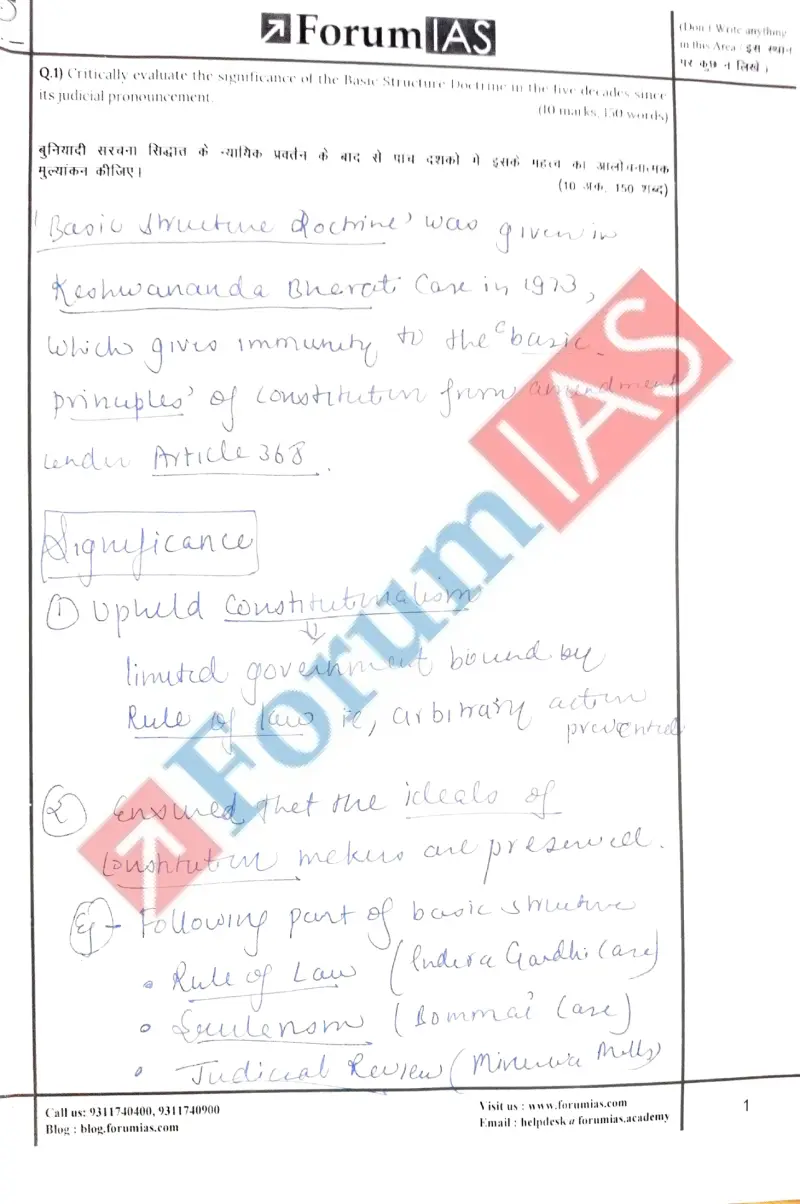
Their question: “Basic Structure Doctrine - critical evaluation over five decades (10m)”
The topper's dated case-spine evaluating the basic-structure doctrine and the judiciary's role over decades is exactly the evidence base a student needs to evaluate judicial activism in achieving the ideals of democracy.
Key learnings from their answer
- ›On Q1, which asked to evaluate the Basic Structure doctrine 'over five decades', she built a chronological case spine, Kesavananda Bharati (1973) -> Indira Gandhi case -> S.R. Bommai -> Minerva Mills, and then capped it with current proof of the doctrine in action (NJAC/99th Amendment struck down, J&K reorganisation). -> When a question carries a time span ('five decades', 'since independence'), answer it as a dated sequence of landmarks and finish on the most recent application, instead of listing cases in random order.
- ›She matched the quote to the office the question was about: in Q12 (free & fair elections / CEC) she closed with S.Y. Quraishi's actual line 'CEC shouldn't be a weak-kneed person, rather someone who isn't afraid to take on the ruling party', i.e. she quoted a former CEC on a question literally about the CEC, and used the Preamble's 'We, the people of India' to close the Basic Structure answer (Q1). -> Don't reach for a generic motivational quote; deploy the line spoken by the exact authority/office the question concerns so the quote becomes evidence, not decoration.
- ›Strong fact anchoring - landmark cases (Kesavananda Bharati, Minerva Mills, Bommai) and current schemes/acts (NEP 2020, MGNREGA, POCSO 2012, RODTEP, CEC Act 2023).
What they cited: Q1: Kesavananda Bharati (1973), Indira Gandhi case, S.R. Bommai case, Minerva Mills; 97th Amendment, NJAC/99th Amendment struck down, J&K reorganisation
Quotes used: “'We, the people of India' (Preamble phrase, Q1 conclusion)”