
 View answer copy →
Suvan SharmaRank 412CSE 2023scored 10m
Answered a very similar question
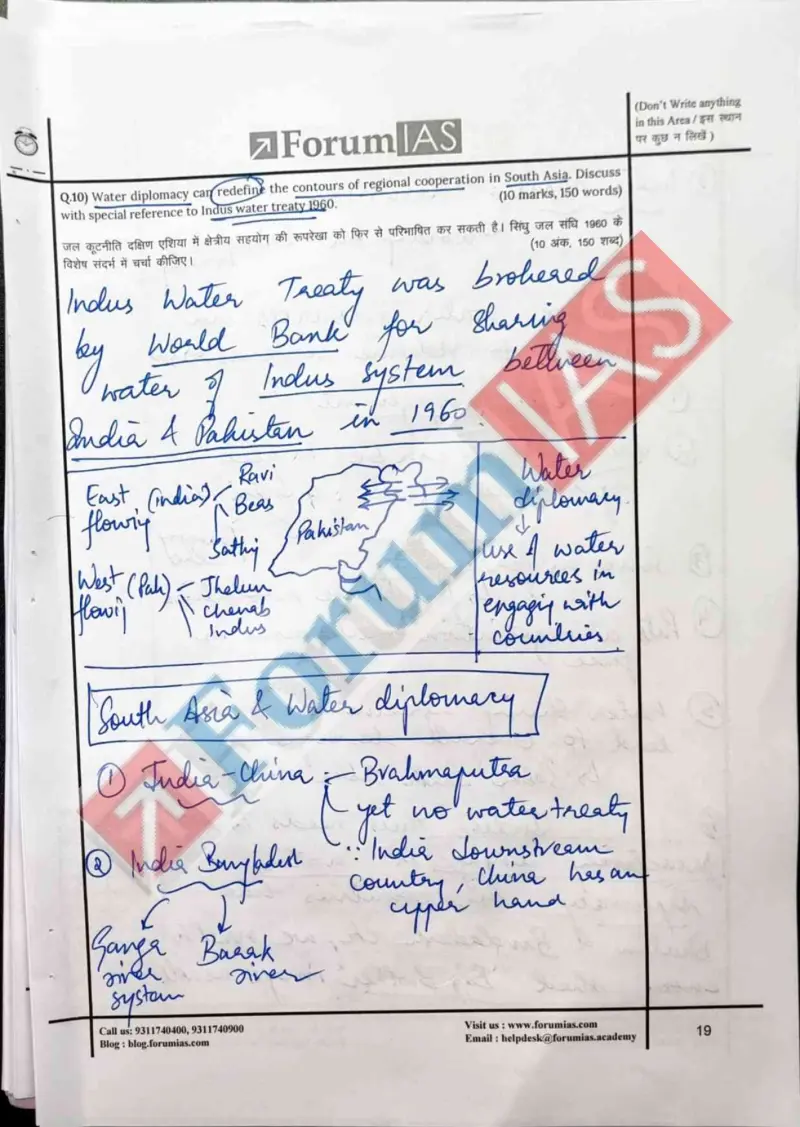
Their question: “Water diplomacy & South Asia cooperation — Indus Waters Treaty 1960 (10m)”
The topper's treatment of the Indus Waters Treaty and India's cross-border river relations gives the exact material for the PYQ's demand on the IWT's ecological, economic and political implications.
Key learnings from their answer
- ›He lands conclusions on a value or right rather than a summary, Q17 (Jal Jeevan Mission) closes on 'Water for All' tied to Right to Life under Article 21, and recurring slogans like 'Sashakt Bharat' (Q8) and 'Sabke Saath Sabka Vikas' (Q10). -> End an answer by linking the topic back to a constitutional value or rights guarantee; it elevates a scheme/policy answer from administrative to principled in one sentence.
- ›Diagrams are integrated as analysis, not decoration: a Q15 'Deprivation' mind-map splitting Extent vs Source (caste/class/regional/gender) vs Complexity that feeds into 'Informed policymaking', a Q8 bar chart plotting the actual NSS-2017 42/15/24 digital-divide numbers, and a hand-drawn Indo-Pacific map in Q20. -> Make each visual do argumentative work, a labelled chart that carries your own data or a mind-map that classifies causes adds value, whereas a generic box-and-arrow does not.
What they cited: Indus Waters Treaty 1960 brokered by World Bank; Brahmaputra (India-China), Ganga/Barak (India-Bangladesh), Kosi (India-Nepal) (Q10)