
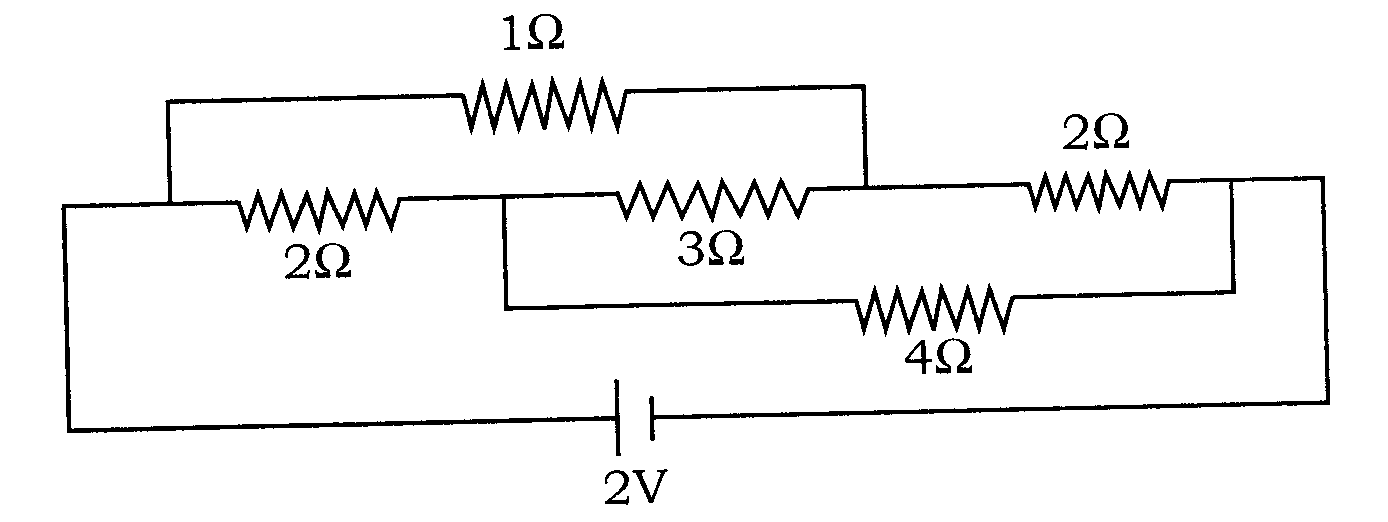
In the network of resistances shown below, Current through the battery will be ___________.
- (1)1.5 A
- (2)3.5 A
- (3)4.0 A
- (4)1.0 A
Correct — option (4), 1.0 A. Label the node at the battery's negative terminal A and the node at its positive terminal D. Tracing the printed diagram gives two junctions between A and D: node Q, where the 1-ohm resistor (from A) meets the second 2-ohm resistor (leading to D), and node B, where the first 2-ohm resistor (from A) meets the 4-ohm resistor (leading to D); the 3-ohm resistor connects B and Q directly, bridging the two branches. This is a Wheatstone-bridge layout, and it happens to be balanced: a bridge is balanced when the ratio of the two resistors in one arm equals the ratio of the two resistors in the other arm, measured from the same starting node. Here, going through B, the ratio is (A-to-B)/(B-to-D) = 2/4 = 1/2; going through Q, the ratio is (A-to-Q)/(Q-to-D) = 1/2 = 1/2. The two ratios are equal, so the bridge is balanced and, by the balanced-bridge property, no current flows through the bridging 3-ohm resistor at all — both its ends sit at the same potential. With the 3-ohm resistor carrying no current, it can be removed from the circuit for the purpose of calculating total current, leaving two independent parallel paths from A to D: the path through B, with resistance 2 + 4 = 6 ohms, and the path through Q, with resistance 1 + 2 = 3 ohms. Their parallel combination is (6 x 3)/(6 + 3) = 18/9 = 2 ohms, which is the network's total equivalent resistance across the battery. By Ohm's law, the current drawn from the 2 V battery is I = V/R = 2/2 = 1.0 A, matching option (4) exactly.
- (1)1.5 A — 1.5 A would require a total equivalent resistance of 2/1.5 = 1.33 ohms, which does not match the network's actual 2-ohm equivalent resistance. A value like this typically comes from treating the bridge as unbalanced and folding the 3-ohm resistor into a series-parallel calculation instead of first checking the balance condition (2/4 = 1/2, matching 1/2) that lets it be dropped.
- (2)3.5 A — 3.5 A would require a total resistance of 2/3.5 which is well under 1 ohm, far lower than the network can actually present — even the smaller of the two parallel branches (the 1-ohm-plus-2-ohm path) alone is 3 ohms. This value is consistent with mistakenly summing conductances or resistances in the wrong combination, producing an implausibly low total resistance.
- (3)4.0 A — 4.0 A would require a total resistance of only 0.5 ohm, smaller than any single resistor in the network and smaller than either full branch (3 ohms and 6 ohms) computed independently. A resistor network built purely from series and parallel combinations of 1, 2, 2, 3 and 4-ohm resistors cannot present less resistance than its smallest single resistor (1 ohm) in this configuration, so this value does not correspond to any correct reading of the circuit.
A Wheatstone bridge is a four-resistor network arranged as two parallel branches between a common source and a common return, each branch made of two resistors in series, with a fifth 'bridge' resistor (or galvanometer, in the classic measuring instrument) connecting the midpoint of one branch to the midpoint of the other. The bridge is balanced exactly when the ratio of the two resistors in one branch equals the ratio of the two resistors in the other branch (R1/R2 = R3/R4, read from the same end); when that condition holds, both midpoints sit at the same electric potential, so no current flows through the bridge resistor regardless of its own value, and it can be deleted from the circuit for the purpose of computing total resistance or current, leaving a simple parallel combination of the two branches.
MPSC's physics section occasionally supplies a printed circuit diagram and expects candidates to (1) correctly read off the wiring from the figure, (2) recognise when a bridge-shaped network is balanced, and (3) apply series-parallel reduction only after confirming that. The habit this question rewards is checking the balance ratio first, since a balanced bridge collapses a five-resistor problem into a much simpler two-branch parallel calculation, while treating it as a generic unbalanced network invites a much longer (and here, unnecessary) node-analysis calculation.
- A Wheatstone bridge is balanced when the resistor ratio in one branch equals the resistor ratio in the other branch, measured from the same starting node.
- In a balanced bridge, no current flows through the bridging resistor, regardless of its own resistance value, because both of its ends are at the same potential.
- Once the bridge resistor is confirmed to carry no current, the network reduces to two independent series-then-parallel branches, here 6 ohms and 3 ohms in parallel, giving 2 ohms total.
- Ohm's law, I = V/R, then gives the current drawn from the battery: 2 V across 2 ohms equals 1.0 A.
A balanced bridge carries no current in its bridging arm — remove it, then just combine the two branches in parallel.
- Assuming every five-resistor bridge-shaped diagram needs full node or loop analysis, instead of checking the balance ratio first, which can eliminate the bridge resistor entirely
- Misreading which resistor is the 'bridge' element and which two form each branch when a printed circuit diagram is drawn with resistors at different heights
- Forgetting that once a bridge is confirmed balanced, the bridge resistor's own value (3 ohms here) plays no role at all in the final answer
When MPSC's physics section includes a circuit diagram, it typically tests whether a candidate can both read the figure correctly and apply the right reduction technique — balanced-bridge removal, series-parallel combination, or Kirchhoff's laws — rather than testing the arithmetic alone.
No directly related past PYQ was found.
- practice — not a real PYQ
A Wheatstone bridge has resistances of 4 ohm and 8 ohm in one branch and 6 ohm and 12 ohm in the other branch, with a bridge resistor connecting their midpoints. Is this bridge balanced ?
- (a)Yes, because 4/8 = 6/12 = 1/2
- (b)No, because the two branches have different total resistance
- (c)Yes, but only if the bridge resistor is removed first
- (d)No, because the resistor values are not identical across both branches
Answer(a) Yes, because 4/8 = 6/12 = 1/2 — a bridge is balanced when the resistor ratio in one branch equals the ratio in the other branch, not when the branches carry identical resistor values or identical total resistance.
- practice — not a real PYQ
In a balanced Wheatstone bridge, the current through the bridging resistor is ?
- (a)Equal to the current in the larger branch
- (b)Zero, regardless of the bridging resistor's own value
- (c)Equal to the total current drawn from the source
- (d)Dependent only on the bridging resistor's value
Answer(b) Zero, regardless of the bridging resistor's own value — a balanced bridge places both midpoints at the same potential, so no current flows across the bridge resistor no matter what its resistance is.