
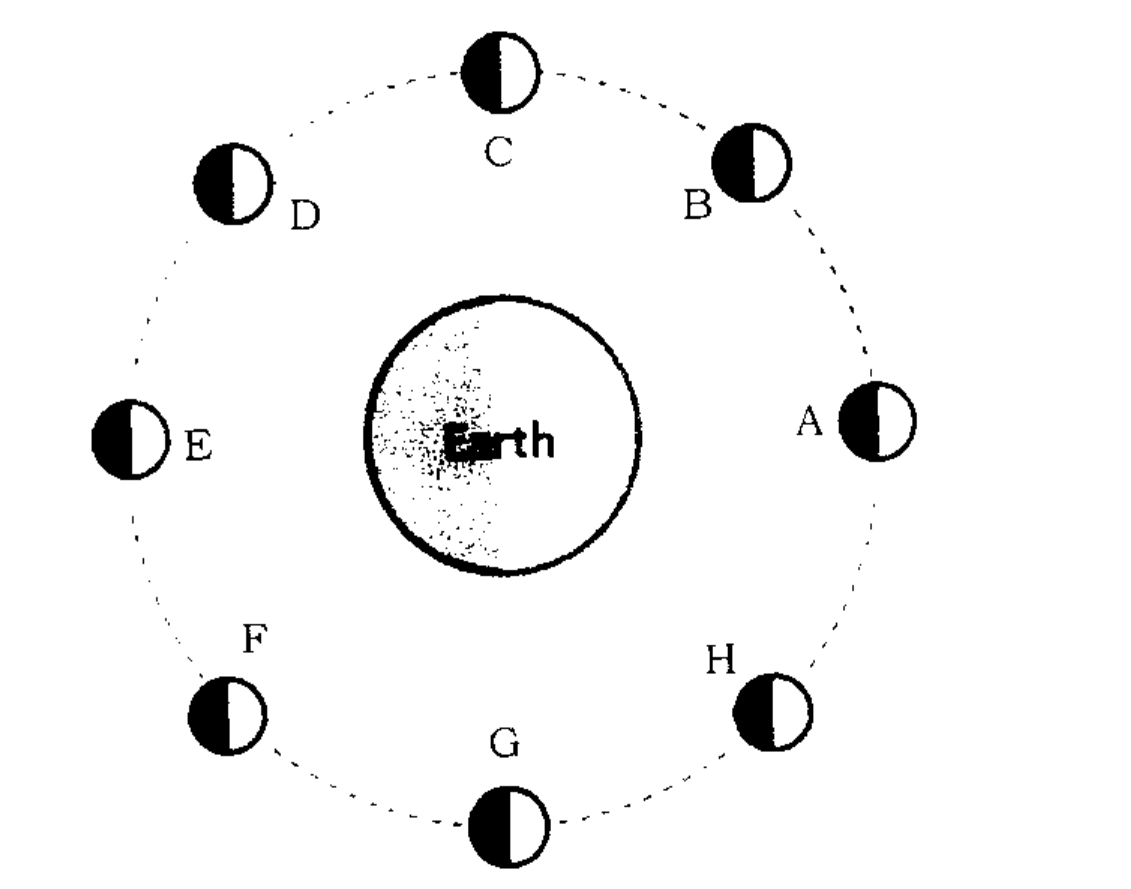
Observe the following diagram and state which of the following alphabets indicate the gibbous phase of the moon ?
- (1)B and H
- (2)C and G
- (3)D and F
- (4)E and A
Correct — option (3), 'D and F'. The first thing to settle is that this question cannot be answered by looking at how dark the discs are. In the booklet all eight moons are drawn the same way, right half light and left half dark, so a candidate who hunts for the disc that 'looks fullest' finds nothing to choose between them. The diagram is not a picture of what the phases look like from Earth; it is a map of where the Moon is, and the phase has to be deduced from position. The one piece of information the drawing does give is the direction of the sunlight. Every one of the eight discs is lit on its right-hand side, so the Sun lies off the right-hand edge of the figure and its rays cross the page travelling leftwards. Fix that, and the whole ring falls into order around the Earth at the centre. A sits on the right, between the Earth and the Sun, so its sunlit face is turned away from us: A is the new moon. E sits directly opposite on the left, with the Earth between it and the Sun, so its whole sunlit face is turned towards us: E is the full moon. C at the top and G at the bottom stand at right angles to the Earth-Sun line, where exactly half of the near face is lit — these are the two quarter phases, the half moons. Gibbous means more than half of the visible disc lit but not yet the whole of it, and on this ring that is precisely the arc lying between a quarter position and the full moon. The two positions that satisfy it are the ones flanking E: D, between C and E, and F, between E and G. Hence option (3). The figure is symmetrical about the Earth-Sun line, and that symmetry is a free check on the answer, because every position in the upper half has a mirror twin below it in the same phase. B and H pair as the crescents, C and G as the quarters, D and F as the gibbous pair, and only A and E are left unpaired, because those two sit on the axis itself. Any answer that puts A and E together, or that mixes positions from two different pairs, has broken that symmetry.
- (1)B and H — B and H are the crescent pair, not the gibbous pair. They flank A, which the direction of the shading identifies as the new moon, so they lie between new moon and quadrature and show less than half of the near face lit — the waxing crescent and the waning crescent. This option is the mirror image of the right answer, and it is chosen by a candidate who has correctly seen that the phases wanted are the two flanking an axis position but has attached them to the wrong end of the axis. The check that separates the two is the one thing the drawing states plainly: the lit halves face right, so the Sun is on the right and A is the moon caught between Earth and Sun. Had the Sun been drawn on the left, A would be full and E new, and B and H would indeed be the gibbous pair — which is exactly why the direction of the lighting is the first thing to read on any phase diagram.
- (2)C and G — C and G are the quarter phases, and the quarter is the boundary of the gibbous range rather than a member of it. Both stand at right angles to the Earth-Sun line, so an observer on Earth sees exactly half of the near face lit: these are the first quarter and the last quarter, what is loosely called the half moon. Gibbous begins where the quarter ends — strictly more than half lit, strictly less than full. The option catches two kinds of candidate: the one who remembers the definition as 'between half and full' and then picks the half itself, and the one who assumes that the top and bottom of a circular diagram must be the significant positions because they are the easiest to see. Note also that C and G are as symmetrical a pair as D and F, so symmetry alone cannot decide between them; only the definition of the phase can.
- (4)E and A — E and A are the two positions on the Earth-Sun axis itself, and they are the only two phases in the whole cycle that are neither crescent, quarter nor gibbous. A lies between the Earth and the Sun, giving the new moon, whose lit face is turned entirely away from us; E lies on the far side of the Earth from the Sun, giving the full moon, whose lit face is turned entirely towards us. These are the syzygies, the alignments at which eclipses become possible, though not at every new or full moon, because the Moon's orbit is tilted to the plane of the Earth's orbit. Choosing this option generally means that gibbous has been read as a synonym for a fully lit moon. It is not: the word comes from the Latin for a hump, and it describes a disc that bulges beyond a half but stops short of a circle, so a full moon is by definition not gibbous.
The Moon produces no light of its own and the Sun always lights exactly one half of it. What changes through the month is not how much of the Moon is lit but how much of the lit half an observer on Earth can see, and that depends purely on the angle between the Sun, the Earth and the Moon as the Moon travels round its orbit. When the Moon is between the Earth and the Sun, its lit hemisphere faces away from us and we see the new moon. As it moves on, a sliver of the lit side swings into view and grows: waxing crescent, then first quarter when the Sun-Earth-Moon angle reaches ninety degrees and exactly half the visible disc is lit, then waxing gibbous as the lit portion passes a half, then full moon when the Earth lies between the Sun and the Moon. The sequence then reverses through waning gibbous, last quarter and waning crescent back to new. Gibbous therefore occupies the two arcs on either side of full, and crescent the two arcs on either side of new, with the quarters as the boundaries between them. Note what the phases are not: they have nothing to do with the Earth's shadow falling on the Moon, which is a lunar eclipse and a separate, occasional event. A phase diagram of this kind is drawn from above the orbit, so it shows positions rather than appearances, and the reader has to convert one into the other.
This is the only question in the paper that prints a figure, and it is a reading test as much as a knowledge test. The commission's booklets are photocopied for the examination hall, and shading is the first thing a photocopy destroys — here every disc has come out with the same half-light, half-dark rendering, so the fraction of illumination simply cannot be measured off the page. A candidate who spends time squinting at the discs loses the question; a candidate who asks the two structural questions instead answers it in under a minute. Those questions are: where is the light coming from, and where does each labelled position sit relative to the Earth-Sun line. Both are answerable from the geometry alone. The habit this rewards is general, and it is worth carrying into every diagram-based item in a geography paper: read the figure for what it fixes rather than for what it depicts, identify the light source or the reference direction first, and use any symmetry in the drawing to check the answer rather than to find it. In a paper of a hundred questions, one figure means one mark that no amount of recall can supply and no amount of guesswork can protect.
- Exactly half of the Moon is lit by the Sun at all times; the phases are the changing fraction of that lit hemisphere that is visible from the Earth, and they are produced by the changing Sun-Earth-Moon angle, not by the Earth's shadow.
- The full cycle of phases runs new moon, waxing crescent, first quarter, waxing gibbous, full moon, waning gibbous, last quarter, waning crescent and back to new moon.
- Gibbous describes a disc more than half lit but not yet full, and it occurs twice in each cycle, in the two arcs lying between a quarter phase and the full moon; the word derives from the Latin gibbus, a hump.
- The synodic month, from one new moon to the next, averages about 29.5 days, while the sidereal month, the Moon's orbital period measured against the background stars, is about 27.3 days; the Earth's own motion along its orbit accounts for the difference.
- Eclipses can occur only at new moon, when a solar eclipse is possible, or at full moon, when a lunar eclipse is possible, and not at every one of them, because the Moon's orbital plane is inclined by roughly five degrees to the plane of the Earth's orbit.
The ring is symmetrical about the Earth-Sun line, which gives a free check: B-H crescents, C-G quarters, D-F gibbous, with only A and E unpaired because they sit on the axis itself. Had the Sun been drawn on the LEFT, A would be full and B and H would be the gibbous pair — which is why lighting direction is the first thing to read on any phase diagram.
- Trying to read the phase off the shading of a printed diagram, when a reproduced figure usually renders every disc identically and carries no usable information about illumination
- Forgetting to locate the Sun before naming any position, which is the single step that decides whether a given letter is the new moon or the full moon
- Treating gibbous as a synonym for full, or as a synonym for half, when it is strictly the range in between
- Assuming the letters run in a particular rotational direction instead of reading each label's actual position on the ring
Earth-Sun-Moon relations are standing material in the geography section, and MPSC usually asks them as plain recall: the date of a solstice or an equinox, the condition for an eclipse, the length of a lunar month, the phase at which spring tides occur. Once in a while, as here, the commission prints a schematic diagram and asks the candidate to name a position on it, which converts the same knowledge into a reading exercise. The diagrams are always plan views of the orbit rather than pictures of the sky, and the information they carry is geometric: the direction of the incoming sunlight, the position of the Earth at the centre, and the placing of the labelled points relative to the Sun-Earth line. Expect the shading in such figures to be unreliable after reproduction, and treat the geometry as the only evidence.
No directly related past PYQ was found.
- practice — not a real PYQ
In the cycle of lunar phases, the waning gibbous moon appears immediately after which of the following phases ?
- (a)New moon
- (b)First quarter
- (c)Full moon
- (d)Last quarter
Answer(c) Full moon — the lit fraction of the visible disc grows from new moon to full and then shrinks, so the two gibbous stretches lie on either side of the full moon. The one before it is the waxing gibbous, which follows the first quarter, and the one after it is the waning gibbous, which is followed by the last quarter and then the waning crescent.
- practice — not a real PYQ
Spring tides, the tides of the greatest range, occur when the Moon is in which position relative to the Sun and the Earth ?
- (a)At new moon and at full moon
- (b)At the first quarter only
- (c)At the first quarter and the last quarter
- (d)At every position, since the Moon's pull does not change
Answer(a) At new moon and at full moon — at both of these the Sun, the Earth and the Moon lie roughly in a straight line, so the tide-raising pull of the Sun reinforces that of the Moon and the range between high and low water is at its greatest. At the two quarter positions the Sun and the Moon pull at right angles to one another and partly cancel, producing the neap tides of smallest range.