
The 2024 OPCW (Organization for the Prohibition of Chemical Weapons)-The Hague Award has been conferred upon which one of the following organizations?
- (a)The Indian Chemical Council
- (b)The Indian Chemical Society
- (c)The National Authority Chemical Weapons Convention
- (d)Gujarat Fluorochemicals Limited
Correct — A, The Indian Chemical Council. The 2024 OPCW–The Hague Award was presented to the Indian Chemical Council at the twenty-ninth session of the Conference of the States Parties in The Hague on 25 November 2024, with the OPCW Director-General and the Mayor of The Hague handing over the award and the Council's Director General receiving it. The citation recognised the Council's work in promoting chemical safety and security and compliance with the Chemical Weapons Convention across the Indian chemical industry, and the OPCW noted that this was the first time the award had gone to a chemical industry body. That industry-association character is the deciding detail, because the other three options are not industry associations at all.
- (b)The Indian Chemical Society — The Indian Chemical Society is a learned scientific society founded in 1924 at Kolkata with Prafulla Chandra Ray as its first president, and it publishes chemistry journals. It is a research body, not the industry association that the award recognised.
- (c)The National Authority Chemical Weapons Convention — The National Authority Chemical Weapons Convention is India's own statutory implementing authority for the Convention. It is the government body that would nominate or support such work, not the recipient of an award for industry outreach.
- (d)Gujarat Fluorochemicals Limited — Gujarat Fluorochemicals Limited is a single chemical manufacturer. The award went to a body representing the industry as a whole rather than to one company.
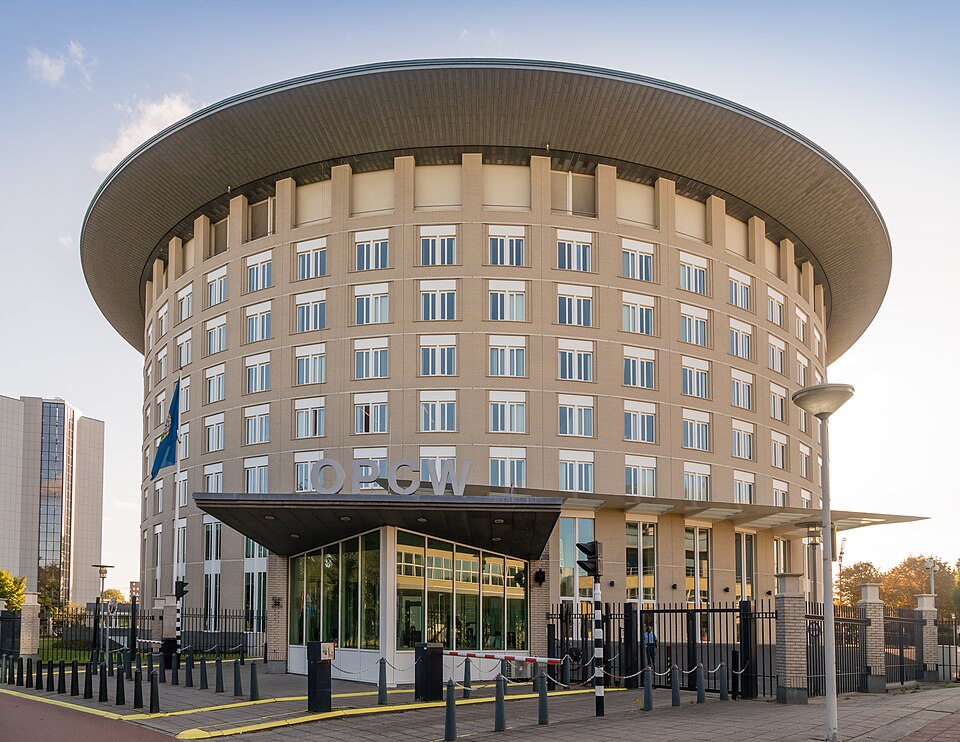
The OPCW–The Hague Award was created after the Organisation for the Prohibition of Chemical Weapons won the 2013 Nobel Peace Prize; the OPCW and the municipality of The Hague set aside the prize money to fund an annual award for outstanding contributions towards a world free of chemical weapons. The OPCW itself is the implementing body of the Chemical Weapons Convention, with 193 States Parties, and its work runs from verifying the destruction of declared stockpiles to inspecting industry so that new weapons cannot emerge.
This item is decided by reading the four options as categories rather than as names. One is an industry association, one is a learned society, one is a government regulator and one is a manufacturing company. An international award for spreading Convention compliance through an industry naturally goes to the body that can reach every firm in that industry, which is the association. The Council and the Society are separated by a single word, so a candidate who has half-memorised the news will fail here; the safeguard is to ask what kind of organisation each option is before asking which one you have heard of.
- The 2024 OPCW–The Hague Award went to the Indian Chemical Council, an industry association.
- It was presented on 25 November 2024 at the twenty-ninth Conference of the States Parties in The Hague.
- The award was funded from the OPCW's 2013 Nobel Peace Prize money, jointly with the city of The Hague.
- The OPCW implements the Chemical Weapons Convention and has 193 States Parties.
- India's own implementing body under the Convention is the National Authority Chemical Weapons Convention.
- Reading the Indian Chemical Council as the Indian Chemical Society — one word apart, entirely different bodies.
- Assuming a national regulator must be the recipient of an international award for industry outreach.
- Forgetting that the OPCW is a treaty body of its own States Parties, not a United Nations agency.
Asked as a single-name recall item where two options differ by one word and the deciding test is what type of organisation each one is.
With reference to “Organization for the Prohibition of Chemical Weapons (OPCW)”, consider the following statements: 1. It is an organization of European Union in working relation with NATO and WHO. 2. It monitors chemical industry to prevent new weapons from emerging. 3. It provides assistance and protection to States (Parties) against chemical weapons threats. Which of the statements given above is/are correct?
- (a) 1 only
- (b) 2 and 3 only
- (c) 1 and 3 only
- (d) 1, 2 and 3
Answer(b) 2 and 3 only
The institution behind the award. Prelims tested what the OPCW is and is not — an independent treaty body, not a European Union organ — and its industry-monitoring mandate is exactly the work the 2024 award recognised.
- practice — not a real PYQ
The OPCW–The Hague Award was instituted using the proceeds of which honour?
- (a)The 2013 Nobel Peace Prize awarded to the OPCW
- (b)The UNESCO Peace Prize
- (c)The Right Livelihood Award
- (d)The Indira Gandhi Prize for Peace
Answer(a) The 2013 Nobel Peace Prize awarded to the OPCW — shared with the municipality of The Hague to fund the award.
- practice — not a real PYQ
Which body is India's National Authority for implementing the Chemical Weapons Convention?
- (a)The Indian Chemical Council
- (b)The National Authority Chemical Weapons Convention
- (c)The Central Pollution Control Board
- (d)The Bureau of Indian Standards
Answer(b) The National Authority Chemical Weapons Convention — the statutory body set up under the Chemical Weapons Convention Act, 2000.