
Which of the following are the main features of 'Saracenic' architecture? 1. Arch 2. Vault and dome 3. Lintel and beam 4. Application of lime cement Select the answer using the code given below.
- (a)1 and 2 only
- (b)2 and 3
- (c)1, 2 and 4
- (d)1, 3 and 4
Correct — C, 1, 2 and 4. Indo-Islamic building, which older textbooks label 'Saracenic', is arcuate: weight is carried across an opening by an arch, and roofs are closed by a vault or a dome rather than by a flat slab. Holding that geometry together needs a mortar that can take shear, and lime cement — often with brick dust or surkhi — is what made true arches and large domes possible in India. Statement 3 is the odd one out: lintel and beam, where a straight member is laid across two uprights, is the trabeate method of the earlier temple builders. The Qutb complex shows the change happening, its earliest arches corbelled by masons who still thought in courses, its later ones turned on true voussoirs.
- (a)1 and 2 only — Arch and dome are right but the answer stops short. Lime mortar is not an incidental detail; without a binder that grips, the voussoirs of a true arch and the courses of a dome cannot hold, which is why its arrival marks the technical break.
- (b)2 and 3 — Pairs a genuine feature with its opposite. Lintel and beam is the trabeate system of pre-Sultanate temple architecture — the very method the arcuate style displaced.
- (d)1, 3 and 4 — Keeps lintel and beam and drops the vault and dome, which inverts the position. The dome is the single most recognisable element of the style, from Balban's tomb through Humayun's to the Taj.
Two structural systems divide Indian architecture. In the trabeate or post-and-lintel system a horizontal stone spans two vertical supports, and the span is limited by what a stone beam can carry before it snaps. In the arcuate system the opening is bridged by an arch made of wedge-shaped voussoirs that transmit load sideways into the piers, and roofs become vaults and domes. Turkish builders brought the arcuate method to north India at the end of the twelfth century, along with lime mortar and the true keystone arch.
Every one of these four-statement sets rewards spotting the intruder rather than validating all four. Here 'lintel and beam' is the trabeate marker; once you tag it as the older Indian system, options (b) and (d) fall together and only (a) and (c) survive. The tie-break is lime cement, which candidates undervalue because it sounds like a building-site material rather than an architectural feature. It was the enabling material: the earliest Qutb arches at the Quwwat-ul-Islam were corbelled, cut in horizontal courses by masons trained in the older tradition, and the true arch on voussoirs appears only afterwards.
- Arcuate construction carries load across an opening through an arch, vault or dome; trabeate construction carries it on a lintel resting on posts.
- Lime mortar, frequently mixed with brick dust called surkhi, is the binder that made true arches and large domes practicable in India.
- The earliest arches of the Quwwat-ul-Islam mosque at the Qutb complex are corbelled, not true arches turned on voussoirs.
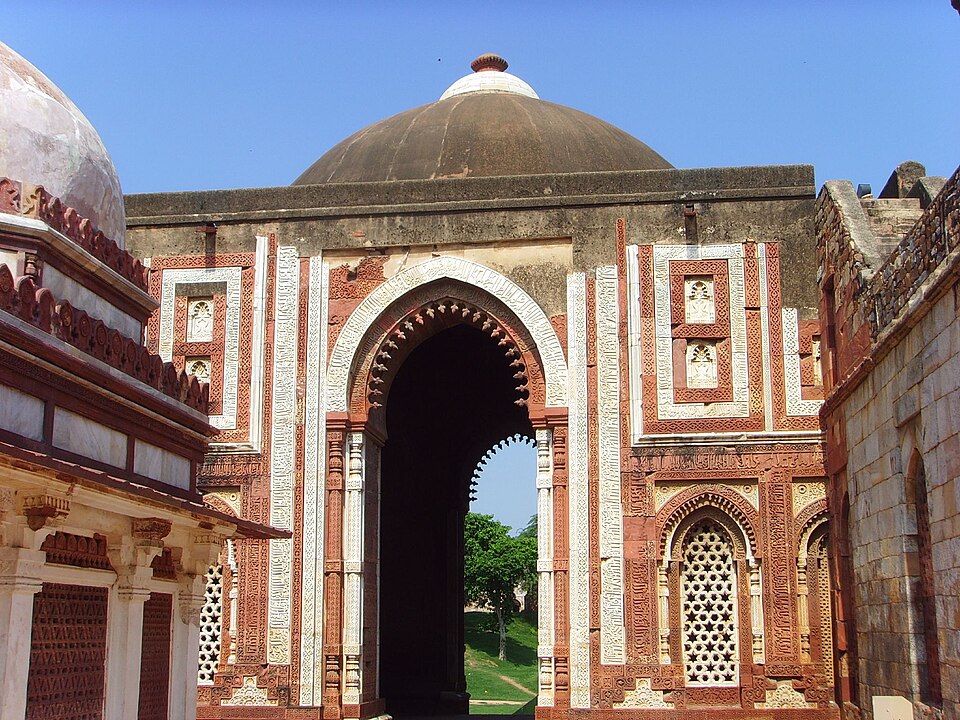
- Alai Darwaza, built by Alauddin Khalji in 1311, is usually cited as an early example of a true arch and true dome in India.
- 'Indo-Saracenic' is also used, confusingly, for the nineteenth-century colonial revival style — the question here means the medieval arcuate tradition.
- Reading 'Saracenic' as the colonial revival style of the 1880s rather than the medieval arcuate tradition.
- Treating lime mortar as too ordinary to be an architectural feature.
- Assuming every arch in a Sultanate building is a true arch; the earliest ones are corbelled.
Asked as a feature-list item where one statement names the technique that the style replaced rather than one it used.
Consider the following : The arrival of Babur into India led to the 1. Introduction of gunpowder in the subcontinent 2. Introduction of the arch and dome in the region's architecture 3. Establishment of Timurid dynasty in the region Select the correct answer using the code given below.
- (a) 1 and 2 only
- (b) 3 only
- (c) 1 and 3 only
- (d) 1, 2 and 3
Answer(b) 3 only
The chronological half of the same topic. Arch and dome were already three centuries old in India by 1526, which is why crediting them to Babur is wrong — and why the Sultanate, not the Mughals, is where this style begins.
- practice — not a real PYQ
The system of construction in which a horizontal beam is laid across two vertical supports is known as
- (a)arcuate
- (b)trabeate
- (c)corbelled
- (d)cantilevered
Answer(b) trabeate — the post-and-lintel method of pre-Sultanate Indian temple building.
- practice — not a real PYQ
Which structure in the Qutb complex at Delhi is commonly cited as an early Indian example of a true arch and a true dome?
- (a)Quwwat-ul-Islam mosque
- (b)Iron Pillar
- (c)Alai Darwaza
- (d)Alai Minar
Answer(c) Alai Darwaza — added by Alauddin Khalji in 1311.