
Which one of the following ancient towns is known for the evidence of a ploughed field from its early Harappan levels, with two sets of furrows at right angles to each other, suggesting two different crops grown together?
- (a)Dholavira
- (b)Rakhigarhi
- (c)Kunal
- (d)Kalibangan
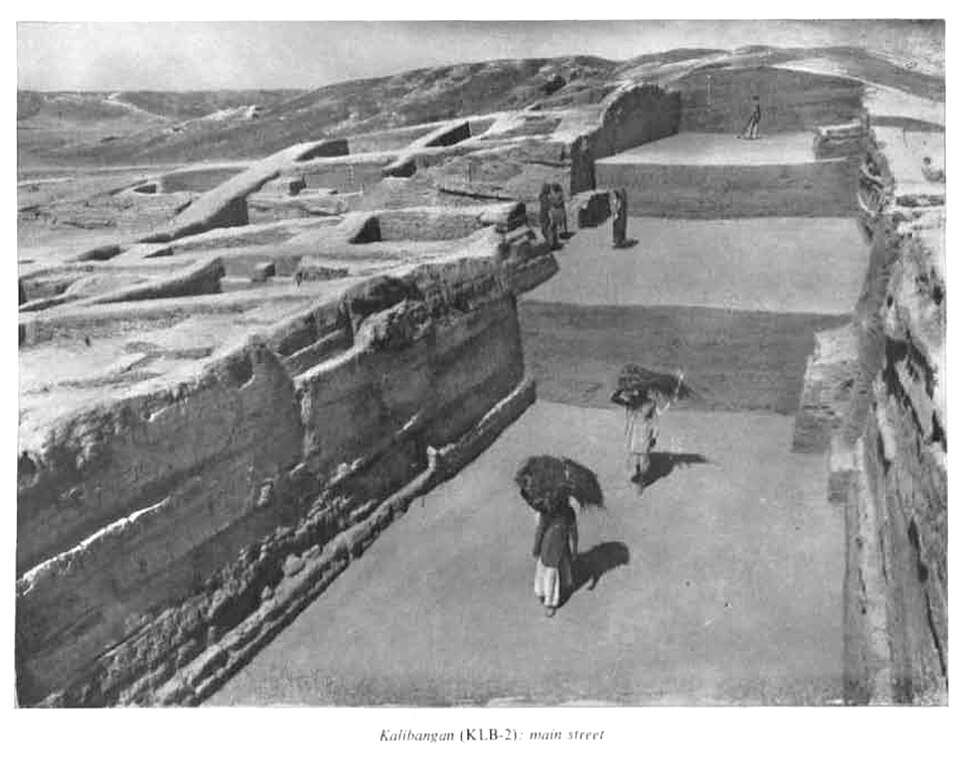
Correct — D, Kalibangan. Excavation at Kalibangan, on the dry bed of the Ghaggar in Hanumangarh district of Rajasthan, uncovered a ploughed field below the Harappan township, belonging to the early Harappan level and so dating to the middle of the third millennium before the common era. What made it remarkable was the pattern: two sets of furrows crossing at right angles, the closer-spaced set running one way and the wider-spaced set the other, which is the grid still used in that region to grow two crops together in the same field. It is the earliest excavated ploughed field known anywhere, and it is the detail by which Kalibangan is identified in every examination.
- (a)Dholavira — Dholavira, in the Rann of Kutch, is known for its reservoirs, check dams and stone architecture, and for the ten-sign inscription found at its gateway. Water management, not ploughing, is its signature.
- (b)Rakhigarhi — Rakhigarhi in Haryana is the largest Harappan site in India and is known for its extent, its cemetery and its ancient genome study, not for a ploughed field.
- (c)Kunal — Kunal, also in Haryana, is an early Harappan site significant for its pre-Harappan levels and silver ornaments, but no ploughed field of this kind was reported from it.
Kalibangan preserves both a pre-Harappan and a Harappan settlement on adjacent mounds. Besides the ploughed field it has yielded fire altars, arranged in a row on a platform in the citadel and also found in houses, which have been read as evidence of ritual practice, and it is one of the sites where a bullock cart wheel impression and cylindrical seals were found. Its name means black bangles, from the fragments of bangles scattered on the surface. The settlement was abandoned when the river system that supported it dried.
Harappan sites are examined almost entirely by their distinguishing find, so the productive way to prepare is one site, one signature. Lothal for the dockyard, Dholavira for water management and the signboard inscription, Kalibangan for the ploughed field and fire altars, Rakhigarhi for size, Chanhudaro for bead making, Surkotada for horse bones. This item hands you the signature and asks for the site, but the same pairs are asked in the other direction just as often, and a match-the-list version can require all four at once.
- Kalibangan lies on the dry bed of the Ghaggar in Hanumangarh district, Rajasthan.
- Its early Harappan level yielded a ploughed field with two sets of furrows crossing at right angles.
- The crossing furrows suggest two crops grown together in one field, a practice still followed in the region.
- Kalibangan also produced rows of fire altars on a platform in the citadel.
- The name means black bangles, after the bangle fragments found scattered at the site.
- Attaching the ploughed field to Rakhigarhi because it is the largest Indian Harappan site.
- Confusing Kalibangan's fire altars with the Great Bath at Mohenjo-daro as evidence of ritual.
- Placing Kalibangan in Haryana; it is in Rajasthan, though its river system runs through both.
Asked as a signature-find identification item, the commonest form of Harappan question — one distinguishing discovery given, the site to be named.
Which one of the following ancient towns is well-known for its elaborate system of water harvesting and management where a series of bunds created check-dams and canals carried the water to connected reservoirs?
- (a) Dholavira
- (b) Kalibangan
- (c) Rakhigarhi
- (d) Ropar
Answer(a) Dholavira
The same question form with the same option set and a different signature find. Reading the two together fixes Dholavira to water management and Kalibangan to the ploughed field.
Match List-I with List-II and select the correct answer using the code given below the Lists: List-I (Harappan Site) A. Nageshwar B. Alamgirpur C. Kalibangan D. Rakhigarhi List-II (Location) 1. Uttar Pradesh 2. Rajasthan 3. Saurashtra 4. Haryana Code:
- (a) A-3, B-1, C-2, D-4
- (b) A-4, B-2, C-1, D-3
- (c) A-4, B-1, C-2, D-3
- (d) A-3, B-2, C-1, D-4
Answer(a) A-3, B-1, C-2, D-4
The location half of the same knowledge, and confirmation that Kalibangan is in Rajasthan while Rakhigarhi is in Haryana — the two sites most often interchanged.
- practice — not a real PYQ
Rows of fire altars in the citadel are a distinguishing find at which Harappan site?
- (a)Lothal
- (b)Kalibangan
- (c)Chanhudaro
- (d)Banawali
Answer(b) Kalibangan — found both on a citadel platform and in houses.
- practice — not a real PYQ
Kalibangan is situated on the dry bed of which river?
- (a)The Sutlej
- (b)The Ghaggar
- (c)The Yamuna
- (d)The Luni
Answer(b) The Ghaggar — whose drying is linked to the site's abandonment.