
Which one of the following principles of physics is primarily used in sonography, a medical diagnostic process?
- (a)Resonance
- (b)Superposition of waves
- (c)Doppler effect
- (d)Standing wave
Correct — C, Doppler effect. Of the four principles offered, the Doppler effect is the one that medical ultrasound actually exploits to extract information the eye cannot get from a still picture: when the emitted ultrasound reflects off moving red blood cells, the returning frequency is shifted upward if the flow is towards the probe and downward if it is away, and the size of that shift gives the speed of the blood. Doppler sonography is what shows a blocked artery, a leaking heart valve or the flow in an umbilical cord, and it is the physics of the moving source and observer applied to sound.
- (a)Resonance — Resonance is large-amplitude vibration when a driving frequency matches a body's natural frequency. It explains a shattering wine glass or a swinging bridge, and it plays no part in forming an ultrasound image.
- (b)Superposition of waves — Superposition covers interference and beats. It underlies the shaping of the ultrasound beam by an array of elements, but it is not the principle that gives sonography its diagnostic information.
- (d)Standing wave — A standing wave is formed by two identical waves travelling in opposite directions and is what governs vibrating strings and air columns. Diagnostic ultrasound uses short travelling pulses, not standing waves.
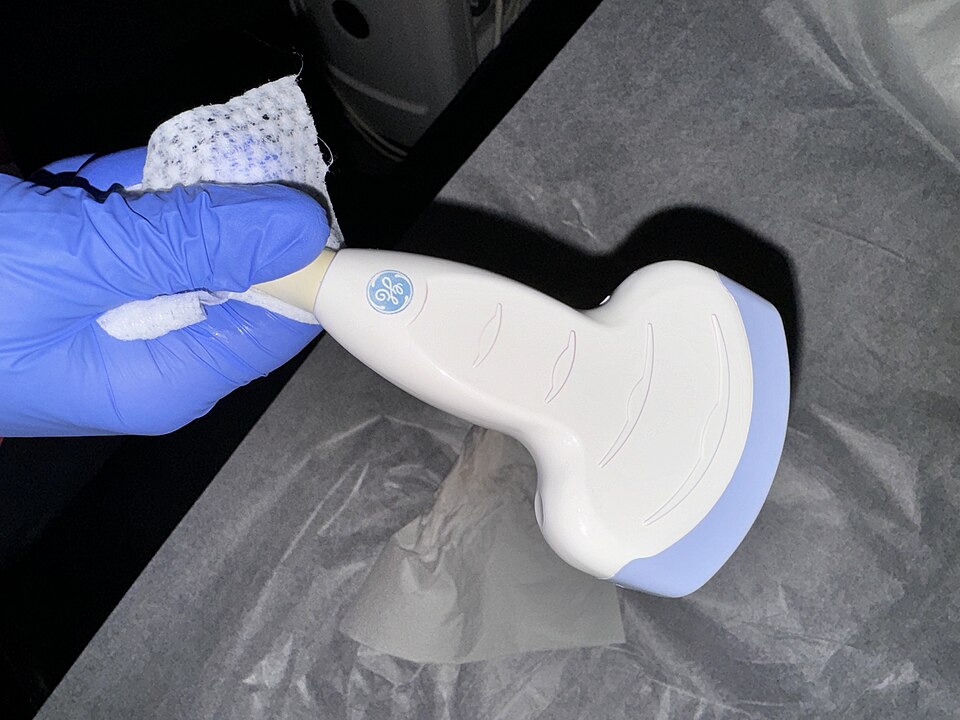
Sonography sends short pulses of ultrasound, above 20 kilohertz and typically in the megahertz range, into the body from a hand-held transducer. Two things come back. The echoes returning from boundaries between tissues of different acoustic impedance, timed against the speed of sound in tissue, are assembled into the grey-scale picture. Where the reflector is moving, the returning pulse also comes back at a shifted frequency, and that Doppler shift is converted into a velocity and often displayed in colour over the grey-scale image. The technique is preferred in obstetrics and cardiology because it uses no ionising radiation.
Strictly, plain grey-scale imaging rests on the reflection of pulses and their timing, and reflection is not among the options — so the item is asking which of these four named principles sonography uses, and the honest answer is the Doppler effect, which is the principle every flow study depends on. It is worth holding both facts: pulse-echo for the picture, Doppler for the motion. The same Doppler physics turns up in a traffic-police speed gun, in weather radar and in the red shift of receding galaxies.
- Ultrasound is sound above about 20 kilohertz; medical probes work in the megahertz range.
- Grey-scale ultrasound images are built from the timing and strength of echoes at tissue boundaries.
- Doppler ultrasound measures blood flow from the frequency shift of echoes off moving red blood cells.
- A shift upward means flow towards the probe, downward means flow away.
- Ultrasound uses no ionising radiation, which is why it is the routine choice in pregnancy.
- Choosing resonance because ultrasound involves vibrating crystals; the crystal's resonance makes the wave, it does not make the image.
- Forgetting that plain grey-scale imaging is a pulse-echo technique, so both reflection and Doppler are involved.
- Assuming ultrasound uses radiation like an X-ray; it does not.
A single-principle item where three options are wave phenomena from a different chapter, so it rewards knowing what each phenomenon is for.
Consider the following statements: 1. Light of longer wavelength is scattered much more than light of shorter wavelength. 2. The speed of visible light in water is 0.95 times its speed in vacuum. 3. Radio waves are produced by rapidly oscillating electrical currents. 4. To detect over-speeding vehicles, police use the Doppler effect of reflected short radio waves. Which of these statements are correct?
- (a) 1 and 2
- (b) 1 and 3
- (c) 2 and 4
- (d) 3 and 4
Answer(d) 3 and 4
Its fourth statement is the same principle in a different setting — a reflected wave returning at a shifted frequency because the reflector is moving. Swap the radio wave for ultrasound and the speeding car for a red blood cell and you have Doppler sonography.
The frequency of ultrasound waves is
- (a) less than 20 Hz
- (b) between 20 Hz and 2 kHz
- (c) between 2 kHz and 20 kHz
- (d) greater than 20 kHz
Answer(d) greater than 20 kHz
Fixes what ultrasound is before asking what it does. The high frequency is what allows the short wavelengths needed to resolve small structures inside the body.
- practice — not a real PYQ
The technique of obtaining images of internal organs using echoes of high-frequency sound is called
- (a)radiography
- (b)ultrasonography
- (c)endoscopy
- (d)tomography
Answer(b) ultrasonography — pulses above the audible range are sent in and their echoes are assembled into an image.
- practice — not a real PYQ
A speed gun used by traffic police to measure the speed of a vehicle works on
- (a)the photoelectric effect
- (b)total internal reflection
- (c)the Doppler effect
- (d)resonance
Answer(c) the Doppler effect — the frequency of the reflected wave shifts in proportion to the vehicle's speed.