
What are bhuni, pachara, and dopati mentioned frequently in the biographies of the Vaishnava reformers of medieval Assam?
- (a)Vessels of metal used in religious oblation
- (b)Agricultural implements
- (c)Musical instruments used at the time of Bohag Bihu festival
- (d)Pieces of men's clothes
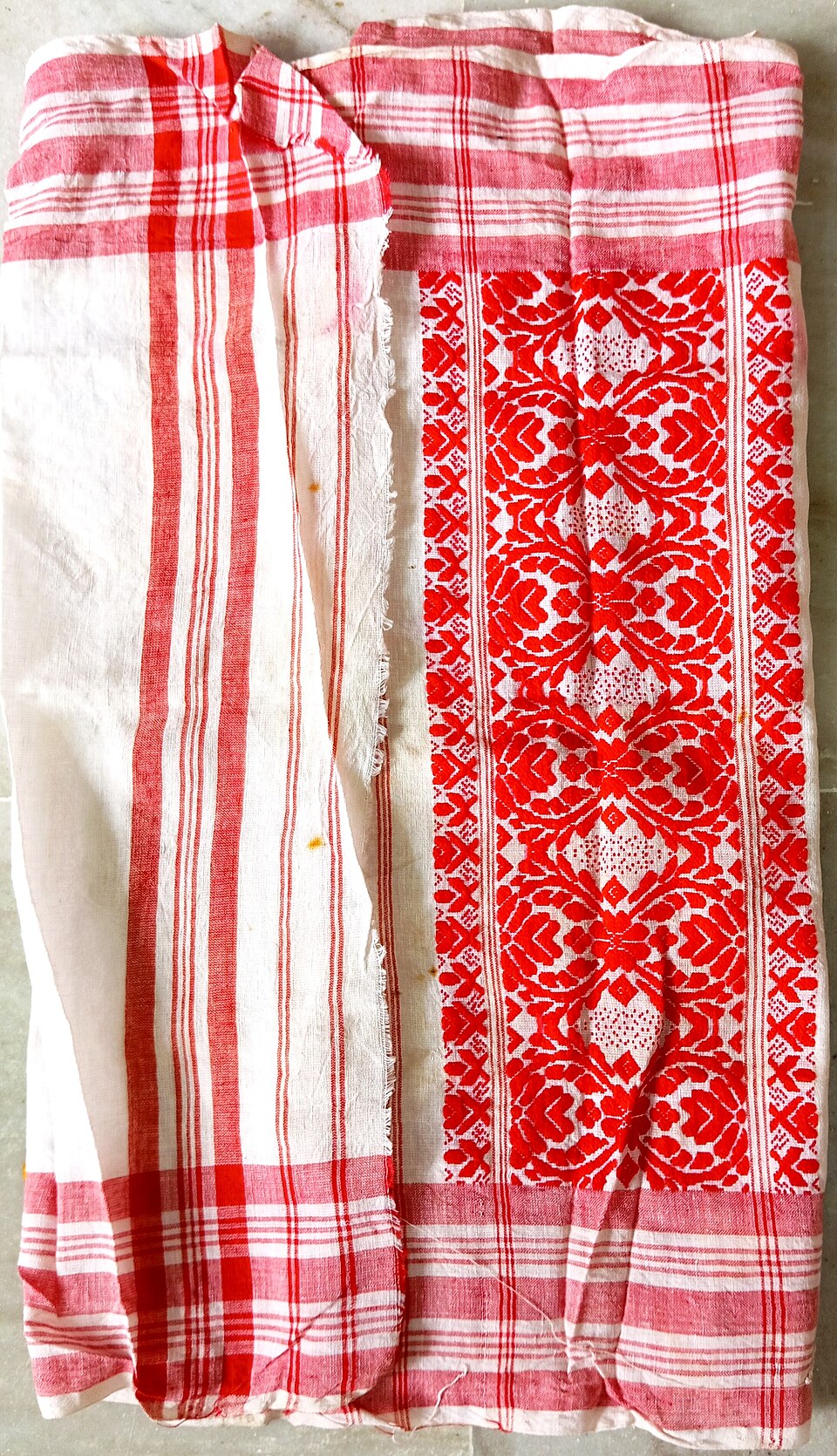
Correct — D, pieces of men's clothes. The biographies in question are the charit-puthis, the Assamese verse lives of Sankaradeva, Madhavadeva and the later Vaishnava preceptors, and they are unusually full of cloth — garments worn, woven, gifted to a guru and offered in a sattra. Weaving was a household craft in medieval Assam and cloth served as gift, honour and currency of respect, which is why the names of particular pieces recur so often in these narratives. The three terms belong to that vocabulary of male dress. The other categories are ruled out by their own well-attested Assamese names: the metal vessels of worship are the xorai, the bota and the kanhi; the instruments of Bohag Bihu are the dhol, the pepa, the gogona and the taal; and the plough and its fittings carry names of their own.
- (a)Vessels of metal used in religious oblation — Assam's ritual metalware is named separately and unmistakably — the pedestalled xorai, the covered bota and the kanhi bowl, all in the bell-metal of Sarthebari.
- (b)Agricultural implements — The charit-puthis are religious biographies and the terms cluster in passages about dress, gift and personal appearance rather than about cultivation.
- (c)Musical instruments used at the time of Bohag Bihu festival — Bihu's instruments are the dhol, the pepa cut from buffalo horn, the gogona, the toka and the taal. None of the three words in the question belongs to that list.
Medieval Assam's Vaishnava movement was led by Sankaradeva in the fifteenth and sixteenth centuries and carried on by Madhavadeva and their successors, and it generated its own literature — the kirtan and borgeet, the ankiya nat plays, and the charit-puthis or hagiographies that record the lives of the preceptors. Because the movement grew inside village society, its texts preserve everyday vocabulary: for cloth, for food, for household objects and for the gifts exchanged between disciple and guru.
The safest way through an item like this is by elimination on names, rather than by trying to recall a rare word. Assamese has strong, well-known terms for ritual metalware and for Bihu instruments, and none of the three words offered belongs to either family; agricultural implements sit oddly with a set of religious biographies. Textiles were central to this movement in a way that is easy to underestimate — the best-known object associated with Sankaradeva is the Vrindavani vastra, a figured silk cloth woven under his direction, fragments of which are now held in museums abroad. Individual dictionary glosses for the three terms are not carried in general reference works, so this card rests the answer on the category rather than on word-by-word meanings.
- The charit-puthis are the Assamese verse biographies of the Vaishnava preceptors of the fifteenth to seventeenth centuries.
- Sankaradeva led the Ekasarana Nama-Dharma movement; Madhavadeva was his foremost disciple.
- Weaving was a household craft across medieval Assam, and cloth was a standard gift of honour.
- The Vrindavani vastra, a figured silk woven under Sankaradeva's direction, is the most celebrated textile of the tradition.
- Assamese ritual vessels are the xorai, bota and kanhi, all of Sarthebari bell-metal; Bihu instruments include the dhol, pepa, gogona and toka.
- Guessing from the sound of an unfamiliar word rather than eliminating the categories that have known names.
- Assuming religious biographies would not record ordinary dress.
- Confusing the Bihu instrument list with the vocabulary of the sattra.
A vocabulary item from a regional literature, answerable by elimination because the three rejected categories have well-attested Assamese names of their own.
No directly related past PYQ was found.
- practice — not a real PYQ
The charit-puthis of medieval Assam are
- (a)revenue records of the Ahom state
- (b)verse biographies of the Vaishnava preceptors
- (c)manuals of temple architecture
- (d)collections of folk riddles
Answer(b) verse biographies of the Vaishnava preceptors — the lives of Sankaradeva, Madhavadeva and their successors.
- practice — not a real PYQ
The Vrindavani vastra is associated with
- (a)Sankaradeva
- (b)Chaitanya
- (c)Ramananda
- (d)Namdev
Answer(a) Sankaradeva — a figured silk cloth woven under his direction, depicting scenes of Krishna's life.