
With reference to 'Black Tigers', which of the following statements is/are correct? 1. They are also referred to as Melanistic Tigers 2. In India they are found only in Similipal Tiger Reserve in Odisha Select the answer using the code given below:
- (a)1 only
- (b)2 only
- (c)Both 1 and 2
- (d)Neither 1 nor 2
Correct — C, Both 1 and 2. Statement 1 is correct as the term is used: black tigers are so called for their unusually broad, merged black stripes, and they are described as melanistic, more precisely pseudo-melanistic, because the dark pigment spreads rather than replacing the coat colour entirely. Genetic work has traced the trait to a single mutation in the Taqpep gene, the same gene family responsible for the king cheetah's blotches. Statement 2 is also correct: the only wild population of these tigers anywhere is in the Similipal Tiger Reserve in Mayurbhanj district, Odisha, where a small and largely isolated tiger population has allowed the recessive variant to become unusually common. Since both statements stand, the code accepting both is the answer.
- (a)1 only — This accepts the melanistic description and rejects the location, but Similipal is the only place in the wild where these animals are found. Reports from elsewhere have not produced a confirmed wild population.
- (b)2 only — This rejects the melanistic description. The animals are genuinely dark-pigmented variants, and although the technically exact term is pseudo-melanistic, melanistic is the description in common and scientific use.
- (d)Neither 1 nor 2 — This rejects both statements, and neither can be rejected. The animals are pigment variants of the Bengal tiger, and Similipal is their only known wild home.
A melanistic animal carries extra dark pigment. In true melanism the coat is uniformly black, as in the black panther, which is a leopard or jaguar with the pattern still faintly visible underneath. In pseudo-melanism the pattern itself is distorted — stripes widen and run together until the pale background is nearly squeezed out, which is what happens in the Similipal tigers. The trait is recessive, so it surfaces where a population is small and isolated and mating occurs within a narrow gene pool, which is exactly Similipal's situation.
Similipal is worth knowing on several counts: it is a tiger reserve, a national park, a biosphere reserve and an elephant reserve, in Mayurbhanj district of Odisha, and it joined UNESCO's World Network of Biosphere Reserves in 2009. The black tigers are its distinctive feature, and their concentration there is a conservation warning as much as a curiosity, since it points to a genetically isolated population. As of the 2024 exam Similipal remained the only site with a wild population; a separate captive group has since been established at the zoological park in Nandankanan, also in Odisha.
- Black tigers are pseudo-melanistic Bengal tigers whose stripes are unusually broad and merged.
- The trait has been traced to a mutation in the Taqpep gene, which is recessive.
- Similipal Tiger Reserve in Mayurbhanj district, Odisha, holds the only known wild population.
- Similipal is also a national park, a biosphere reserve and an elephant reserve, and joined the UNESCO network in 2009.
- The concentration of a recessive trait there reflects a small, genetically isolated tiger population.
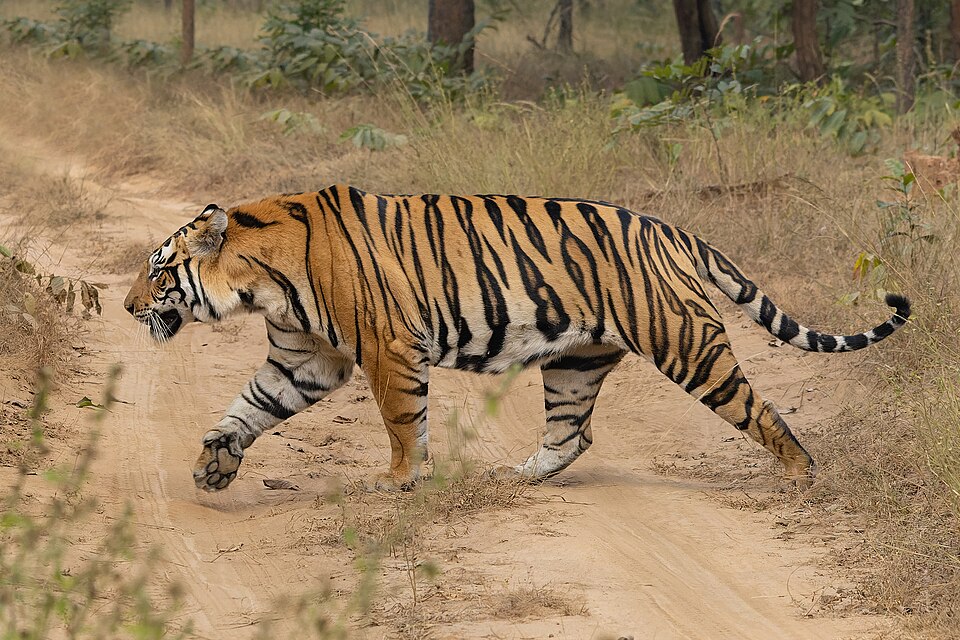
- Assuming black tigers are a separate species or subspecies rather than a colour variant.
- Confusing them with the black panther, which is a melanistic leopard or jaguar.
- Placing the population in another eastern Indian reserve.
A two-statement code item on a distinctive conservation fact, where both statements happen to hold.
The term 'M-STrIPES' is sometimes seen in the news in the context of
- (a) Captive breeding of Wild Fauna
- (b) Maintenance of Tiger Reserves
- (c) Indigenous Satellite Navigation System
- (d) Security of National Highways
Answer(b) Maintenance of Tiger Reserves
The monitoring system behind tiger-reserve management in India. It is the tool through which reserves such as Similipal are patrolled and their populations tracked, which is how a localised trait like this one comes to be documented at all.
- practice — not a real PYQ
Similipal Tiger Reserve is located in which State?
- (a)Jharkhand
- (b)Odisha
- (c)Chhattisgarh
- (d)West Bengal
Answer(b) Odisha — in Mayurbhanj district, and it is also a biosphere reserve.
- practice — not a real PYQ
The black panther is a melanistic form of which animal?
- (a)Tiger
- (b)Leopard or jaguar
- (c)Cheetah
- (d)Lion
Answer(b) Leopard or jaguar — the rosette pattern remains faintly visible under the dark coat.