
Which one of the following statements with reference to the ancient Indian coins is not correct?
- (a)The Indo-Greeks issued the first coins bearing the name and images of rulers.
- (b)The Kushanas issued the first gold coins.
- (c)The Kushana gold coins were different in weight from the coins issued by contemporary Roman emperors.
- (d)These Kushana gold coins have been found from several sites in north India and central Asia.
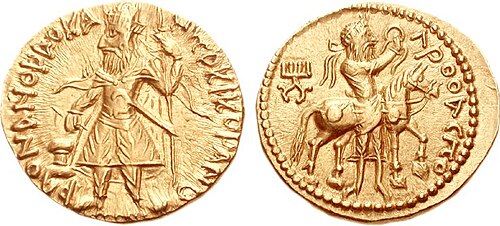
Correct — C, The Kushana gold coins were different in weight from the coins issued by contemporary Roman emperors. This is the statement that is not correct, and it inverts a well-known passage. The standard account is that the Kushanas issued the first gold coins in the subcontinent in about the first century CE and that these were virtually identical in weight with those issued by contemporary Roman emperors and by the Parthian rulers of Iran. That shared weight standard is precisely what makes the coins historically interesting, because it points to a gold economy linked across Rome, Iran and India by trade. Saying the weights differed reverses the point.
- (a)The Indo-Greeks issued the first coins bearing the name and images of rulers. — Correct, so it is not the answer. Earlier punch-marked coins carried symbols but no ruler's name or portrait; the Indo-Greeks, who controlled the north-west from about the second century BCE, were the first to put both on their issues.
- (b)The Kushanas issued the first gold coins. — Correct, so it is not the answer. The first gold coinage of the subcontinent is Kushana, from about the first century CE, and the widespread use of gold points to the scale of the transactions being financed.
- (d)These Kushana gold coins have been found from several sites in north India and central Asia. — Correct, so it is not the answer. Their distribution across north India and Central Asia matches the geography of the Kushana empire and of the trade routes it straddled.
Coins are among the most useful sources for ancient Indian history because they carry a date-able style, a legend, an image and a metal content all at once. Numismatics studies all of these together with the contexts in which coins are found, so a hoard can indicate trade routes, a legend can confirm a ruler's titles, and a weight standard can reveal contact with a distant economy.
The sequence to hold is short. Punch-marked coins come first, carrying symbols rather than names, and are attributed to kings as well as to merchants, bankers and townspeople. The Indo-Greeks then introduce the ruler's name and portrait. The Kushanas introduce gold, on a weight standard close to the Roman aureus, and their coins turn up across north India and Central Asia. Tribal republics such as the Yaudheyas of Punjab and Haryana issued large quantities of copper. The Guptas later produced the most spectacular gold issues of all, the earliest of them remarkable for their purity. Alongside this, hoards of actual Roman coins have been found at sites in south India, which was never part of the Roman empire — a reminder that trade networks ignored political boundaries. Note the shape of the question too: all four options are drawn from one short passage, and only one word in one of them has been altered. Reading such an option carefully, rather than recognising it as familiar, is the whole skill.
- The first coins bearing a ruler's name and image in the subcontinent were issued by the Indo-Greeks, from about the second century BCE.
- The Kushanas issued the first gold coins, from about the first century CE.
- Kushana gold coins were virtually identical in weight with those of contemporary Roman emperors and the Parthian rulers of Iran.
- They have been found at several sites across north India and Central Asia.
- Punch-marked coins carry symbols but no ruler's name; the Yaudheyas issued copper coins; the Guptas issued the most spectacular gold coins, the earliest notable for their purity.
- Skimming a familiar-sounding option and missing the single word that has been reversed.
- Assuming the Guptas issued the first gold coins; theirs were the most celebrated, but the Kushanas were first.
- Confusing the presence of Roman coins in India with Indian coins being struck on a Roman standard — both are true here, but they are different facts.
Asked in the negative, with all four options lifted from a single textbook passage and one of them quietly inverted.
With reference to the invaders in ancient India, which one of the following is the correct chronological order?
- (a) Greeks – Sakas – Kushans
- (b) Greeks – Kushans – Sakas
- (c) Sakas – Greeks – Kushans
- (d) Sakas – Kushans – Greeks
Answer(a) Greeks – Sakas – Kushans
The chronology that makes the coin sequence intelligible. The Indo-Greeks come first and introduce the ruler's portrait; the Kushanas arrive later and introduce gold, which is why the two innovations belong to two different peoples and cannot be swapped.
Near which one of the following cities in India have large statues of Kushana rulers been discovered?
- (a) Karnal
- (b) Ropar
- (c) Hisar
- (d) Mathura
Answer(d) Mathura
The sculptural counterpart to the coins. The Kushanas projected kingship through images as well as through currency, and the colossal royal statues from a shrine at Mat near Mathura are the best-known example.
Which one of the following statements about coins struck during 200 BCE to 300 CE in the Indian subcontinent is not correct?
- (a) The Indo-Greeks introduced bilingual and biscript legends on their coins.
- (b) The Kushanas minted large quantities of gold coins as well as copper coins of low denomination.
- (c) The Satavahanas issued coins of silver, copper, lead and potin.
- (d) Absence of Negama coins suggests the declining power and authority of merchant guilds.
Answer(d) Absence of Negama coins suggests the declining power and authority of merchant guilds.
CAPF asked an almost identical question the previous year, over the same period and in the same negative form. Between the two items you get the Indo-Greek, Kushana, Satavahana and guild coinages, which is most of what this topic contains.
- practice — not a real PYQ
The first coins in the Indian subcontinent to bear the name and image of a ruler were issued by
- (a)the Mauryas
- (b)the Indo-Greeks
- (c)the Kushanas
- (d)the Guptas
Answer(b) the Indo-Greeks — earlier punch-marked coins carried symbols only, without a ruler's name or portrait.
- practice — not a real PYQ
Which one of the following dynasties issued the largest number of gold coin types in ancient India, several of them named after the activity shown on the obverse?
- (a)The Satavahanas
- (b)The Kushanas
- (c)The Guptas
- (d)The Indo-Greeks
Answer(c) The Guptas — their gold issues include the archer, lyrist, tiger-slayer and ashvamedha types.