
The common element in graphite, fullerene, diamond and graphene is:
- (a)Oxygen
- (b)Nitrogen
- (c)Hydrogen
- (d)Carbon
Correct — D, Carbon. All four named substances are allotropes of carbon — the same element arranged in different ways, with wildly different results. In diamond each carbon atom is bonded to four others in a rigid three-dimensional network, which makes it the hardest natural substance and an electrical insulator. In graphite each atom bonds to only three, leaving one electron free to move along the sheet, so graphite conducts electricity, and the sheets slip over one another, so it also works as a lubricant and as pencil lead. Fullerene, discovered in 1985, is a closed cage — the best-known form, C60, has sixty carbon atoms arranged like a football. Graphene, isolated in 2004, is a single sheet peeled out of graphite, one atom thick. Not one of them contains oxygen, nitrogen or hydrogen as a defining constituent.
- (a)Oxygen — Oxygen does have allotropes — ordinary dioxygen and ozone — which may be why it is offered here, but none of the four substances named contains oxygen in its structure.
- (b)Nitrogen — Nitrogen appears in none of the four. Diamond, graphite, graphene and fullerene are built from carbon atoms alone.
- (c)Hydrogen — Hydrogen belongs to the hydrocarbons, where carbon is bonded to it. The allotropes of carbon contain no hydrogen at all.
Allotropy is the existence of an element in more than one physical form in the same physical state, the forms differing in how the atoms are bonded to one another. Carbon is the classic case, because its four bonding electrons can be arranged in a three-dimensional network, in flat sheets, in a single sheet or in a closed cage, and each arrangement produces a material with different hardness, conductivity and appearance while remaining chemically the same element.
The examiner has chosen four names that sound like four different substances, which is exactly the point of the question — a student who knows only that diamond and graphite are carbon still has to place fullerene and graphene. Both are recent additions to the family and both carry Nobel Prizes, which is the usual reason they turn up in general-science papers. Burning any of them in oxygen gives carbon dioxide, which is the laboratory test that they are the same element underneath.
- Diamond, graphite, graphene and fullerene are all allotropes of the element carbon.
- In diamond each carbon atom is bonded to four neighbours in a rigid network; in graphite each is bonded to three, leaving one delocalised electron per atom.
- Graphite conducts electricity and acts as a solid lubricant; diamond does neither.
- Buckminsterfullerene, C60, was reported in 1985 by Kroto, Curl and Smalley, who shared the 1996 Nobel Prize in Chemistry.
- Graphene, a single one-atom-thick sheet of graphite, was isolated in 2004 by Geim and Novoselov, who shared the 2010 Nobel Prize in Physics.
- Graphite is the thermodynamically stable form of carbon at ordinary temperature and pressure, which is why diamond is described as metastable.
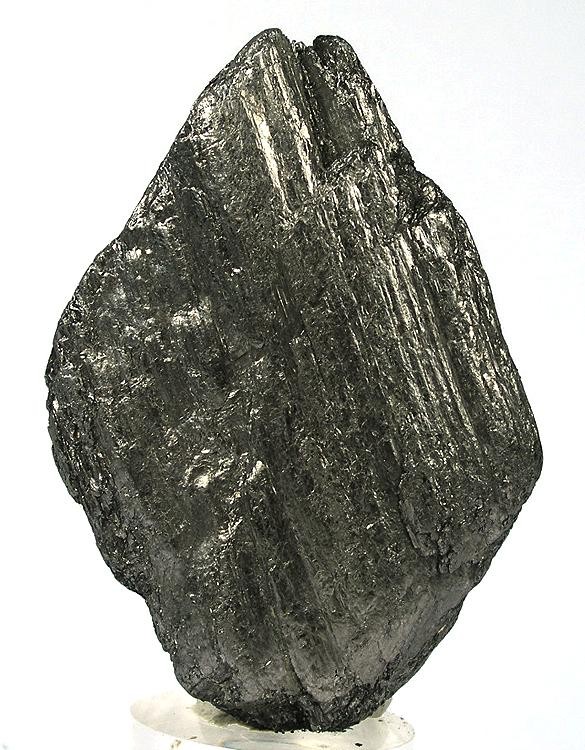
- Assuming graphene is made of silicon, a statement UPSC once planted in a prelims question on the material.
- Treating diamond and graphite as chemically different substances rather than two arrangements of one element.
- Expecting the hardest allotrope to also be the most stable — graphite, not diamond, is the stable form at room conditions.
Asked as a one-line 'common element' item, which is the easiest form this topic takes; the harder version lists properties and asks which allotrope shows them.
Graphene is frequently in news recently. What is its importance? 1. It is a two-dimensional material and has good electrical conductivity. 2. It is one of the thinnest but strongest materials tested so far. 3. It is entirely made of silicon and has high optical transparency. 4. It can be used as conducting electrodes required for touch screens, LCDs and organic LEDs. Which of the statements given above are correct?
- (a) 1 and 2 only
- (b) 3 and 4 only
- (c) 1, 2 and 4 only
- (d) 1, 2, 3 and 4
Answer(c) 1, 2 and 4 only
The statement that fails in that item is the one claiming graphene is made of silicon — the identical piece of knowledge CAPF later asked for directly. Everything else there describes what a one-atom-thick sheet of carbon can do.
Match List I (Naturally occurring substances) with List II (Elements) and select the correct answer using the codes given below the Lists: List I I. Diamond II. Marble III. Sand IV. Ruby List II A) Calcium B) Silicon C) Aluminium D) Carbon Codes:
- (a) I-C, II-A, III-B, IV-D
- (b) I-D, II-B, III-A, IV-C
- (c) I-B, II-A, III-C, IV-D
- (d) I-D, II-A, III-B, IV-C
Answer(d) I-D, II-A, III-B, IV-C
The same substance-to-element skill on an older paper, with diamond matched to carbon, marble to calcium, sand to silicon and ruby to aluminium.
- practice — not a real PYQ
Graphite conducts electricity while diamond does not, because
- (a)graphite contains metallic impurities
- (b)each carbon atom in graphite is bonded to three others, leaving one free electron
- (c)graphite has a lower density than diamond
- (d)graphite is softer than diamond
Answer(b) each carbon atom in graphite is bonded to three others, leaving one free electron — that delocalised electron carries current along the sheet, while all four of diamond's electrons are locked into bonds.
- practice — not a real PYQ
The buckminsterfullerene molecule C60 is best described as
- (a)a flat sheet of carbon one atom thick
- (b)a hollow cage of sixty carbon atoms
- (c)a three-dimensional network of carbon atoms
- (d)a long cylindrical tube of carbon atoms
Answer(b) a hollow cage of sixty carbon atoms — arranged in pentagons and hexagons like a football. The flat sheet is graphene and the network is diamond.