
The term 'Sagittarius A*', sometimes mentioned in news, refers to
- (a)a supermassive black hole in our Milky Way Galaxy
- (b)two giant black holes spiralling around each other several light-years away from the Earth
- (c)a Supernova explosion seen in real time for the first time ever by scientists
- (d)a huge asteroid that passed by very close to the Earth
Correct — A, a supermassive black hole in our Milky Way Galaxy. Sagittarius A* is the compact radio source at the centre of our own galaxy, about 27,000 light-years away in the direction of the constellation Sagittarius, and its mass comes to roughly 4.3 million times the Sun's. It was in the news three months before this paper because the Event Horizon Telescope collaboration released the first image of it on 12 May 2022 — only the second black hole ever imaged, after the one in M87 in 2019.
- (b)two giant black holes spiralling around each other several light-years away from the Earth — A pair of black holes orbiting one another is a binary, and such systems are detected chiefly through the gravitational waves their merger sends out. Sagittarius A* is a single object, and it is in our own galaxy rather than light-years away in another.
- (c)a Supernova explosion seen in real time for the first time ever by scientists — A supernova is an exploding star, not a black hole, and the name Sagittarius A* has never referred to one. The asterisk in the name marks it as an excited, energetic source in radio-astronomy notation.
- (d)a huge asteroid that passed by very close to the Earth — Near-Earth asteroids are tracked and named under an entirely different system. Nothing at the galactic centre passes anywhere near the Earth.
The centre of the Milky Way holds a supermassive black hole whose presence was inferred long before it was imaged, from the orbits of stars whipping around an unseen mass at enormous speed. Andrea Ghez and Reinhard Genzel shared the 2020 Nobel Prize in Physics for those decades of stellar-orbit measurements; Roger Penrose shared it for the theory that black hole formation is a robust prediction of general relativity.
Imaging Sagittarius A* is far harder than imaging M87's black hole even though it is much closer, because it is also much smaller: gas swings around it in minutes rather than days, so the picture changes while the telescope is still collecting it. The Event Horizon Telescope solves this by linking radio dishes across the Earth into one instrument the size of the planet.
- Sagittarius A* lies at the centre of the Milky Way, about 27,000 light-years from Earth.
- Its mass is about 4.3 million solar masses.
- The Event Horizon Telescope released its first image on 12 May 2022; the M87 image came in April 2019.
- The 2020 Nobel Prize in Physics went to Penrose, Genzel and Ghez for work on black holes and the galactic centre.
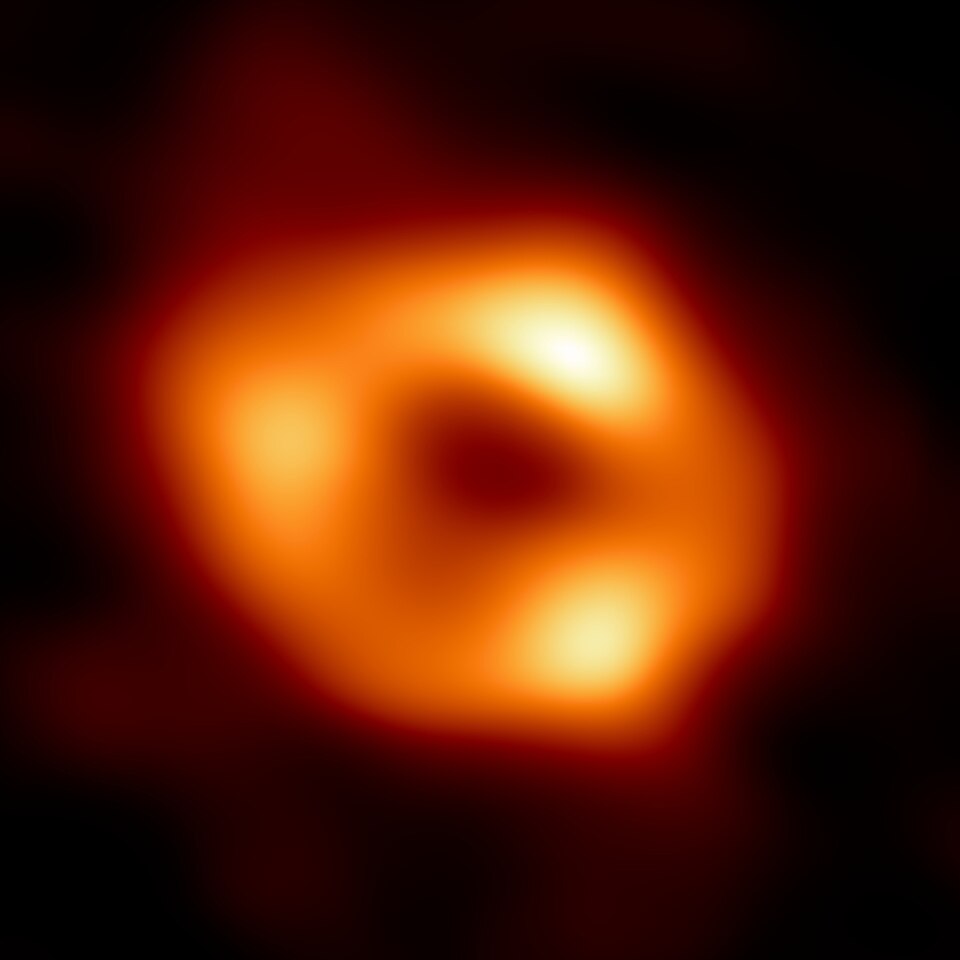
- Reading the asterisk as a footnote mark; it is part of the object's name.
- Confusing the 2022 image of Sagittarius A* with the 2019 image of the M87 black hole.
As a 'what does this term refer to' item, or through the telescope and technique behind the image.
A ‘black hole’ is a body in space which does not allow any radiation to come out. This property is due to its
- (a) very small size
- (b) very large size
- (c) very high density
- (d) very low density
Answer(c) very high density
The physics under the headline. A black hole traps radiation because an enormous mass is packed into a tiny volume, and that same extreme density is what makes an object 4.3 million times the Sun's mass fit inside the orbit of a star.
- practice — not a real PYQ
The first image of a black hole, released in 2019, was of the black hole at the centre of which galaxy?
- (a)The Milky Way
- (b)Messier 87
- (c)Andromeda
- (d)The Large Magellanic Cloud
Answer(b) Messier 87 — the Milky Way's own Sagittarius A* was imaged three years later, in May 2022.
- practice — not a real PYQ
The Event Horizon Telescope produces its images by
- (a)a single dish in orbit around the Earth
- (b)linking radio telescopes across the world into one Earth-sized instrument
- (c)stacking optical exposures from ground observatories
- (d)measuring gravitational waves from merging black holes
Answer(b) linking radio telescopes across the world into one Earth-sized instrument — the technique of very long baseline interferometry.