
'The King of Dance' is a description of
- (a)Trimurti at Elephanta Caves
- (b)Kaliyamardan of Krishna
- (c)Bodhisattva Maitreya at Gandhara
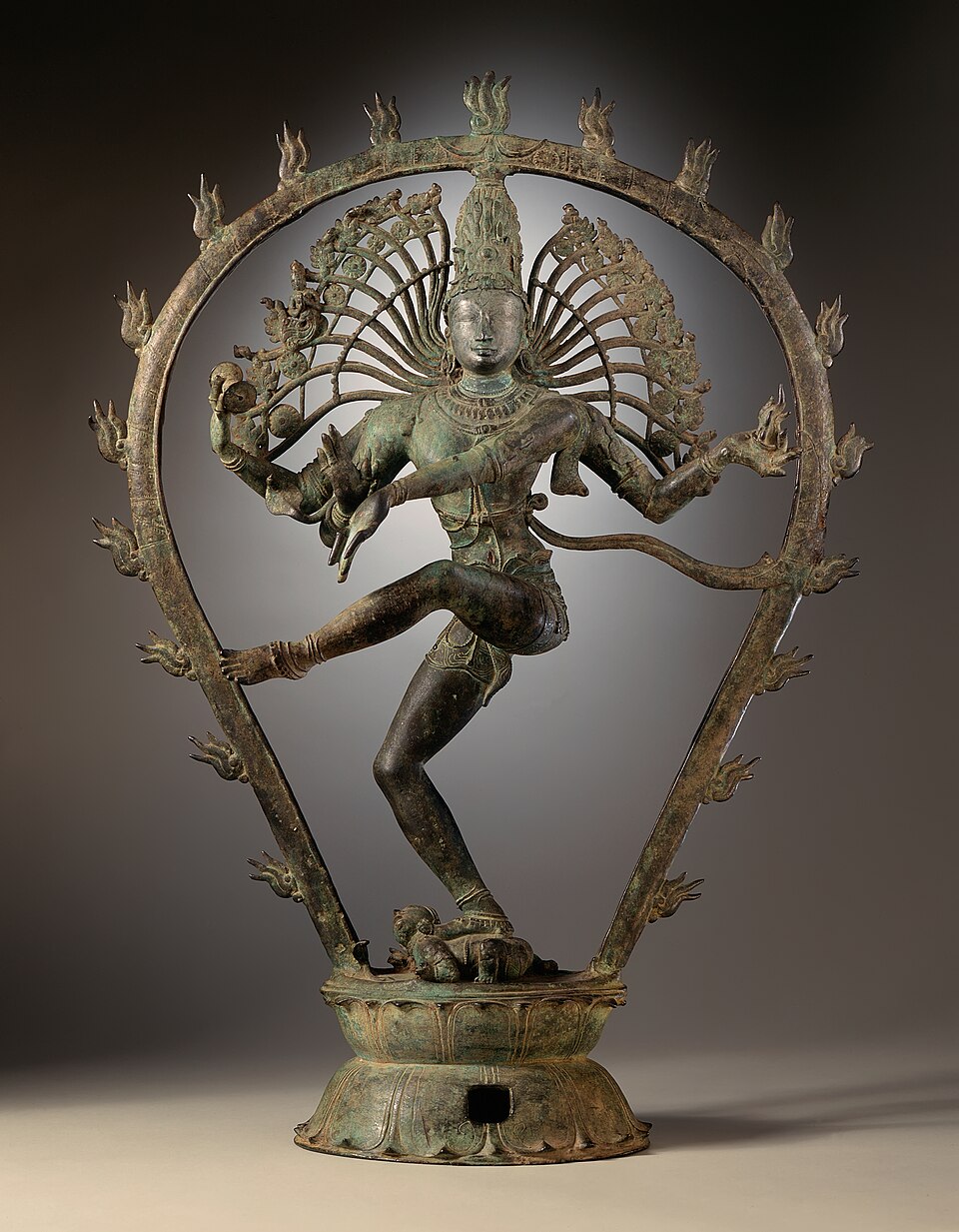
- (d)Bronze Nataraja of the Cholas
Correct — D, Bronze Nataraja of the Cholas. Nataraja is the Sanskrit for lord or king of the dance, and the image the phrase names is the Chola bronze of Shiva dancing the ananda tandava inside a ring of flame. The other three are famous sculptures, but none of them is a dancing figure and none carries that title.
- (a)Trimurti at Elephanta Caves — The great three-headed bust in Cave 1 at Elephanta shows Shiva in three aspects at rest. It is a colossal face, not a dancer, and its usual name is Maheshamurti or Trimurti.
- (b)Kaliyamardan of Krishna — Kaliyamardana is Krishna subduing the serpent Kaliya. Krishna is often shown poised on the snake's hoods, which looks like dance, but the subject is a victory over the serpent and the figure is not Shiva.
- (c)Bodhisattva Maitreya at Gandhara — A seated or standing Gandhara Bodhisattva in the Graeco-Roman manner, marked by heavy drapery and moustache. Nothing in the type involves dance.
The Chola bronzes, cast by the lost-wax method between the tenth and twelfth centuries in the Kaveri delta, are the high point of Indian metal sculpture. The Nataraja type fixes an iconography that scarcely varies: four arms, a ring of flame, the right leg pressing down the dwarf Apasmara, the left leg raised across the body.
Each element of the image carries a meaning, which is why examiners like it. The upper right hand holds the damaru whose beat starts creation; the upper left holds fire, which ends it; the lower right is raised in abhaya, the gesture of assurance; the raised left leg is refuge. Apasmara underfoot is forgetfulness or ignorance, and the encircling flames are the cosmos itself.
- Nataraja means king of dance; the dance is the ananda tandava.
- Chola bronzes were cast by the cire perdue or lost-wax process, each cast from a single wax model.
- Shiva balances on the right leg, crushing the dwarf Apasmara, and raises the left leg.
- Chidambaram in Tamil Nadu is the temple most closely associated with the Nataraja form.
- Reading Kaliyamardana as a dance because Krishna stands on the serpent's hoods.
- Placing tirobhava on the standing leg — it is the raised left leg that signifies it.
- Assuming Elephanta's Trimurti is a Chola work; it is a Rashtrakuta-era rock-cut sculpture.
Either as this identification, or through the finer iconography — which leg, which hand, what the dwarf stands for.
Bronze icons of Nataraja cast during the Chola period invariably show the deity with
- (a) eight hands
- (b) six hands
- (c) four hands
- (d) two hands
Answer(c) four hands
The same bronze, asked on its iconography rather than its name — the Chola Nataraja is invariably four-armed, and the fixed arrangement of those arms is what the type is recognised by.
- practice — not a real PYQ
In the Chola Nataraja bronze, the dwarf figure crushed under Shiva's foot represents
- (a)wealth
- (b)ignorance or forgetfulness
- (c)disease
- (d)time
Answer(b) ignorance or forgetfulness — the dwarf is Apasmara, suppressed by the right foot.
- practice — not a real PYQ
Chola bronze images were made by which technique?
- (a)Repousse sheet metal
- (b)Lost-wax casting
- (c)Sand casting in reusable moulds
- (d)Beaten copper over a wooden core
Answer(b) Lost-wax casting — the cire perdue process, in which the wax model is melted out and each image is a unique cast.