
Which one of the following aerospace companies designed and manufactured 'Falcon 9', a reusable rocket?
- (a)Blue Origin
- (b)Boeing
- (c)Lockheed Martin
- (d)SpaceX
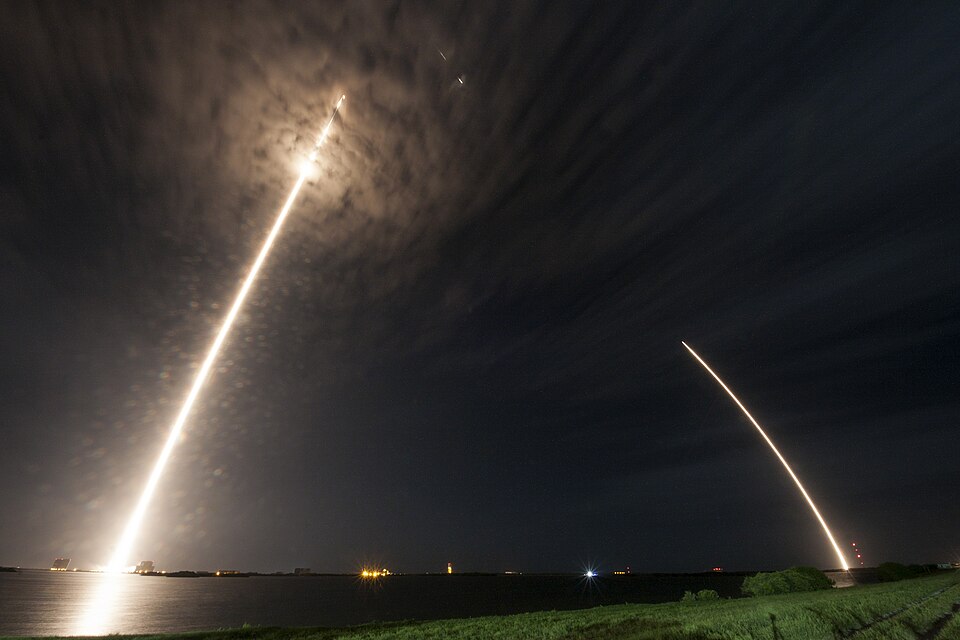
Correct — D, SpaceX. Falcon 9 is SpaceX's two-stage launch vehicle, flown first in June 2010 and designed so that the first stage flies back and lands upright for re-use. The first successful landing of that stage came in December 2015, and re-flying recovered boosters is what turned the rocket into the workhorse it is now — it carries Starlink satellites, commercial payloads, cargo to the International Space Station, and, in Crew Dragon, astronauts.
- (a)Blue Origin — Blue Origin is the closest rival in the reusable-rocket story, but its vehicles are New Shepard and New Glenn, not Falcon 9.
- (b)Boeing — Boeing builds the Starliner crew capsule and is a partner in United Launch Alliance, whose rockets are the Atlas and Delta families.
- (c)Lockheed Martin — Lockheed Martin is the other half of United Launch Alliance and built the Orion capsule; the Falcon name belongs to a different company.
Almost every rocket before Falcon 9 was thrown away after one flight, so the cost of reaching orbit was the cost of building a new vehicle each time. Recovering and re-flying the first stage — the most expensive part, carrying nine engines — is what changed launch economics, and it is the reason a private company now flies more orbital missions in a year than most national programmes.
There is a direct Indian thread. In June 2025 a Falcon 9 launched Axiom Mission 4 to the International Space Station, and Group Captain Shubhanshu Shukla flew on it — the first Indian on the station. Keep the company-to-vehicle pairs straight, because that is what these items test: SpaceX with Falcon 9, Falcon Heavy, Dragon and Starship; Blue Origin with New Shepard and New Glenn; ISRO with PSLV, GSLV and LVM3.
- Falcon 9 is a two-stage rocket whose first stage returns to a landing pad or a drone ship.
- Its first flight was in June 2010 and the first successful booster landing came in December 2015.
- The Crew Dragon capsule carried on Falcon 9 has flown astronauts to the International Space Station since 2020.
- Axiom Mission 4 launched on a Falcon 9 on 25 June 2025 with Shubhanshu Shukla aboard.
- Blue Origin's suborbital vehicle is New Shepard; its orbital rocket is New Glenn.
- Swapping Falcon 9 with New Glenn when the question mentions re-usability.
- Assuming a rocket carrying NASA astronauts must be built by a government agency.
A vehicle-to-company pairing, or a one-line item on which rocket first landed its booster.
India's maiden human space mission will be launched in 2023. What is its name?
- (a) Vayumitra
- (b) Vikram
- (c) Chandrayaan-3
- (d) Gaganyaan
Answer(d) Gaganyaan
The Indian end of the same crewed-spaceflight story, asked in the same exam season.
- practice — not a real PYQ
New Shepard, a suborbital reusable rocket, is built by
- (a)SpaceX
- (b)Blue Origin
- (c)Rocket Lab
- (d)Virgin Galactic
Answer(b) Blue Origin — SpaceX's vehicles are the Falcon family, Dragon and Starship.
- practice — not a real PYQ
The part of the Falcon 9 that is recovered and flown again is the
- (a)first stage booster
- (b)second stage
- (c)payload fairing only
- (d)entire vehicle including the upper stage
Answer(a) first stage booster — it carries nine engines and is the costliest section, so recovering it saves the most.