
Consider the following statements: 1. The early Malwa school of paintings was influenced by Shirazi school while the early Mughal paintings initially followed Bihzad school. 2. The major exponents of Bihzad school in India were Sayyid Ali and Abdus Samad. Which of the statements given above is/are correct?
- (a)1 only
- (b)2 only
- (c)Both 1 and 2
- (d)Neither 1 nor 2
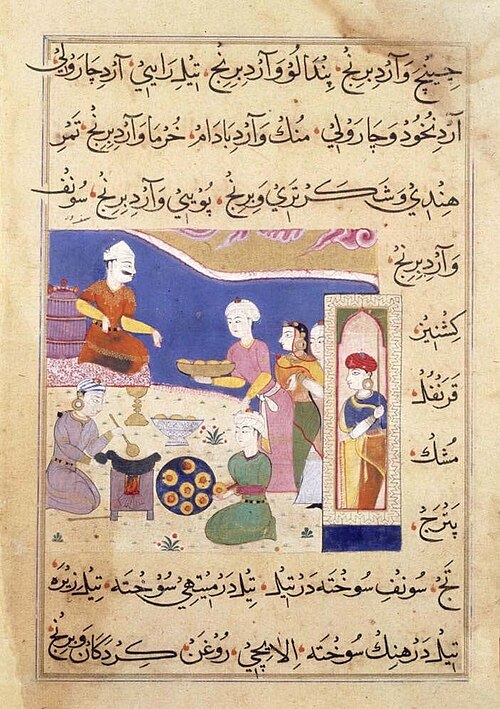
Correct — C, Both 1 and 2. Statement 1 holds because the one great illustrated manuscript to survive from Mandu, the Ni'mat-nama or Book of Delights made for Sultan Ghiyath Shahi around 1500, is painted in a provincial Persian idiom that art historians trace to the Turkman workshops of Shiraz, before its figures start turning visibly Indian. Statement 2 holds because Humayun brought Mir Sayyid Ali and Abd-us-Samad back with him from the Safavid court, where the atelier had been shaped by Bihzad of Herat, and those two then headed the first Mughal painting workshop under Akbar.
- (a)1 only — Drops the better-attested half of the item — the Herat lineage that Mir Sayyid Ali and Abd-us-Samad carried into the Mughal atelier.
- (b)2 only — Rejects the Shiraz link at Mandu, which is precisely what the surviving Ni'mat-nama illustrations show.
- (d)Neither 1 nor 2 — Both statements track documented lines of influence; nothing in either is contradicted by the evidence.
Indian painting in the fifteenth and sixteenth centuries was fed by two different Persian streams. Provincial sultanate courts such as Mandu drew on Shiraz, a busy commercial book-producing centre; the Mughals drew on Herat and then Tabriz, where Bihzad had raised manuscript painting to its highest finish. Different sources, different look.
The names are the whole difficulty here, so anchor them to people and places rather than to labels. Bihzad worked at Herat and later headed the royal library at Tabriz. Humayun, in exile with Shah Tahmasp, met the painters of that court and took two of them to India — Mir Sayyid Ali and Abd-us-Samad. Under Akbar they supervised the illustration of the Hamzanama, which is where the Persian manner starts absorbing Indian colour and gesture and becomes Mughal painting proper.
- The Ni'mat-nama of Mandu, about 1495-1505, was made for Sultan Ghiyath Shahi and continued under his son Nasir Shah.
- Its illustrations follow the Turkman style of Shiraz and become more Indian as the manuscript proceeds.
- Kamaluddin Bihzad worked at Herat and moved to the Safavid court at Tabriz in the 1520s.
- Mir Sayyid Ali and Abd-us-Samad came to India with Humayun and led the early Mughal atelier.
- Their first great project under Akbar was the Hamzanama, painted on cloth over about fifteen years.
- Confusing the early Malwa sultanate manuscripts with the seventeenth-century Malwa Ragamala paintings.
- Treating Bihzad himself as a painter who worked in India.
Two-statement items on artistic influence, or a painter-to-patron matching list.
Which one of the following painters was not associated with Humayun?
- (a) Mir Sayyid Ali
- (b) Maulana Dost Musawir
- (c) Maulana Yusuf
- (d) Bihzad
Answer(d) Bihzad
CDS asked which of four painters was not associated with Humayun, and the odd name is the Herat master whose tradition the other three carried.
- practice — not a real PYQ
The painters Mir Sayyid Ali and Abd-us-Samad were brought to India by
- (a)Babur
- (b)Humayun
- (c)Akbar
- (d)Jahangir
Answer(b) Humayun — he met them at the Safavid court during his exile and they later headed Akbar's atelier.
- practice — not a real PYQ
The Ni'mat-nama, an illustrated manuscript of about 1500, was produced at the court of
- (a)Mandu
- (b)Bijapur
- (c)Jaunpur
- (d)Golconda
Answer(a) Mandu — it was made for Sultan Ghiyath Shahi of Malwa and its paintings follow the Shiraz manner.