
Which one of the following artworks was hailed by Sister Nivedita as the ‘first masterpiece of Indian art’?
- (a)Bharatmata by Abanindranath Tagore
- (b)Arjuna and Subhadra by Raja Ravi Varma
- (c)Sita in Captivity in Lanka by Abanindranath Tagore
- (d)Sati by Nandalal Bose
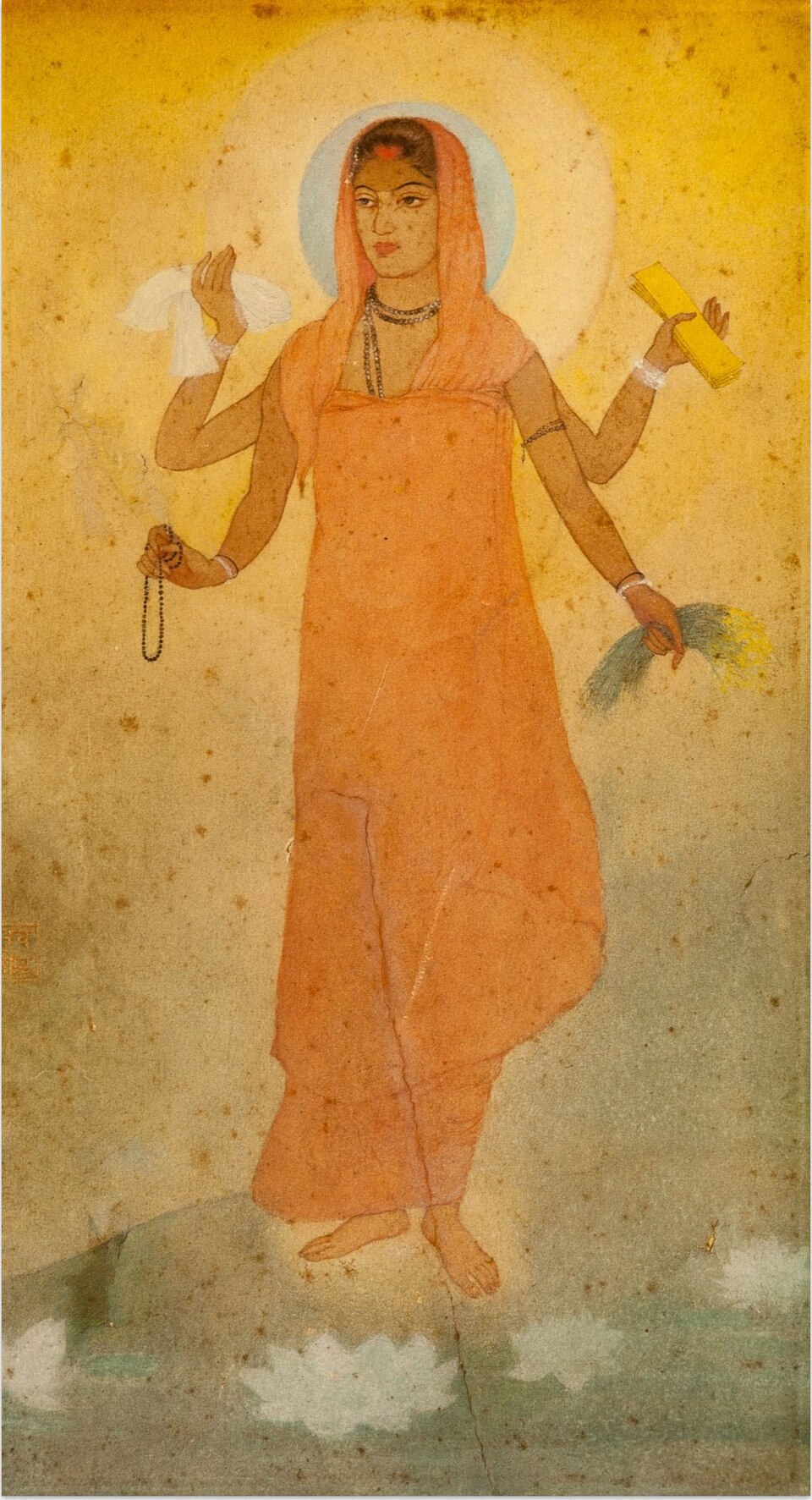
Correct — A, Bharatmata by Abanindranath Tagore. Abanindranath painted the four-armed figure in 1905, while Bengal was in the middle of the Swadeshi agitation against Curzon's partition, and he titled it Banga Mata — Mother Bengal. It was Sister Nivedita who renamed it Bharat Mata, and her published notice on it runs: 'From beginning to end, the picture is an appeal, in the Indian language, to the Indian heart. It is the first great masterpiece in a new style.' She added that she would reprint it by tens of thousands if she could, until every peasant's cottage between Kedar Nath and Cape Comorin carried the image.
- (b)Arjuna and Subhadra by Raja Ravi Varma — Ravi Varma worked in oils in the academic European manner that the Bengal School was reacting against, so his canvas is the opposite of the 'new style' Nivedita was announcing.
- (c)Sita in Captivity in Lanka by Abanindranath Tagore — Right artist, wrong canvas — the phrase belongs to the 1905 mother-figure, not to Abanindranath's Ramayana subject.
- (d)Sati by Nandalal Bose — Nandalal Bose was Abanindranath's pupil and his reputation was built later; the 1905 praise was for his teacher's work.
Abanindranath Tagore (1871-1951) led the Bengal School of Art, which set out to build a modern Indian painting on Indian and wider Asian sources instead of on European academic oil painting. His Bharat Mata is the first painted personification of the nation, and it turned a political idea from Bankim Chandra's Anandamath into an image the Swadeshi movement could carry.
The trap is fame. Raja Ravi Varma is the better-known name and also painted mythological subjects, so his option looks safe. But Nivedita's sentence is a manifesto for a break with Ravi Varma's manner, which is why she called the work the first masterpiece 'in a new style' rather than simply a fine painting.
- Painted in 1905 and first titled Banga Mata; Sister Nivedita renamed it Bharat Mata.
- The figure is dressed as a sadhvi and holds a book, sheaves of paddy, a piece of white cloth and a rudraksha mala in her four hands.
- Sister Nivedita was Margaret Noble, the Irish disciple of Swami Vivekananda, and the intellectual anchor of the Bengal School circle.
- Abanindranath and his brother Gaganendranath founded the Indian Society of Oriental Art at Calcutta in 1907.
- The canvas was put on public display at the Victoria Memorial Hall, Kolkata, in 2016.
- Picking the most famous painter rather than the one the quoted critic actually praised.
- Confusing Abanindranath's two canvases — the mother-figure of 1905 and his Ramayana subject.
One-line attribution: who painted a named work, who renamed it, or who founded a named art society.
The paintings of Abanindranath Tagore are classified as
- (a) realistic
- (b) socialistic
- (c) revivalistic
- (d) impressionistic
Answer(c) revivalistic
The same artist from the other side: prelims asked how his painting is classified, and the answer — revivalistic — is precisely the 'new style' Nivedita was hailing.
Who among the following was one of the founders of the Indian Society of Oriental Art?
- (a) Rabindranath Tagore
- (b) Abanindranath Tagore
- (c) Dwarakanath Tagore
- (d) Bankim Chandra Chattopadhyaya
Answer(b) Abanindranath Tagore
Abanindranath again, this time as an institution-builder: he and his brother Gaganendranath founded the Indian Society of Oriental Art in 1907.
- practice — not a real PYQ
Abanindranath Tagore's 1905 painting, later famous as Bharat Mata, was originally titled
- (a)Banga Mata
- (b)Matrimurti
- (c)Kali
- (d)Ganga Mata
Answer(a) Banga Mata — the artist had modelled the figure on an everyday Bengali woman; the pan-Indian title came from Sister Nivedita.
- practice — not a real PYQ
Sister Nivedita, who named Abanindranath Tagore's canvas Bharat Mata, was a disciple of
- (a)Sri Aurobindo
- (b)Swami Vivekananda
- (c)Rabindranath Tagore
- (d)Dayanand Saraswati
Answer(b) Swami Vivekananda — Margaret Noble took the name Nivedita after joining him in India.