
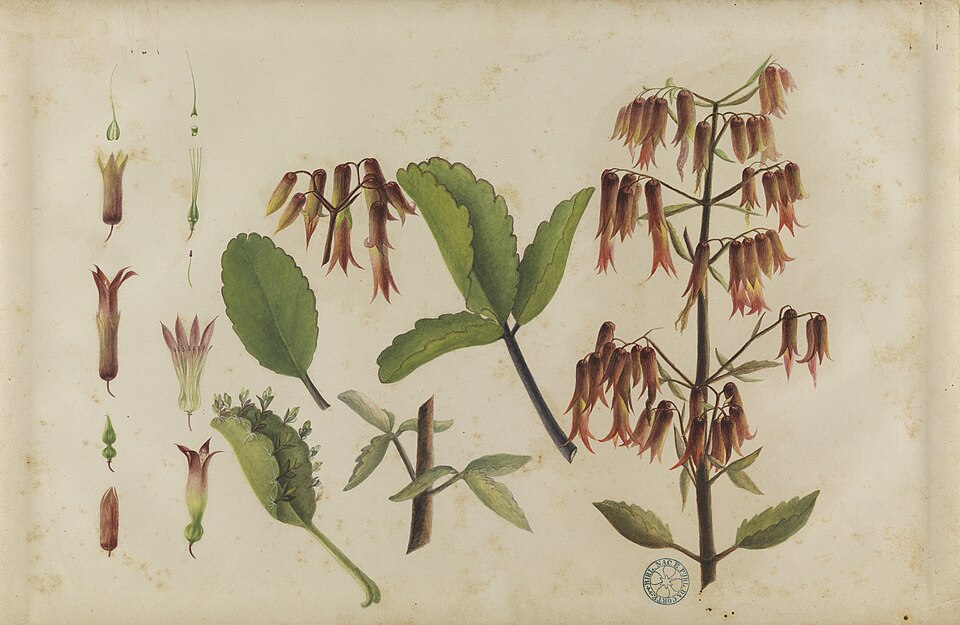
Buds produced in the notches along the leaf margin of Bryophyllum fall on soil and develop into new plants. This is an example of which one of the following types of reproduction?
- (a)Vegetative propagation
- (b)Budding
- (c)Spore formation
- (d)Regeneration
Correct — A, Vegetative propagation. The buds that appear in the notches along a Bryophyllum leaf margin are adventitious buds growing on a vegetative organ — a leaf, not a flower. When they fall on moist soil each grows into a complete plant that is genetically identical to the parent. Producing new plants from a vegetative part of the body, with no gametes and no seed, is vegetative propagation, and this is its standard example of the process happening from a leaf rather than from a stem or a root.
- (b)Budding — As a category of reproduction, budding names the outgrowth of a small individual from the parent's body in yeast and in Hydra. The word 'bud' in this question is the botanical structure, not the reproductive mode, and the two are being deliberately confused.
- (c)Spore formation — Spore formation is reproduction through single specialised cells with protective walls, as in Rhizopus and in ferns. Bryophyllum produces small plants, not spores.
- (d)Regeneration — Regeneration is the regrowth of a lost part, or the rebuilding of a whole organism from a fragment, as in Planaria. It requires the parent to be damaged or cut; here the leaf is intact and the plantlets form as a normal part of the plant's life.
Plants can reproduce without gametes by growing new individuals from an ordinary vegetative organ — a root, a stem or a leaf. Because the offspring arise by mitosis from parental tissue, they are clones and carry the parent's characters unchanged. Farmers and gardeners use the same principle deliberately through cuttings in sugarcane and rose, layering in jasmine, grafting in mango, and tissue culture for planting material raised in bulk.
All four options describe asexual reproduction, so the distinction being tested is between four mechanisms rather than between sexual and asexual. The decisive word in the stem is 'notches along the leaf margin': the new plants are coming from a leaf, which is a vegetative organ of the parent. The overlap that traps people is the word 'bud' itself, which appears in the stem and again in option (b), but budding as a reproductive category belongs to yeast and Hydra, where a small copy grows out of the parent's body and detaches. Note the trade-off in vegetative propagation. Growers get plants that flower and fruit sooner and that keep the exact characters of the parent, but the population has no genetic variation, so a disease that can attack one plant can attack all of them.
- Bryophyllum raises new plants from adventitious buds in the notches of its leaf margins — the standard example of vegetative propagation from a leaf.
- Offspring produced this way are clones, genetically identical to the parent.
- Other everyday examples are the eyes of a potato, the rhizome of ginger and the bulb of an onion.
- Horticultural methods that use the same principle include cuttings, layering, grafting and tissue culture.
- Budding as a mode of reproduction belongs to yeast and Hydra; regeneration, as in Planaria, rebuilds an organism from a fragment.
- Matching the word 'bud' in the stem to the option 'budding' without checking what budding means as a category.
- Choosing regeneration because a new whole plant appears; regeneration follows damage or fragmentation of the parent.
- Assuming a leaf cannot be a reproductive organ.
Asked by describing the process in the plant's own terms and offering four modes of asexual reproduction, with the stem's vocabulary overlapping one of the wrong options.
Which of the following statements is/are correct regarding vegetative propagation of plants? 1. Vegetative propagation produces clonal population. 2. Vegetative propagation helps in eliminating the virus. 3. Vegetative propagation can be practiced most of the year.
- (a) 1 only
- (b) 2 and 3 only
- (c) 1 and 3 only
- (d) 1, 2 and 3
Answer(c) 1 and 3 only
The same process examined for its consequences. It confirms the clonal outcome that follows from raising plants off a parent's own tissue, and rejects the idea that the method clears viruses — a clone inherits the parent's infection along with everything else.
- practice — not a real PYQ
Reproduction by fragmentation, in which a broken piece grows into a complete organism, is seen in
- (a)Spirogyra
- (b)Yeast
- (c)Bryophyllum
- (d)Rhizopus
Answer(a) Spirogyra — a filament that breaks up, with each piece growing into a new filament.
- practice — not a real PYQ
The eyes of a potato tuber are used for
- (a)spore formation
- (b)vegetative propagation
- (c)seed germination
- (d)regeneration after damage
Answer(b) vegetative propagation — each eye is a bud that can grow into a new plant.