
Which one of the following animals has a four-chambered heart?
- (a)King cobra
- (b)Turtle
- (c)Chameleon
- (d)Crocodile
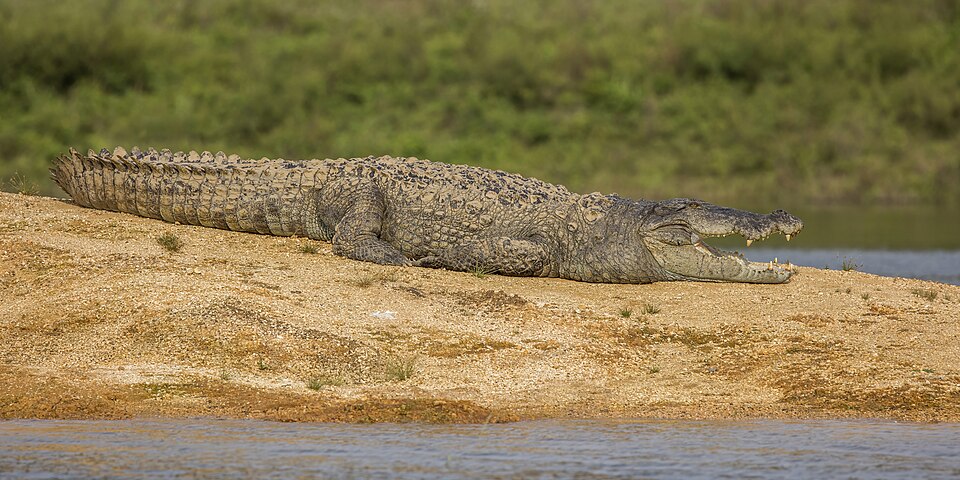
Correct — D, Crocodile. Most reptiles have a heart of three chambers — two atria and a single ventricle that is only partly divided, so oxygen-rich and oxygen-poor blood mix inside it. Crocodilians are the exception. Their ventricle is split by a complete septum into left and right halves, giving a genuinely four-chambered heart of the kind found in birds and mammals. They do retain a small opening between the two great arteries leaving the heart, the foramen of Panizza, which lets blood be diverted away from the lungs during a long dive, so mixing can still happen outside the heart even though the chambers themselves are fully separate.
- (a)King cobra — A snake, and snakes have the standard reptilian three-chambered heart with a ventricle that is only incompletely divided.
- (b)Turtle — Turtles are reptiles with three chambers as well. The ventricle carries a partial ridge that reduces mixing, but it does not divide the chamber in two.
- (c)Chameleon — A lizard, and lizards follow the same three-chambered pattern. Its striking colour changes have nothing to do with its circulation.
Heart structure tracks the separation of oxygenated from deoxygenated blood. Most fish have two chambers, one atrium and one ventricle, with blood passing once through the heart per circuit. Amphibians and most reptiles have three, two atria emptying into a single ventricle where some mixing occurs. Birds and mammals have four, giving complete double circulation. Crocodilians sit with the birds and mammals on this count, which fits their close evolutionary relationship to birds within the archosaurs.
The question is really a test of whether 'reptiles have three-chambered hearts' has been learnt as a rule with an exception or as a rule without one. Three of the four options are the rule — a snake, a turtle and a lizard — and the fourth is the exception. It is worth knowing why the exception exists: a fully divided ventricle lets a crocodile hold high pressure in the systemic circuit while keeping the lung circuit at low pressure, and the foramen of Panizza then gives it a controllable bypass so that blood is not wastefully pumped to the lungs while it is submerged. India has three crocodilians — the mugger, the saltwater crocodile and the gharial — and all three share this arrangement.
- Crocodilians are the only reptiles with a fully four-chambered heart; snakes, lizards and turtles have three chambers.
- Birds and mammals also have four-chambered hearts; amphibians have three and most fish two.
- The foramen of Panizza connects the two great arteries leaving a crocodilian heart and allows blood to bypass the lungs during a dive.
- Crocodilians and birds both belong to the archosaurs, which is why they share the divided ventricle.
- India's three crocodilians are the mugger, the saltwater crocodile and the gharial.
- Applying 'all reptiles have three chambers' without allowing for the crocodilian exception.
- Assuming a four-chambered heart means no mixing of blood at all; the foramen of Panizza allows some outside the heart.
- Treating the turtle as special because of its shell — its circulation is the ordinary reptilian one.
Asked as a single odd-one-out where three options follow the general rule for reptiles and the fourth is the standard exception to it.
Which one of the following animals has a three-chambered heart?
- (a) Scoliodon
- (b) Salamander
- (c) Pigeon
- (d) Human being
Answer(b) Salamander
The exact mirror of this item. There the four-chambered animals — a pigeon and a human — are the wrong options and the amphibian is the answer, so the two questions together fix the whole ladder from two chambers in a shark to four in a bird.
- practice — not a real PYQ
Which one of the following groups has a two-chambered heart?
- (a)Amphibians
- (b)Most fishes
- (c)Birds
- (d)Lizards
Answer(b) Most fishes — one atrium and one ventricle, with blood passing once through the heart per circuit.
- practice — not a real PYQ
The foramen of Panizza is found in
- (a)birds
- (b)crocodilians
- (c)amphibians
- (d)bony fishes
Answer(b) crocodilians — it links the two great arteries and lets blood bypass the lungs during a dive.