
Who among the following is credited with the introduction and popularization of Dhrupad form of music?
- (a)Raja Man Singh Tomar of Gwalior
- (b)Tansen
- (c)Naik Gopal
- (d)Shaikh Bahauddin of Barnawa
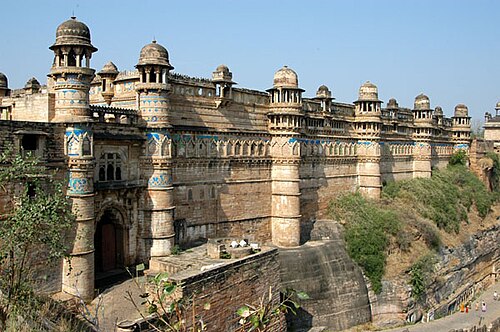
Correct — A, Raja Man Singh Tomar of Gwalior. The question asks who is credited with the introduction and popularization of the form, which points to a patron rather than a performer, and the tradition is unusually clear on this one. Man Singh Tomar ruled Gwalior from about 1486 to 1516, gathered singers at his court, and is associated with the compilation on music known as Man Kautuhal. Most accounts trace dhrupad's rise as a courtly genre to that court, and the Gwalior gharana still claims descent from it. The other three names all belong to the world of performers and composers rather than to the patronage under which the form took shape.
- (b)Tansen — Tansen was a great singer of dhrupad and one of the navaratnas at Akbar's court, but he is a product of the tradition rather than its founder. He served at Rewa before Akbar, and he lived well after Man Singh Tomar's death in 1516.
- (c)Naik Gopal — Naik Gopal is remembered in the musical tradition as a celebrated singer, not as the ruler-patron under whom dhrupad was established and spread. The question asks for the person credited with introducing and popularising the form.
- (d)Shaikh Bahauddin of Barnawa — Shaikh Bahauddin of Barnawa is another name from the roll of musicians associated with the genre, again a performer and composer rather than the patron whose court gave dhrupad its start.
Dhrupad is the oldest surviving form of Hindustani classical vocal music. It is austere and slow to unfold, sung to a long unmetred alap before the composition begins, accompanied by the pakhawaj rather than the tabla, and its texts are usually devotional or in praise of a patron. It gave way to khayal as the dominant courtly form from the eighteenth century onwards, but it never disappeared, and lineages such as the Dagar family have carried it into the present.
Questions on Indian music often set a patron against performers, and reading the verb in the stem is what separates them. Introduction and popularization is the language of patronage — of the court that gave a form its institutional home — while a name like Tansen answers a question about who sang it. Gwalior is the anchor to hold on to here, because the fort, the palace Man Singh built there, the compilation on music associated with his court and the gharana that bears the city's name all point to the same place. One caution is worth carrying: some popular accounts place Tansen at Man Singh's court, which the dates make very unlikely, since Man Singh died in 1516 and Tansen belongs to the sixteenth-century Mughal decades.
- Raja Man Singh Tomar ruled Gwalior from about 1486 to 1516 and was a major patron of music.
- The compilation on music known as Man Kautuhal is associated with his court.
- Dhrupad is sung with an extended unmetred alap and is accompanied by the pakhawaj.
- Tansen, a dhrupad singer, served at Rewa and then as one of Akbar's navaratnas — a generation and more after Man Singh.
- The Gwalior gharana traces its descent to the same court, and the Dagar lineage is the best-known dhrupad family of modern times.
- Picking Tansen because he is the famous dhrupad name. He performed the form; he did not establish it.
- Placing Tansen at Man Singh Tomar's court. The dates do not allow it.
- Reading 'introduction and popularization' as a question about a composer rather than about a patron.
As a form-to-patron question, as a work-to-court match such as Man Kautuhal, or through the gharana associated with a city.
The brothers Umakant and Ramakant Gundecha are
- (a) Dhrupad vocalists
- (b) Kathak dancers
- (c) Sarod maestros
- (d) Tabla players
Answer(a) Dhrupad vocalists
The living end of the same tradition. The Gundecha brothers sing the form that took shape at Gwalior five centuries earlier, which is a reminder that dhrupad survived the rise of khayal.
Man Kautuhal, a work on music, was prepared under the aegis of
- (a) Raja Man Singh of Gwalior
- (b) Tansen
- (c) Meera Bai
- (d) Amir Khusrau
Answer(a) Raja Man Singh of Gwalior
The same patron reached through the book instead of the genre, and with Tansen again placed as the obvious wrong option. Fixing the name to Gwalior settles both items.
- practice — not a real PYQ
Which instrument traditionally accompanies dhrupad singing?
- (a)Tabla
- (b)Pakhawaj
- (c)Mridangam
- (d)Dholak
Answer(b) Pakhawaj — the tabla belongs to the later khayal tradition and the mridangam to Carnatic music.
- practice — not a real PYQ
The Gwalior gharana of Hindustani music traces its origin to the court of
- (a)Raja Man Singh Tomar
- (b)Sultan Hussain Sharqi
- (c)Ibrahim Adil Shah II
- (d)Wajid Ali Shah
Answer(a) Raja Man Singh Tomar — the Gwalior court where dhrupad took shape as a courtly form.