
Consider the following quote: "On the 26th January, 1950, we are going to enter a life of contradictions. In politics we will have equality and in social and economic life we will have inequality." To whom among the following leaders is this quote attributed?
- (a)Mahatma Gandhi
- (b)Sarojini Naidu
- (c)B. R. Ambedkar
- (d)Somnath Lahiri
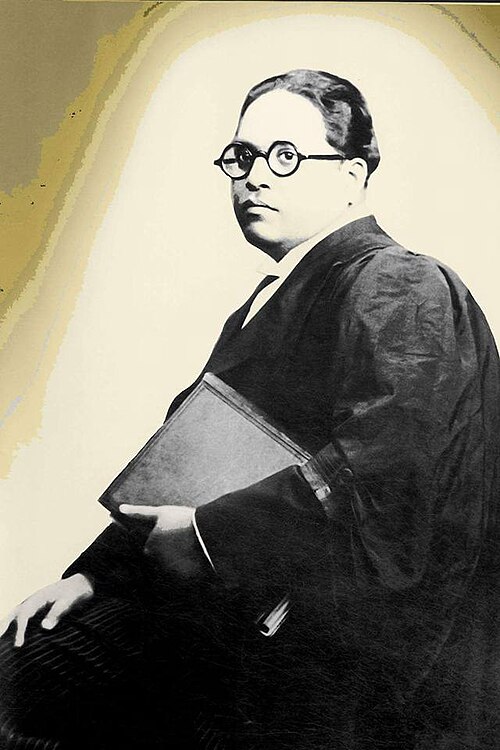
Correct — C, B. R. Ambedkar. The lines come from Ambedkar's closing speech to the Constituent Assembly on 25 November 1949, the day before the Constitution was adopted. He told the House that on 26 January 1950 India would enter a life of contradictions — equality in politics, inequality in social and economic life — because one man one vote and one vote one value would sit alongside a social order that denied equal worth. He added the warning that gives the passage its force: those who suffer the inequality will blow up the structure of political democracy the Assembly had so laboriously built, unless the contradiction is removed quickly.
- (a)Mahatma Gandhi — Gandhi was never a member of the Constituent Assembly and was assassinated in January 1948, nearly two years before this speech was made.
- (b)Sarojini Naidu — Naidu was a member of the Assembly and by 1949 Governor of the United Provinces, but this passage is not hers; her Assembly interventions are not associated with the equality-inequality formulation.
- (d)Somnath Lahiri — Lahiri was the sole Communist member and is remembered for a different intervention — his complaint that the fundamental rights chapter had been framed from the point of view of a police constable.
Ambedkar's final speech set out three warnings — abandon the grammar of anarchy in favour of constitutional methods, avoid hero-worship in politics, and move from political to social democracy. The quoted passage belongs to the third. Political democracy, he argued, rests on liberty, equality and fraternity as a union; a country that grants the vote while withholding social and economic equality has built the roof without the walls.
Attribution questions of this kind are decided by dating the quotation first. The reference to 26 January 1950 as a date still in the future places the speech in the Assembly's closing days, which rules out Gandhi at once. What remains is a choice among Assembly members, and the argument — formal political equality against substantive social inequality — is the argument most closely identified with the chairman of the Drafting Committee.
- The speech was delivered on 25 November 1949; the Constitution was adopted on 26 November 1949 and came into force on 26 January 1950.
- Ambedkar chaired the Drafting Committee, constituted on 29 August 1947.
- His three warnings were against the grammar of anarchy, against hero-worship, and against stopping at political democracy.
- Article 32, which he called the heart and soul of the Constitution, is the enforcement mechanism behind the equality he was defending.
- Somnath Lahiri, the Assembly's only Communist member, is the source of the police-constable remark about the rights chapter.
- Attributing any famous line about equality to Gandhi, who was not in the Assembly.
- Missing the date clue in the quotation itself.
A quotation-attribution item where the internal date does most of the elimination.
Which one of the following rights was described by Dr B. R. Ambedkar as the heart and soul of the Constitution?
- (a) Right to freedom of religion
- (b) Right to property
- (c) Right to equality
- (d) Right to Constitutional remedies
Answer(d) Right to Constitutional remedies
The same speaker on the same theme. Article 32 was his answer to the problem this quotation states — a right on paper is worth what its enforcement machinery is worth.
- practice — not a real PYQ
On which date did B. R. Ambedkar deliver his closing speech to the Constituent Assembly?
- (a)26 January 1950
- (b)25 November 1949
- (c)15 August 1947
- (d)9 December 1946
Answer(b) 25 November 1949 — the Constitution was adopted the following day.
- practice — not a real PYQ
Which member of the Constituent Assembly argued that the fundamental rights chapter had been framed from the point of view of a police constable?
- (a)Somnath Lahiri
- (b)K. M. Munshi
- (c)Alladi Krishnaswami Ayyar
- (d)H. C. Mookerjee
Answer(a) Somnath Lahiri — the Assembly's only Communist member, speaking on the limitations attached to the rights.