
Which one of the following plant tissues has large air spaces?
- (a)Sclerenchyma
- (b)Meristem
- (c)Collenchyma
- (d)Aerenchyma
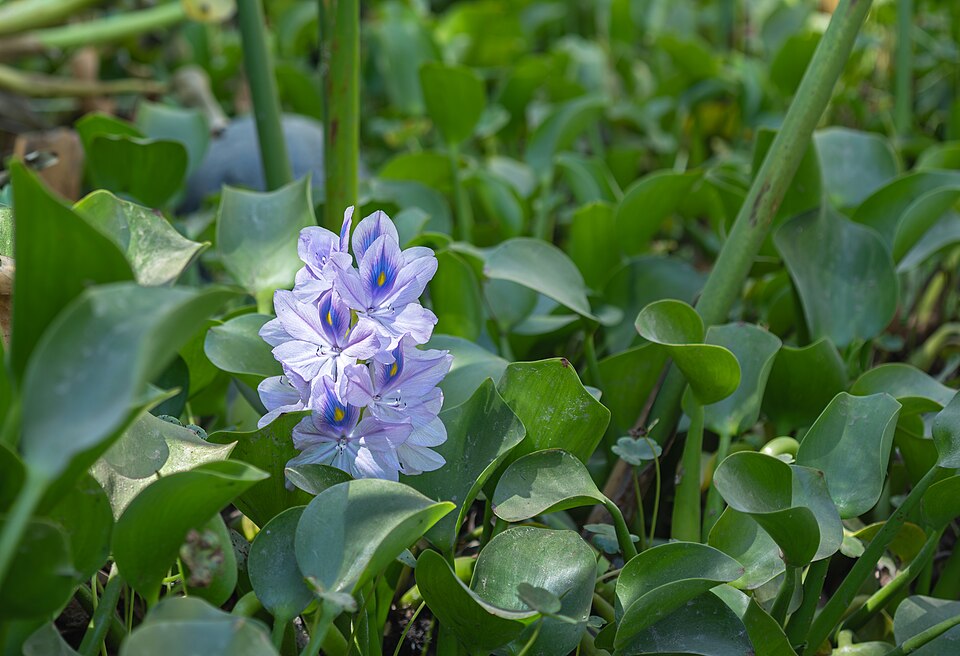
Correct — D, Aerenchyma. Aerenchyma is a form of parenchyma whose cells are separated by unusually large interconnected air spaces, and the name says so — 'aer' for air. Aquatic and marshy plants such as water hyacinth, lotus and rice depend on it twice over: the trapped air gives buoyancy so leaves float, and the continuous air channels carry oxygen down to roots sitting in waterlogged soil where diffusion through water would be far too slow.
- (a)Sclerenchyma — Sclerenchyma is the opposite case — dead cells with thick lignified walls packed tightly together for mechanical strength, as in the husk of a coconut. There is no room for air spaces.
- (b)Meristem — Meristem is the dividing tissue at growing tips and cambium. Its cells are small, thin-walled, densely cytoplasmic and closely packed, with almost no intercellular space.
- (c)Collenchyma — Collenchyma has living cells with cellulose thickened at the corners, giving young stems and leaf stalks flexible support. It has small intercellular spaces, nothing on the scale of aerenchyma.
Simple permanent tissue in plants comes in three kinds. Parenchyma is living, thin-walled and general purpose, and it takes special forms — chlorenchyma when it holds chloroplasts, aerenchyma when it holds air. Collenchyma gives flexible support with corner-thickened walls, and sclerenchyma gives rigid support through dead, lignified cells.
The answer is available from the word alone, and that is deliberate — the examiner is rewarding the candidate who reads Greek and Latin roots inside biological names. The same trick unlocks chlorenchyma, sclerenchyma (skleros, hard) and collenchyma (kolla, glue). Where the item is set the other way round, as NDA did with 'large air sacs in aquatic plants', the expected answer is parenchyma, since aerenchyma is one of its specialised forms.
- Aerenchyma is parenchyma with large air cavities, found in aquatic and marshy plants.
- It supplies buoyancy and carries oxygen to roots in waterlogged soil.
- Parenchyma is living and thin-walled; collenchyma is living with corner thickening; sclerenchyma is dead and lignified.
- Chlorenchyma is the chloroplast-containing parenchyma of green tissue.
- Meristematic tissue is compactly arranged with no intercellular spaces.
- Choosing parenchyma when aerenchyma is on the list — aerenchyma is the specific answer.
- Assuming sclerenchyma is porous because coconut husk feels light.
- Treating meristem as a permanent tissue.
A vocabulary-plus-function item; CAPF and NDA both ask it, one by naming the tissue and the other by describing the air sacs and asking what surrounds them.
In aquatic plants, large air sacs give them buoyancy effects. These sacs are surrounded by which one of the following types of tissues?
- (a) Parenchyma
- (b) Collenchyma
- (c) Sclerenchyma
- (d) Complex tissue
Answer(a) Parenchyma
The same air spaces from the other side. Aerenchyma is a specialised parenchyma, so when aerenchyma is not offered the general answer is parenchyma.
Mature sclerenchyma cells have
- (a) cellulose wall and are living
- (b) lignified wall and are living
- (c) suberized wall and are dead
- (d) lignified wall and are dead
Answer(d) lignified wall and are dead
Settles the first distractor here. Sclerenchyma is dead and lignified, which is precisely why it cannot be the tissue with large air spaces.
- practice — not a real PYQ
The tissue that provides buoyancy to floating aquatic plants is
- (a)sclerenchyma
- (b)aerenchyma
- (c)phloem
- (d)epidermis
Answer(b) aerenchyma — its large air cavities keep the leaves at the surface.
- practice — not a real PYQ
Which one of the following plant tissues is made of dead cells with lignified walls?
- (a)Parenchyma
- (b)Collenchyma
- (c)Sclerenchyma
- (d)Meristem
Answer(c) Sclerenchyma — lignin makes the wall rigid and the cells lose their contents at maturity.