
Which one of the following pairs of Deccan Sultanates and their respective regions is not correctly matched?
- (a)Nizam Shahis : Bijapur
- (b)Barid Shahis : Bidar
- (c)Qutb Shahis : Golkonda
- (d)Imad Shahis : Berar
Correct — A, the pairing of the Nizam Shahis with Bijapur. The Nizam Shahis ruled from Ahmadnagar, not Bijapur; Bijapur belonged to the Adil Shahis, founded by Yusuf Adil Khan. Five sultanates emerged as the Bahmani kingdom broke up between 1490 and 1518, and each has its own seat: Adil Shahi at Bijapur, Nizam Shahi at Ahmadnagar, Qutb Shahi at Golconda, Imad Shahi at Berar and Barid Shahi at Bidar. The other three pairings in the question reproduce that list correctly, which leaves the first as the mismatch the stem asks for.
- (b)Barid Shahis : Bidar — Correctly matched, so not the answer. The Barid Shahis took over Bidar, the last Bahmani capital, which is also where the Madrasa of Mahmud Gawan stands.
- (c)Qutb Shahis : Golkonda — Correctly matched. The Qutb Shahis ruled from the fortress of Golconda and later founded Hyderabad, where Muhammad Quli Qutb Shah built the Charminar in 1591.
- (d)Imad Shahis : Berar — Correctly matched. Berar in the north-eastern Deccan was the Imad Shahi share of the Bahmani inheritance, and the first of the five to be absorbed — Ahmadnagar annexed it in 1574.
The Bahmani sultanate, founded in 1347 with its capital first at Gulbarga and later at Bidar, dissolved into five successor states between 1490 and 1518. They fought one another constantly, but combined at Talikota in 1565 to destroy the Vijayanagara army, and were then swallowed one by one by the Mughals — Berar in 1600 under Akbar, Ahmadnagar finally in 1636, Bijapur in 1686 and Golconda in 1687 under Aurangzeb.
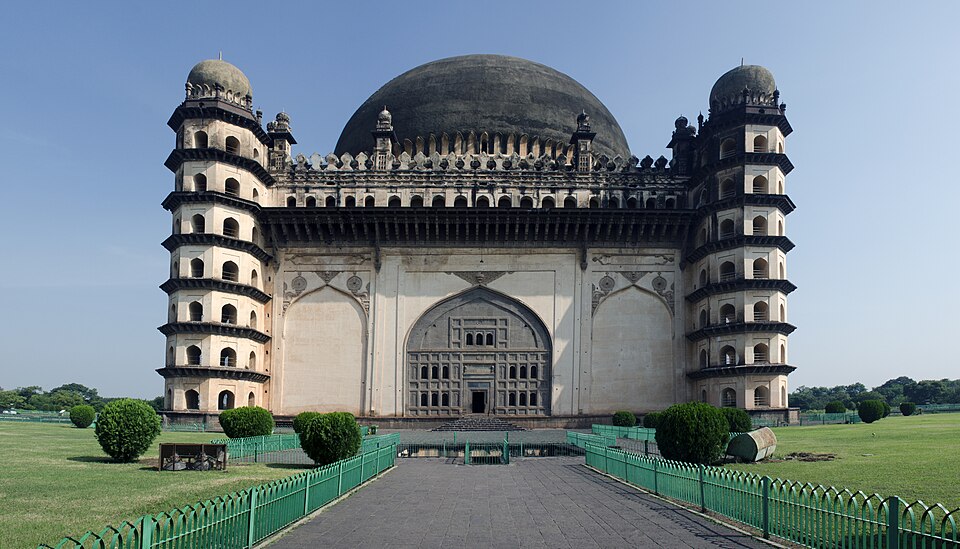
The reliable way to hold the five is by capital rather than by dynasty name, since the capitals are places you meet again through their monuments. Bijapur carries the Gol Gumbaz, the tomb of Muhammad Adil Shah with one of the largest domes in the world. Golconda gives Hyderabad and the Charminar. Bidar keeps Mahmud Gawan's madrasa. Ahmadnagar is where Chand Bibi held out against Akbar's forces and where Malik Ambar later organised Maratha light cavalry against the Mughals. Berar, the least distinguished, is the one that vanished first.
- Adil Shahi — Bijapur; Nizam Shahi — Ahmadnagar; Qutb Shahi — Golconda; Imad Shahi — Berar; Barid Shahi — Bidar.
- All five emerged from the break-up of the Bahmani sultanate between 1490 and 1518.
- The Battle of Talikota in 1565 saw the Deccan sultanates combine to defeat Vijayanagara.
- The Gol Gumbaz at Bijapur is the tomb of Muhammad Adil Shah; the Charminar at Hyderabad was built by Muhammad Quli Qutb Shah in 1591.
- Aurangzeb annexed Bijapur in 1686 and Golconda in 1687, ending the last two.
- Attaching Bijapur to the Nizam Shahis because both names are familiar from the same century.
- Treating the five sultanates as allies; they were rivals except at Talikota.
- Placing the Qutb Shahis at Hyderabad from the start — they ruled from Golconda before the new city was founded.
A not-correctly-matched pairing item. Learn the five dynasty-capital pairs as a block and any permutation of the question is answerable.
How did the dynasty of Nizam Shahis of Ahmadnagar come to an end?
- (a) Ahmadnagar was annexed into Mughal empire and Husain Shah was consigned to life imprisonment
- (b) Mughal troops destroyed Daulatabad fort and killed Nizam-ul-Mulk of Ahmadnagar
- (c) Fateh Khan usurped the throne from Nizam-ul-Mulk
- (d) Malik Ambar was defeated in a battle with Mughals in 1631 and the entire royal family was killed by the Mughal troops
Answer(a) Ahmadnagar was annexed into Mughal empire and Husain Shah was consigned to life imprisonment
The same dynasty named with its correct capital in the stem itself. That item takes the Nizam Shahis to their end under Mughal pressure, and its phrasing settles the pairing this CAPF question inverts.
- practice — not a real PYQ
The Adil Shahi dynasty ruled from
- (a)Ahmadnagar
- (b)Bijapur
- (c)Golconda
- (d)Berar
Answer(b) Bijapur — founded by Yusuf Adil Khan after the Bahmani break-up.
- practice — not a real PYQ
In the Battle of Talikota, 1565, the Deccan sultanates jointly defeated
- (a)the Mughals
- (b)the Portuguese
- (c)Vijayanagara
- (d)the Marathas
Answer(c) Vijayanagara — after which its capital at Hampi was sacked.