
Where is Asan Conservation Reserve located?
- (a)Himachal Pradesh
- (b)Uttarakhand
- (c)Sikkim
- (d)Arunachal Pradesh
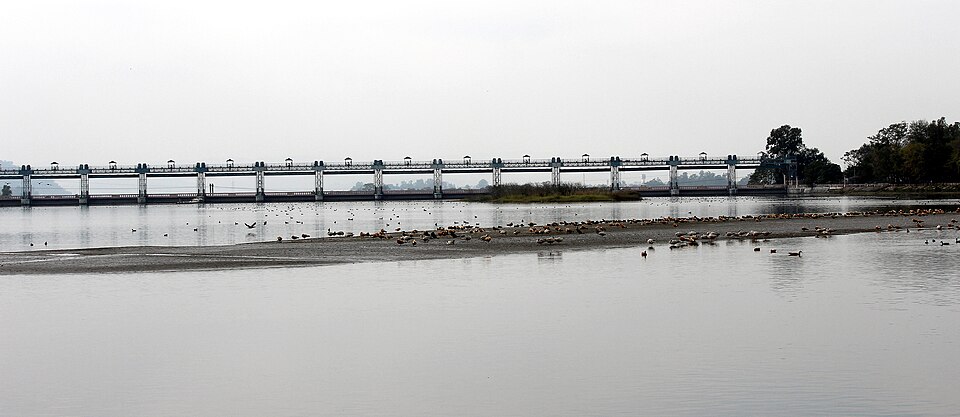
Correct — B, Uttarakhand. The Asan Conservation Reserve lies in Dehradun district of Uttarakhand, along the last stretch of the Asan river where it meets the Yamuna, and the wetland itself was created when the Asan barrage was built in the 1960s to feed a hydel channel. Uttarakhand notified it as a conservation reserve in 2005, the first area in the State to be given that category, and in July 2020 it was designated a Ramsar site of international importance — again the first in Uttarakhand. Its value is as a stopover: the reservoir sits on the migratory route into the Doon valley and draws large numbers of wintering waterbirds, including the ruddy shelduck and the red-crested pochard.
- (a)Himachal Pradesh — Himachal's Ramsar wetlands are the high-altitude Chandra Taal and Renuka, and the reservoir at Pong Dam. Asan is not among them.
- (c)Sikkim — Sikkim's best-known wetland is Khecheopalri lake, and the State's protected areas centre on Khangchendzonga. It has no Asan.
- (d)Arunachal Pradesh — Arunachal's protected areas include Namdapha and Mouling National Parks and the Deepor-type wetlands lie further west in Assam. The Asan is a Yamuna tributary, far from the Eastern Himalaya.
A conservation reserve is one of the two categories added to the Wild Life (Protection) Act by the amendment of 2002, the other being a community reserve. It covers government-owned land, typically adjoining a national park or sanctuary or linking two of them, and it is managed with a committee that includes local representatives — a lighter regime than a sanctuary, designed for corridors and for landscapes where people and wildlife share space.
Ramsar designation is a separate track, made under the Convention on Wetlands signed at Ramsar in Iran in 1971. India acceded in 1982 and the number of Indian sites has grown quickly since 2019; Asan was among the additions of 2020. The two labels do different work — the conservation reserve is a domestic legal category with a management regime, while the Ramsar listing is an international commitment to wise use and brings no fresh domestic powers. Note for a current-affairs answer that India's Ramsar tally has continued to climb well past the figure that stood at the time of this paper.
- The Asan Conservation Reserve is in Dehradun district, Uttarakhand, at the confluence of the Asan and the Yamuna.
- The wetland formed behind the Asan barrage, built in the 1960s.
- Uttarakhand notified it as a conservation reserve in 2005 — the State's first.
- It was designated a Ramsar site in July 2020, Uttarakhand's first Ramsar wetland.
- Conservation reserves and community reserves were introduced by the Wild Life (Protection) Amendment Act, 2002.
- Confusing a conservation reserve with a community reserve; the first is on government land, the second on community or private land.
- Assuming a Ramsar site must be a national park or sanctuary.
- Placing any Himalayan wetland in Himachal Pradesh by default.
A place-to-State item on a site that entered the news through its Ramsar designation. Recent additions to the Ramsar list are a reliable source of such questions.
Consider the following pairs: Wetland/Lake — Location 1. Hokera Wetland — Punjab 2. Renuka Wetland — Himachal Pradesh 3. Rudrasagar Lake — Tripura 4. Sasthamkotta Lake — Tamil Nadu How many pairs given above are correctly matched?
- (a) Only one pair
- (b) Only two pairs
- (c) Only three pairs
- (d) All four pairs
Answer(b) Only two pairs
The same skill of putting a named wetland in the right State, tested across four sites at once. Hokera belongs to Jammu and Kashmir and Sasthamkotta to Kerala, which leaves Renuka and Rudrasagar standing.
- practice — not a real PYQ
Conservation reserves and community reserves were introduced into Indian law by
- (a)the Wild Life (Protection) Act, 1972 as originally enacted
- (b)the Wild Life (Protection) Amendment Act, 2002
- (c)the Forest (Conservation) Act, 1980
- (d)the Biological Diversity Act, 2002
Answer(b) the Wild Life (Protection) Amendment Act, 2002 — which added both categories.
- practice — not a real PYQ
The Ramsar Convention, to which India is a party, deals with
- (a)trade in endangered species
- (b)conservation and wise use of wetlands
- (c)transboundary movement of hazardous waste
- (d)protection of migratory birds of prey
Answer(b) conservation and wise use of wetlands — signed at Ramsar, Iran, in 1971.