
In the Mathura School of Art, Buddha's images are largely carved in
- (a)Dhyana Mudra
- (b)Abhaya Mudra
- (c)Dharmachakra Mudra
- (d)Varada Mudra
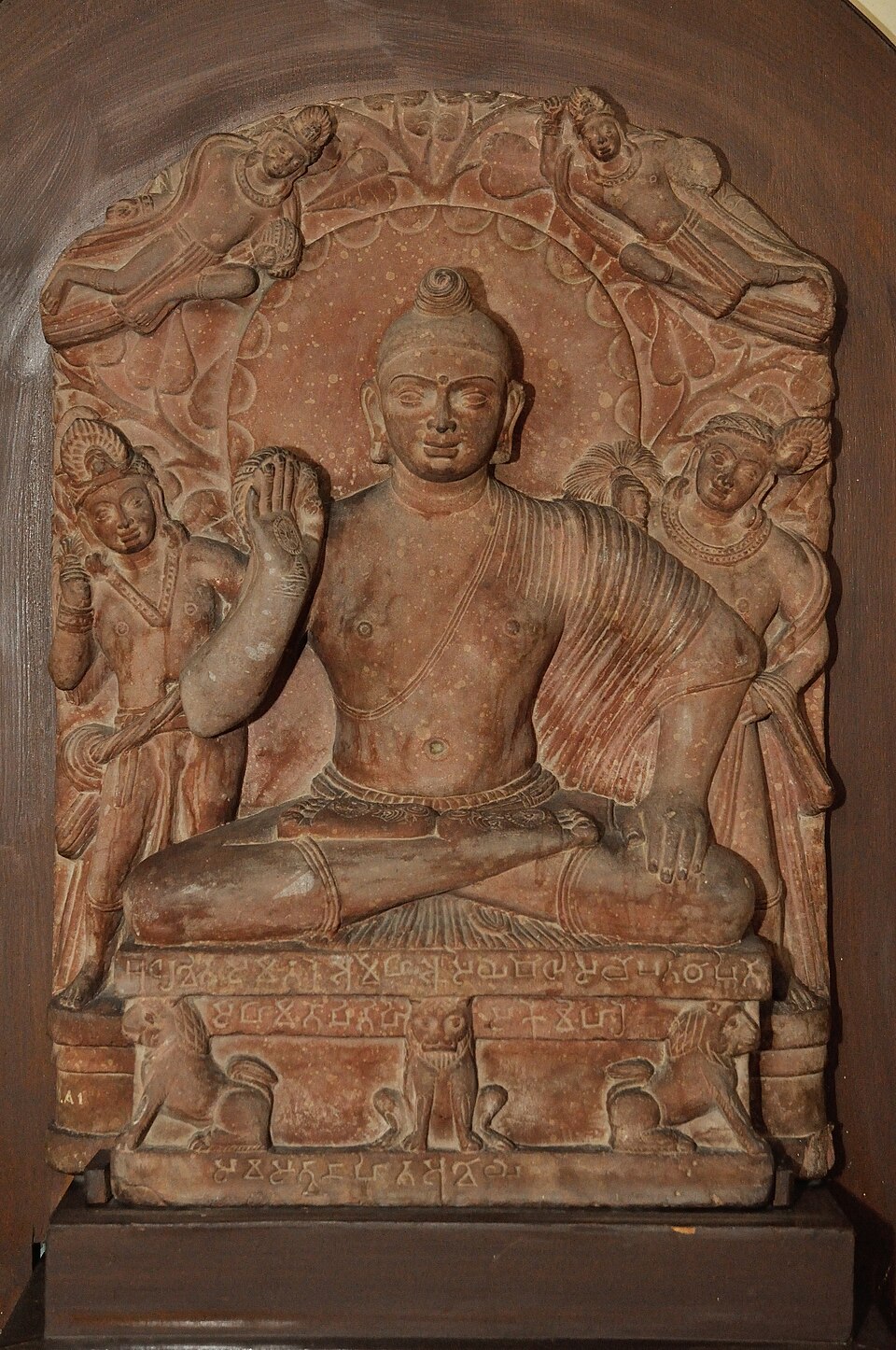
Correct — B, Abhaya Mudra. The Mathura workshops of the Kushana period carved the Buddha as a broad-shouldered, energetic figure seated in padmasana on a lion throne, with the right hand raised to shoulder height, palm outward and fingers up. That gesture is abhaya mudra, the sign of protection and freedom from fear, and it is repeated on Mathura image after Mathura image — the Katra mound Buddha, the Bodhisattva that Friar Bala dedicated at Sarnath, the standing Bodhisattvas of Ahichchhatra. The left hand rests on the thigh or grips the hem of the robe. Everything else about the type is equally standardised: mottled red sandstone from the Sikri quarries, a shaven head with a coiled ushnisha, a thin robe drawn over the left shoulder leaving the right bare, and a large plain halo with a scalloped rim.
- (a)Dhyana Mudra — The meditation gesture, both hands cupped one above the other in the lap. It belongs to the Gandhara idiom, where the Buddha is a withdrawn, contemplative figure in grey schist with wavy hair and heavy Hellenistic drapery — the opposite temperament from Mathura's.
- (c)Dharmachakra Mudra — Turning the wheel of the law, the two hands held at the chest with thumb and forefinger touching. The image every student pictures for it is the Gupta-period preaching Buddha from Sarnath, made three centuries after the Mathura type was fixed.
- (d)Varada Mudra — The boon-granting gesture, the arm hanging down with the palm turned outward. It is common on Bodhisattvas, Tara and Hindu deities, and it is not the gesture the Mathura Buddha is repeatedly shown making.
Indian sculpture built a fixed vocabulary of hand positions, the mudras, so that a figure could be read without an inscription. Abhaya is the raised open palm for reassurance, dhyana the cupped hands of meditation, bhumisparsha the fingers touching the ground to call the earth to witness, dharmachakra the two hands turning the wheel at the chest, and varada the downward open palm of giving. The Mathura school, working in the first three centuries of the Common Era under Kushana patronage, settled on abhaya for the Buddha.
The examiner is really asking whether you can tell Mathura from Gandhara, since both schools flourished under the Kushanas and both produced the earliest anthropomorphic Buddha images. The two split on almost every visible count. Mathura is indigenous and grows out of the earlier yaksha type, so its Buddha is fleshy, smiling and forceful, cut from spotted red sandstone; Gandhara is Greco-Roman in feeling, cut from grey-blue schist, with a sharp nose, wavy hair gathered in a topknot and toga-like folds. Mathura's raised right hand is the single quickest identifier, which is why the paper asked about it.
- Abhaya mudra is the right hand raised to shoulder level, palm facing outward — protection, and the absence of fear.
- Mathura sculptors used mottled red sandstone from the Sikri quarries near Fatehpur Sikri; Gandhara used grey schist and, later, stucco.
- The Mathura Buddha wears a thin robe over the left shoulder with the right shoulder bare, has a shaven head with a spiral ushnisha, and sits on a lion throne.
- Both schools took shape under Kushana rule, roughly the first to third century CE, and both produced the first Buddha figures in human form.
- The Sarnath school of the Gupta period is the third of the trio, working in cream Chunar sandstone with a plain transparent robe and a richly carved halo.
- Attaching dhyana mudra to Mathura because meditation feels like the obvious Buddhist gesture.
- Assuming Mathura and Gandhara are separated in time; they overlap almost exactly under the Kushanas.
- Confusing bhumisparsha, where the fingers point down to the ground, with varada, where the whole palm faces out and down.
A single-fact identification that pays off only if you have fixed one visual marker per school rather than a list of adjectives.
Lord Buddha's image is sometimes shown with the hand gesture called 'Bhumisparsha Mudra'. It symbolizes
- (a) Buddha's calling of the Earth to watch over Māra and to prevent Māra from disturbing his meditation
- (b) Buddha's calling of the Earth to witness his purity and chastity despite the temptations of Māra
- (c) Buddha's reminder to his followers that they all arise from the Earth and finally dissolve into the Earth, and, thus this life is transitory
- (d) Both the statements (a) and (b) are correct in this context
Answer(b) Buddha's calling of the Earth to witness his purity and chastity despite the temptations of Māra
The same vocabulary tested on a different gesture. Reading a Buddha image means reading the hands first, and that item turns on the one mudra where the fingers point downward to the ground rather than outward to the viewer.
Which one of the following sculptures invariably used green schist as the medium?
- (a) Maurya sculptures
- (b) Mathura sculptures
- (c) Bharhut sculptures
- (d) Gandhara sculptures
Answer(d) Gandhara sculptures
The Mathura-Gandhara contrast approached through the stone instead of the gesture. Mathura is the red sandstone school and Gandhara the schist school, and either marker settles the same pair of options.
- practice — not a real PYQ
The stone characteristically used by the Mathura school of sculpture was
- (a)grey schist
- (b)spotted red sandstone
- (c)cream Chunar sandstone
- (d)green phyllite
Answer(b) spotted red sandstone — quarried at Sikri; grey schist belongs to Gandhara and Chunar sandstone to Sarnath.
- practice — not a real PYQ
The gesture in which the Buddha's fingers touch the ground, calling the earth to witness, is
- (a)Abhaya mudra
- (b)Varada mudra
- (c)Bhumisparsha mudra
- (d)Vitarka mudra
Answer(c) Bhumisparsha mudra — the gesture of the moment of enlightenment at Bodh Gaya.