
Most of the mature Harappan sites in the region of Cholistan had been abandoned during
- (a)C. 2250 BCE
- (b)C. 2000 BCE
- (c)C. 1800 BCE
- (d)C. 1700 BCE
Correct — C, C. 1800 BCE. Cholistan is the desert tract along the dried bed of the Ghaggar-Hakra in present-day Pakistani Punjab, and it held one of the densest concentrations of Mature Harappan settlement anywhere. The standard textbook account is explicit about the date: by about 1800 BCE most of the Mature Harappan sites in regions such as Cholistan had been abandoned. The same period saw population expand instead into Gujarat, Haryana and western Uttar Pradesh, where the Late Harappan cultures develop.
- (a)C. 2250 BCE — Around 2250 BCE the Mature Harappan phase was at its height, with Mohenjo-daro and Harappa fully occupied and the trade with Mesopotamia running. Nothing had been abandoned.
- (b)C. 2000 BCE — About 1900 BCE is when the signs of decline begin to appear — the distinctive artefacts, the weights, the seals and the script start to disappear. The abandonment of the Cholistan sites follows that, rather than coinciding with 2000 BCE.
- (d)C. 1700 BCE — By 1700 BCE the Late Harappan cultures were already established in the eastern and southern areas of expansion. This is later than the abandonment being asked about.
The Harappan civilisation is periodised as Early Harappan to about 2600 BCE, Mature Harappan from roughly 2600 to 1900 BCE, and Late Harappan thereafter. The Mature phase is the one with planned cities, standardised burnt bricks, the Indus script, seals, uniform weights and long-distance trade. From about 1900 BCE these markers disappear and settlement shifts eastward and southward into what archaeologists call the Late Harappan or successor cultures.
The four dates are close together, so the item is testing whether a candidate has attached each to its own event rather than carrying one vague sense of 'around 2000 BCE'. Three landmarks are worth keeping separate: about 2600 BCE for the beginning of the Mature phase, about 1900 BCE for the onset of decline, and about 1800 BCE for the abandonment of the Cholistan sites. Cholistan appears in the syllabus in one other connection worth remembering, as one of the places where terracotta models of the plough have been found.
- The Mature Harappan phase runs from about 2600 BCE to about 1900 BCE.
- By c. 1800 BCE most Mature Harappan sites in regions such as Cholistan had been abandoned.
- Settlement expanded at the same time into Gujarat, Haryana and western Uttar Pradesh.
- Terracotta models of the plough have been found at sites in Cholistan and at Banawali in Haryana.
- Distinctive Harappan artefacts — weights, seals, the script and standardised beads — disappear after about 1900 BCE.
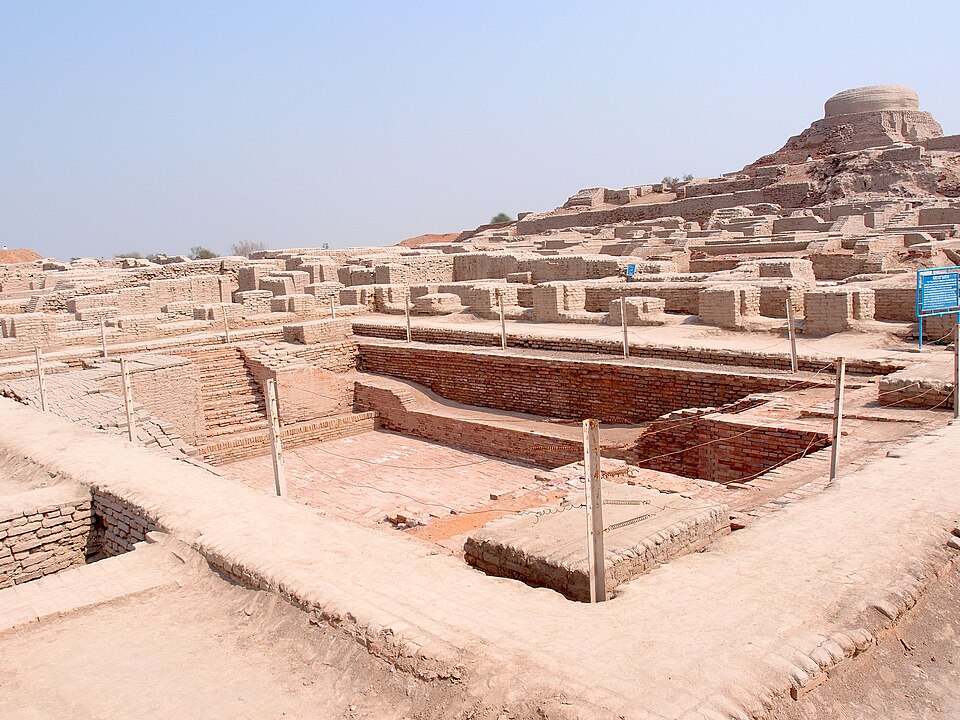
- Blurring the onset of decline near 1900 BCE with the abandonment near 1800 BCE.
- Assuming the whole civilisation ended at once rather than region by region.
- Treating Cholistan as an Indian site — it lies in present-day Pakistan, along the dried Ghaggar-Hakra bed.
A date-recall item lifted from the NCERT account of the decline; the sibling papers use Cholistan in the agricultural context instead, through the terracotta ploughs.
Regarding the Indus Valley Civilization, consider the following statements : 1. It was predominantly a secular civilization and the religious element, though present, did not dominate the scene. 2. During this period, cotton was used for manufacturing textiles in India. Which of the statements given above is/are correct?
- (a) 1 only
- (b) 2 only
- (c) Both 1 and 2
- (d) Neither 1 nor 2
Answer(c) Both 1 and 2
Describes the Mature phase whose end this question dates, and names two of the features — civic rather than religious building, and cotton textiles — that vanish from the record afterwards.
Consider the following statements : 1. Terracotta models of the plough have been found at sites in Cholistan and at Banawali (Haryana). 2. There is evidence of a ploughed field at Kalibangan associated with the mature phase of the Harappan civilization. 3. The ploughed field at Kalibangan had two sets of furrows crossing at right angles to each other suggesting two different crops were grown together in it. Which of the statements given above are correct ?
- (a) 1, 2 and 3
- (b) 2 and 3 only
- (c) 1 and 3 only
- (d) None of the above
Answer(c) 1 and 3 only
The other appearance of Cholistan in this syllabus, as the find-spot of terracotta ploughs, and a reminder that the Kalibangan ploughed field belongs to the Early phase rather than the Mature one.
- practice — not a real PYQ
The Mature Harappan phase is generally dated to
- (a)c. 3500-2600 BCE
- (b)c. 2600-1900 BCE
- (c)c. 1900-1500 BCE
- (d)c. 1500-1000 BCE
Answer(b) c. 2600-1900 BCE — the Early phase precedes it and the Late phase follows.
- practice — not a real PYQ
As Mature Harappan settlements were abandoned in the north-west, settlement expanded into
- (a)Kerala and Tamil Nadu
- (b)Gujarat, Haryana and western Uttar Pradesh
- (c)Assam and Bengal
- (d)Odisha and Chhattisgarh
Answer(b) Gujarat, Haryana and western Uttar Pradesh — the areas of Late Harappan occupation.