
What is the depression at the top of a volcano following a volcanic eruption called?
- (a)Chamber
- (b)Vent
- (c)Cinder
- (d)Crater
Correct — D, Crater. A crater is the funnel-shaped depression at the top of a volcanic cone, surrounding the opening through which lava, ash and gas were expelled. It forms because material is blown out from the summit and because the top of the cone subsides once the eruption ends and the pressure beneath drops. Where the collapse is on a much larger scale, after a very violent eruption empties the magma chamber, the resulting depression is called a caldera, which is the same idea at a size of a kilometre or more across.
- (a)Chamber — The magma chamber is the reservoir of molten rock deep below the volcano, not a depression at its summit. It is the source of the eruption rather than a feature left by it.
- (b)Vent — The vent is the pipe or conduit through which magma travels from the chamber to the surface. The crater surrounds the vent's opening; the two are not the same thing.
- (c)Cinder — Cinders are the fragments of solidified lava thrown out during an eruption. They build the cone up rather than form a hollow in it, and a cone built mostly of them is called a cinder cone.
A volcano's parts are arranged from bottom to top: a magma chamber at depth, a vent or conduit rising from it, and at the surface a cone built of lava and pyroclastic material with a crater at its summit. Volcanoes are classified by shape and eruptive style — shield volcanoes are broad and gently sloping, built by repeated flows of fluid lava; composite or strato-volcanoes are steep and layered; cinder cones are small and built of ejecta.
All four options are real volcanic terms, so the item is testing precision rather than recognition. Work down the structure and each word finds its own place — chamber below, vent through, cinder ejected, crater at the top. It is worth keeping the crater-caldera distinction ready as well, since a question that specifies a very large depression formed by collapse is asking for the caldera instead. India's one confirmed active volcano, Barren Island in the Andaman Sea, shows the whole arrangement clearly.
- A crater is the depression at the summit of a volcanic cone, surrounding the vent.
- A caldera is a much larger depression formed when the summit collapses into an emptied magma chamber.
- The magma chamber lies beneath the volcano and the vent connects it to the surface.
- Cinder cones are built of fragments of solidified lava thrown out during eruptions.
- Barren Island in the Andaman Sea is the only confirmed active volcano in Indian territory.
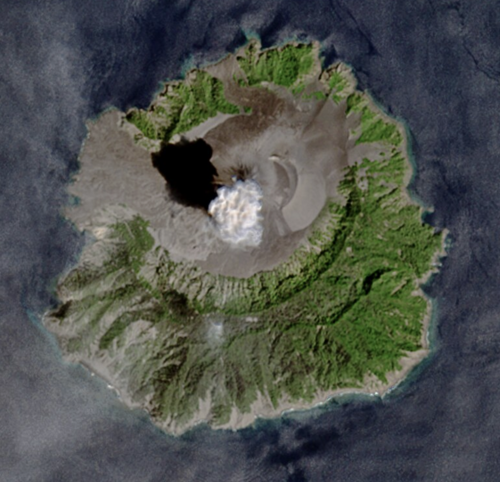
- Using crater and caldera interchangeably; the caldera is far larger and formed by collapse.
- Confusing the vent, which is the conduit, with the crater, which is the hollow around its mouth.
- Assuming a crater must contain a lake — Lonar in Maharashtra is a crater lake, but it was made by a meteorite impact rather than an eruption.
A vocabulary item on the parts of a volcano; the sibling papers ask the same material through volcano types and through statements about volcanic activity and soils.
Consider the following statements : i. The Barren Island volcano is an active volcano located in the Indian territory. 2. Barren Island lies about 140 km east of Great Nicobar. 3. The last time the Barren Island volcano erupted was in 1991 and it has remained inactive since then. Which of the statements given above is/are correct ?
- (a) 1 only
- (b) 2 and 3
- (c) 3 only
- (d) 1 and 3
Answer(a) 1 only
The Indian example of the landform this question defines, and it settles the two facts most often misstated about it — the island's position and its continuing activity.
Individual lava flows are normally only a few feet thick, but over a long period of time, repeated flows may build up a volcano. Such volcanoes are termed as:
- (a) Shield volcano.
- (b) Composite volcano.
- (c) Strato-volcano.
- (d) Cinder-cone volcano.
Answer(a) Shield volcano.
Classifies the cone that carries the crater. Its fourth option names the same cinder material that appears as a distractor here, built into a cone rather than left as a hollow.
- practice — not a real PYQ
A very large depression formed by the collapse of a volcano's summit into an emptied magma chamber is called
- (a)a crater
- (b)a caldera
- (c)a vent
- (d)a fissure
Answer(b) a caldera — the same idea as a crater but on a far larger scale and formed by collapse.
- practice — not a real PYQ
The only confirmed active volcano in Indian territory is
- (a)Narcondam
- (b)Barren Island
- (c)Dhinodhar
- (d)Baratang
Answer(b) Barren Island — in the Andaman Sea; Narcondam is regarded as dormant.