
Which electromagnetic radiation(s) is/are used to cook food?
- (a)Infrared radiation only
- (b)Microwave radiation only
- (c)Infrared and microwave radiations
- (d)All electromagnetic radiations
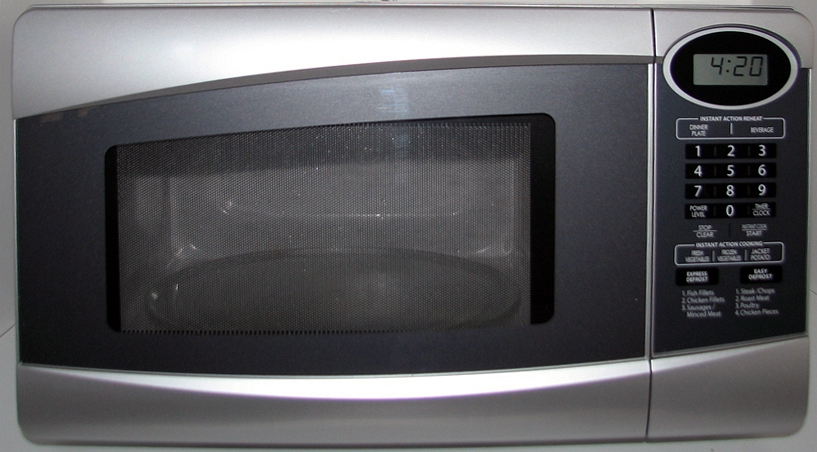
Correct — C, Infrared and microwave radiations. A microwave oven runs at about 2·45 GHz and heats food by driving water molecules to rotate, which spreads as heat through the item — this is why a wet potato heats while a dry paper plate beside it stays cool. Infrared is the older route: a grill element, a toaster coil, a tandoor wall and an open fire all deliver their heat as infrared radiation. Both bands therefore cook, and neither alone covers ordinary kitchen practice.
- (a)Infrared radiation only — Infrared alone leaves out the microwave oven, whose whole principle is that 2·45 GHz radiation is absorbed by water in the food rather than by the container.
- (b)Microwave radiation only — Microwave alone leaves out every radiant heat source in a kitchen — grill, toaster, tandoor and fire all transfer energy in the infrared.
- (d)All electromagnetic radiations — Not all electromagnetic radiation cooks. Radio waves pass through food almost untouched, visible light deposits very little energy, and X-rays and gamma rays ionise rather than heat and are never used for cooking.
Cooking by radiation means getting energy absorbed inside food and turned into heat. Two bands do that well. Infrared is absorbed at the surface by almost any material and conducts inwards, which is how grills and tandoors work. Microwaves at 2·45 GHz are absorbed selectively by polar molecules — chiefly water — which rotate against their neighbours and warm the food from within, an effect called dielectric heating.
The trap is the word 'only' in the first two options and the word 'all' in the fourth. Reading the four together shows the examiner is testing whether a candidate treats microwave cooking as the only radiative cooking there is. A useful check is the container: in a microwave oven, glass and dry paper stay cool because they hold no free water, whereas under a grill the plate gets hot along with the food, because infrared is absorbed by both.
- Domestic microwave ovens operate near 2·45 GHz, inside the 2·4-2·5 GHz ISM band shared with Wi-Fi and Bluetooth.
- Microwave heating is dielectric heating of polar molecules, mainly water, so dry materials heat poorly.
- Metal reflects microwaves, which is why metal vessels are kept out of a microwave oven.
- Grills, toasters, tandoors and open fires transfer energy as infrared radiation.
- Radio waves, visible light, ultraviolet, X-rays and gamma rays are not used to cook food.
- Treating microwaves as the only radiation that can cook, and forgetting the grill.
- Reading 'all electromagnetic radiations' as a safe catch-all answer.
- Confusing microwaves with the far shorter X-rays because both are invisible.
Asked as a two-band recall question with 'only' and 'all' as the discriminators; the same physics appears in UPSC prelims as the potato-and-paper-plate item.
If a potato is placed on a pure paper plate which is white and unprinted and put in a microwave oven, the potato heats up but the paper plate does not. This is because
- (a) Potato is mainly made up of starch whereas paper is mainly made up of cellulose
- (b) Potato transmits microwaves whereas paper reflects microwaves
- (c) Potato contains water whereas paper does not contain water
- (d) Potato is a fresh organic material whereas paper is a dead organic material
Answer(c) Potato contains water whereas paper does not contain water
The mechanism behind half of this CAPF answer. Microwave cooking works through the water in the food, which is why the plate under it stays cool.
Which one of the following types of waves are used in a night vision apparatus ?
- (a) Radio waves
- (b) Microwaves
- (c) Infra-red waves
- (d) None of the above
Answer(c) Infra-red waves
The other band in the CAPF answer, put to a different use. Warm bodies radiate in the infrared, which is what makes both the grill and the night sight work.
- practice — not a real PYQ
A microwave oven heats a bowl of soup but leaves the dry ceramic bowl nearly cool. The best explanation is that
- (a)ceramic reflects microwaves completely
- (b)the soup contains water, which absorbs microwaves strongly
- (c)microwaves cannot pass through ceramic
- (d)the bowl radiates its heat away faster than the soup
Answer(b) the soup contains water, which absorbs microwaves strongly — dielectric heating needs polar molecules.
- practice — not a real PYQ
Which one of the following appliances cooks mainly by infrared radiation?
- (a)Microwave oven
- (b)Electric grill
- (c)Refrigerator
- (d)Pressure cooker
Answer(b) Electric grill — a glowing element radiates in the infrared, and the food absorbs it at the surface.