
Magnesium is used in
- (a)fireworks to make a bright white light
- (b)gemstones in jewellery
- (c)examination of alimentary canal of the patient
- (d)purification of water
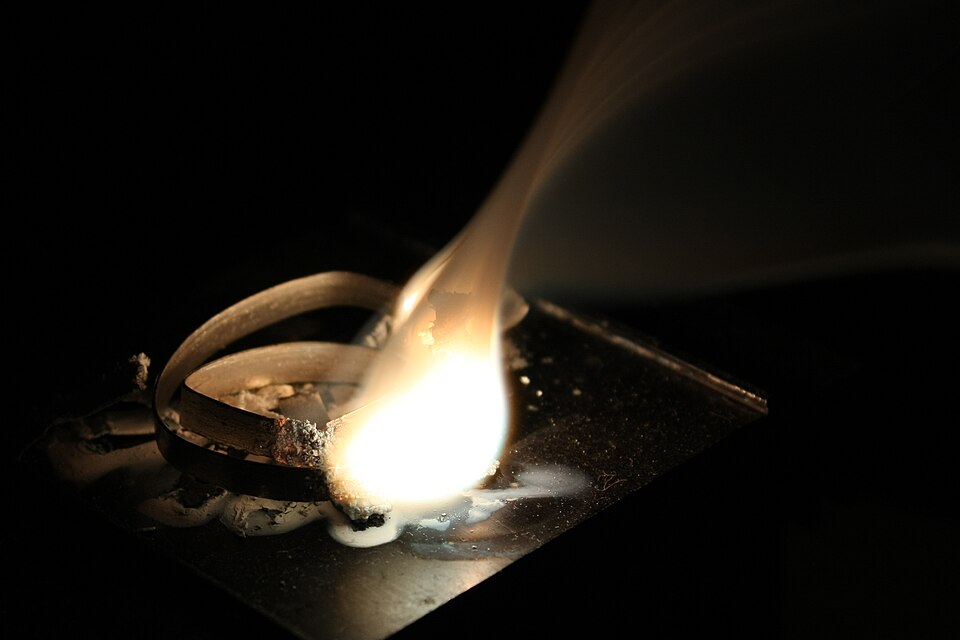
Correct — A, fireworks to make a bright white light. Magnesium ignites readily and burns in air with an intense white flame, forming magnesium oxide, and that brilliance is why magnesium powder and ribbon are packed into fireworks, flares and the old photographic flash. The reaction is strongly exothermic and gives out a great deal of light along with the heat.
- (b)gemstones in jewellery — Magnesium is a reactive silvery metal that tarnishes in air; it is not a gemstone. Gemstones are hard, stable minerals — corundum, beryl, quartz and the like.
- (c)examination of alimentary canal of the patient — That is barium's job. A barium sulphate meal is swallowed before an X-ray because barium absorbs X-rays strongly and outlines the gut; magnesium is far too light to give that contrast.
- (d)purification of water — Water treatment leans on alum, chlorine, lime and ozone. Magnesium salts are part of what makes water hard in the first place, so adding them would work against the purpose.
Magnesium is the second element of group 2, the alkaline earth metals. It has a low density, a strong affinity for oxygen, and a burning reaction so vigorous that once alight it will keep burning in carbon dioxide, which is why a magnesium fire must never be fought with a carbon dioxide extinguisher or with water. The same reactivity makes it useful as a reducing agent and as a sacrificial anode protecting buried steel.
Every option in this item points at a different element, so the fastest route is to name the owner of each. White light in fireworks belongs to magnesium and aluminium; gemstone colour belongs to chromium in ruby and to beryllium's mineral beryl in emerald; the barium meal belongs to barium; water purification belongs to alum and chlorine. Magnesium also matters biologically as the metal at the centre of the chlorophyll molecule, which is worth carrying since it recurs in the very next chemistry question on this paper.
- Magnesium burns in air with a dazzling white flame, forming white magnesium oxide.
- Its brilliance made it the basis of flash photography before electronic flashes, and it is still used in fireworks and military flares.
- A burning magnesium fire continues in carbon dioxide and reacts with water, so those extinguishers cannot be used on it.
- Magnesium is the central metal atom of chlorophyll, which is why plants need it.
- Magnesium hydroxide is milk of magnesia, an antacid, and magnesium sulphate is Epsom salt.
- Confusing magnesium with barium in the X-ray question — both are group 2 metals, but only barium is dense enough to be radio-opaque.
- Attributing ruby's colour to beryllium; the colour comes from chromium impurities in corundum.
- Fighting a magnesium fire with water or carbon dioxide, both of which feed it.
A use-to-element matching item. Each wrong option is the well-known use of a different element, so knowing four elements settles it faster than knowing magnesium alone.
Consider the following statements regarding burning of magnesium ribbon in air : 1. White powder of MgO is formed. 2. It is an example of combustion reaction. 3. Heat and light are produced. Which of the statements given above are correct?
- (a) 1 and 2 only
- (b) 1 and 3 only
- (c) 2 and 3 only
- (d) 1, 2 and 3
Answer(d) 1, 2 and 3
The same reaction taken apart into its three observable features. The light in statement 3 is precisely the property that puts magnesium into fireworks.
Depending on the requirements, plant nutrients are classified as micronutrients and macronutrients. Which one of the following is an example of a macronutrient?
- (a) Manganese
- (b) Copper
- (c) Magnesium
- (d) Chlorine
Answer(c) Magnesium
The biological half of the same element. Magnesium counts as a macronutrient because plants need it in quantity for chlorophyll, not in traces like manganese or copper.
- practice — not a real PYQ
When a magnesium ribbon is burnt in air, the white powder formed is
- (a)magnesium carbonate
- (b)magnesium oxide
- (c)magnesium nitride only
- (d)magnesium hydroxide
Answer(b) magnesium oxide — magnesium combines with atmospheric oxygen to give white MgO, with a little nitride formed alongside.
- practice — not a real PYQ
Magnesium is an essential plant nutrient mainly because it is a constituent of
- (a)haemoglobin
- (b)chlorophyll
- (c)cellulose
- (d)starch
Answer(b) chlorophyll — magnesium sits at the centre of the chlorophyll molecule that absorbs sunlight for photosynthesis.