
Singapore is known as Port of Call because
- (a)it deals in the processing and shipping of oil
- (b)it is a deep water port built away from the actual port
- (c)it is on main sea route where ships use to anchor for refueling, watering and taking food items
- (d)it serves the parent ports by receiving the ships which are unable to approach due to their large size
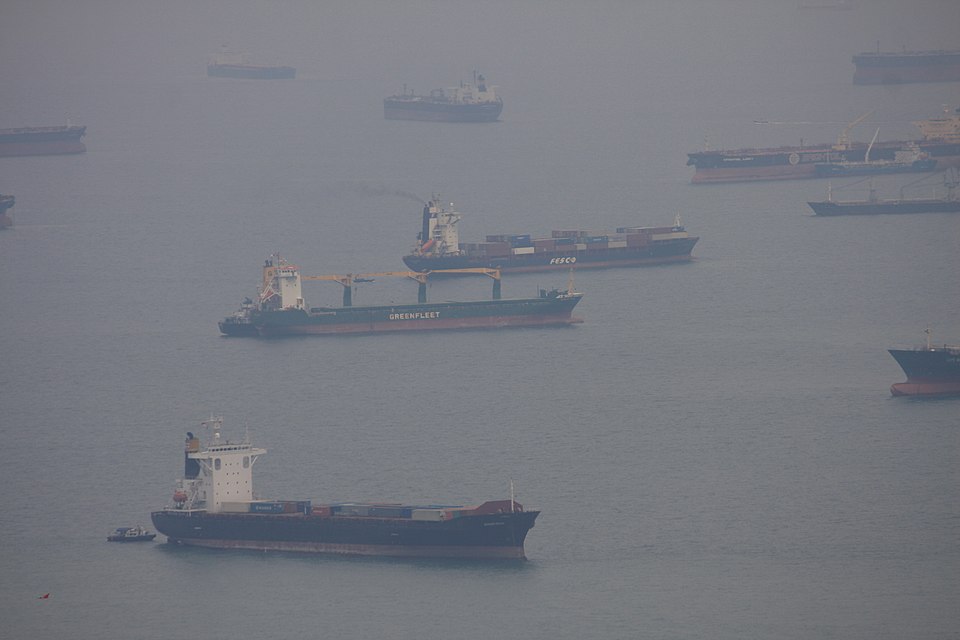
Correct — C, it is on main sea route where ships use to anchor for refueling, watering and taking food items. That is what a port of call is — a halt on a long voyage where a vessel takes on fuel, fresh water and provisions and may make small repairs, rather than a destination where its cargo is loaded or discharged. Singapore sits at the southern end of the Strait of Malacca, on the shortest route between the Indian Ocean and the Pacific, so almost everything moving between the two passes its door. It is today the world's largest bunkering port, which is the modern form of exactly the function the option describes.
- (a)it deals in the processing and shipping of oil — That describes an oil port, of the kind Abadan or Maracaibo are. Singapore does refine and trade a great deal of oil, but the classification the question wants turns on why ships stop there, not on what it processes.
- (b)it is a deep water port built away from the actual port — This is the definition of an outport — and so is option (d). The examiner has split one definition across two options, which means a candidate who knows what an outport is can strike out both at once.
- (d)it serves the parent ports by receiving the ships which are unable to approach due to their large size — The other half of the outport definition. An outport exists because its parent harbour is too shallow for modern vessels, which is the opposite of Singapore's position on the world's busiest sea lane.
Ports are classified by the function they perform rather than by their size. An entrepot collects goods for re-export. An oil port handles crude and refined products. A packet station runs short passenger and mail crossings. A naval port serves warships. An outport is a deep-water harbour built downstream or offshore because the parent port cannot take large ships. A port of call is a scheduled stop on a long route for fuel, water and stores.
Geography rather than industry makes a port of call. The classic examples are all on chokepoints or on long ocean crossings with nowhere else to stop — Aden at the mouth of the Red Sea, Honolulu in the mid-Pacific, Cape Town on the old route round Africa, and Singapore on the Malacca route. Two of those illustrate how fragile the status is: Aden's traffic collapsed when the Suez Canal closed in 1967 and never fully returned, and Cape Town lost most of its calls when the canal made the route round the Cape unnecessary for ordinary cargo. Singapore's position has held because the strait it commands has no practical alternative, and the city has built refining, transhipment and repair capacity on top of the original bunkering business.
- A port of call is a stop on a main sea route where ships take on fuel, water and provisions rather than cargo.
- Singapore stands at the southern end of the Strait of Malacca, the shortest sea link between the Indian Ocean and the Pacific.
- An outport is a deep-water harbour built away from a parent port that cannot receive large vessels.
- An entrepot collects goods for storage and re-export rather than for local consumption.
- Singapore is the largest bunkering port in the world, which is the modern form of the port-of-call function.
- Picking the option that names a real activity at the port rather than the one that defines the category asked for.
- Missing that two options can describe the same category, which is what happens with the outport here.
- Confusing an entrepot with a port of call — one handles goods, the other handles ships.
Definition-by-example items give a famous place and four category definitions. Sort the definitions first and match the place to the surviving one.
Which one of the following can one come across if one travels through the Strait of Malacca?
- (a) Bali
- (b) Brunei
- (c) Java
- (d) Singapore
Answer(d) Singapore
The geography that produces the answer here. Singapore is a port of call because it sits on the Malacca route, and that item fixes the location which this one asks you to explain.
- practice — not a real PYQ
A port that collects goods from many countries for storage and re-export rather than for domestic use is called
- (a)an outport
- (b)an entrepot
- (c)a packet station
- (d)a port of call
Answer(b) an entrepot — Singapore and Rotterdam are the standard examples.
- practice — not a real PYQ
The Strait of Malacca lies between
- (a)the Malay Peninsula and Sumatra
- (b)Java and Borneo
- (c)Sri Lanka and the Indian mainland
- (d)the Arabian Peninsula and Africa
Answer(a) the Malay Peninsula and Sumatra — Singapore stands at its southern end.