
Which one of the following was recognized as 'invisible hand' by Adam Smith?
- (a)Government
- (b)Market/Price Mechanism
- (c)Judiciary
- (d)Legislature
Correct — B, Market/Price Mechanism. Adam Smith used the phrase once in the Wealth of Nations, in 1776, to describe how a trader pursuing only his own gain is led as if by an invisible hand to promote an end that formed no part of his intention. The hand is a metaphor for the price mechanism. Prices carry information about scarcity and about what people want, and buyers and sellers responding to them independently produce a co-ordinated outcome that nobody planned. The whole force of the image is that the co-ordination happens without a director, which is why none of the three institutions offered can be it.
- (a)Government — The opposite of Smith's point. He raised the metaphor to argue that the useful ordering of economic life does not require anyone to direct it, and he was sceptical of the statesman who thought he could allocate capital better than its owners.
- (c)Judiciary — Smith did think a legal order was necessary for exchange to work at all, but courts enforce contracts after the fact. They do not do the allocating that the invisible hand describes.
- (d)Legislature — A visible and deliberate hand by definition. Legislation is exactly the kind of conscious direction the metaphor was set against.
Smith's argument is that self-interest and public benefit need not conflict in a competitive market. A baker bakes for his own income; a buyer who wants bread finds it; the price of flour tells the miller how much to grind. Each decision is private and none of them is coordinated, yet the pattern that emerges allocates resources towards what people are willing to pay for. Later economists formalised this as the claim that competitive markets can reach an efficient allocation.
Two refinements are worth carrying. First, Smith did not think the hand worked everywhere. He argued for public provision of defence, justice, education and works that private profit would not supply, and he was blunt about the tendency of merchants to conspire against the public. Second, the modern qualification is the theory of market failure — the hand does not deliver where there are externalities, public goods, monopoly power or badly asymmetric information, which is why pollution, vaccination and financial regulation are the standard counter-examples. The Wealth of Nations was published in 1776, the same year as the American Declaration of Independence, and Smith's earlier Theory of Moral Sentiments of 1759 also carries the phrase.
- Adam Smith published An Inquiry into the Nature and Causes of the Wealth of Nations in 1776.
- The invisible hand stands for the market or price mechanism, which coordinates independent decisions without a central director.
- Smith also argued for state provision of defence, justice, education and public works that private profit would not supply.
- The phrase appears in his earlier Theory of Moral Sentiments of 1759 as well as in the Wealth of Nations.
- Externalities, public goods, monopoly and asymmetric information are the standard cases in which the mechanism fails to deliver an efficient outcome.
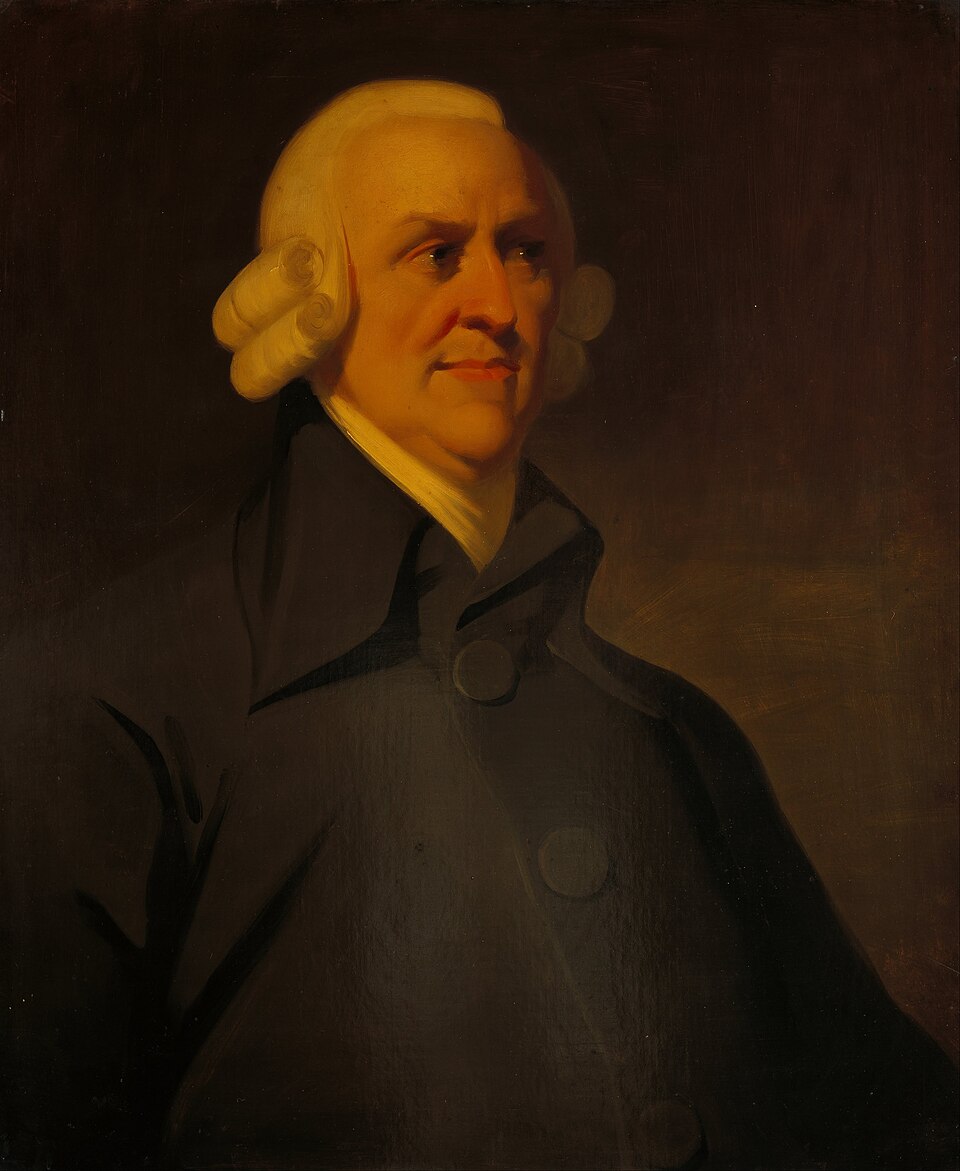
- Reading the invisible hand as a hidden authority rather than as the absence of one.
- Attributing to Smith a blanket opposition to all state activity.
- Confusing the invisible hand with the profit motive; the motive is the input, the coordination is the result.
Attribution items in this paper pair a famous phrase with a famous name; the safest preparation is to know the sentence the phrase comes from, not just the name attached to it.
Who among the following, first mooted the idea of deficit financing ?
- (a) Adam Smith
- (b) Alfred Marshall
- (c) John Maynard Keynes
- (d) Milton Friedman
Answer(c) John Maynard Keynes
- practice — not a real PYQ
The book An Inquiry into the Nature and Causes of the Wealth of Nations was published in
- (a)1759
- (b)1776
- (c)1798
- (d)1817
Answer(b) 1776 — Smith's earlier Theory of Moral Sentiments appeared in 1759.
- practice — not a real PYQ
Which one of the following is NOT usually treated as a case of market failure?
- (a)Pollution from a factory
- (b)National defence
- (c)A competitive market for wheat
- (d)A natural monopoly in water supply
Answer(c) A competitive market for wheat — many buyers and sellers with good information is the case in which the price mechanism works as advertised.