
A long narrow stretch of sand and/or shingle with one end attached to the mainland is called
- (a)Sand spit
- (b)Sand bar
- (c)Sand dune
- (d)Tombolo
Correct — A, Sand spit. A spit is a ridge of sand or shingle built by longshore drift, attached to the land at one end and running out into open water at the other, often with a hooked or curved free end where waves refract round it. The stem's two conditions — long and narrow, and joined to the mainland at one end only — describe exactly that.
- (b)Sand bar — A bar runs right across a bay or the mouth of an inlet and is not attached to the mainland at one end alone. Where a spit grows until it seals a bay it becomes a bar, often enclosing a lagoon behind it.
- (c)Sand dune — A dune is a mound of sand built by wind rather than by waves and currents, and it is not a stretch running out into water.
- (d)Tombolo — A tombolo does join land to land, but it links an offshore island to the mainland, so it is attached at both ends rather than one.
Waves approaching a coast at an angle move sediment along it in a zigzag, a process called longshore drift. Where the coastline turns sharply or an estuary interrupts it, the drifting material carries on in its old direction and is deposited in open water, building a ridge outward from the land. That ridge is a spit, and its shape records the direction of the drift.
The family of depositional coastal landforms is best learnt by how each one is attached. A spit is fixed at one end; a bar is detached or spans a bay; a tombolo joins an island to the shore; a barrier island lies offshore with a lagoon behind it. India's coasts show the whole set, with the sand bars and spits along the Odisha and Kerala coasts enclosing the lagoons of Chilika and Vembanad. Set against these, erosional forms such as cliffs, caves, arches and stacks are the products of removal rather than deposition.
- A spit is a depositional ridge of sand or shingle attached to the land at one end, built by longshore drift.
- A bar spans a bay or inlet and commonly encloses a lagoon behind it.
- A tombolo is a depositional bridge linking an offshore island to the mainland.
- Sand dunes are wind-built and belong to aeolian rather than marine deposition.
- Stacks, arches, caves and cliffs are erosional coastal features, not depositional ones.
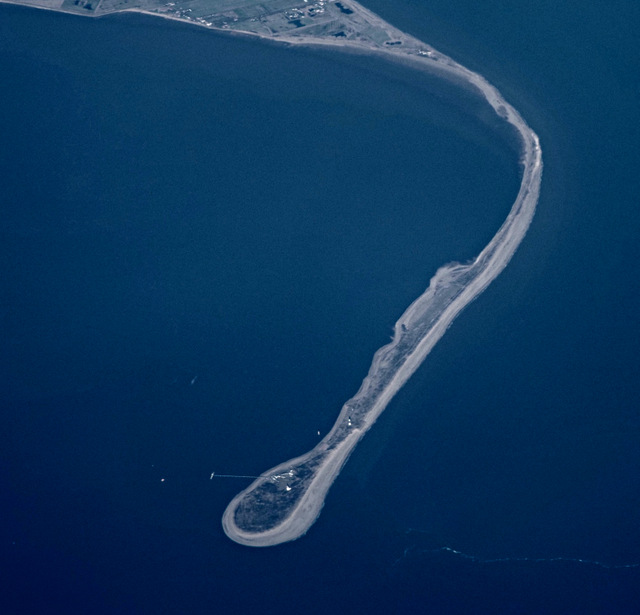
- Confusing a spit with a bar; the difference is whether one end remains attached to the mainland.
- Treating a tombolo as a spit because both are ridges of deposited material.
- Placing sand dunes among marine landforms when they are built by wind.
A definition-to-landform item. The attachment described in the stem is always the discriminating detail, so it is worth reading before the options.
Which one of the following is NOT a coastal depositional feature ?
- (a) Tombolo
- (b) Sand bar
- (c) Stack
- (d) Spit
Answer(c) Stack
The same family tested by exclusion. Tombolo, sand bar and spit are all depositional, which is why that key falls on the stack — and separating the three depositional forms from each other is exactly the work this item asks for.
Which of the following statements regarding barrier islands is/are correct? 1. These are small chain of sand islands that form offshore, far from the coast. 2. Lagoons or shallower marshes separate the barrier islands from the mainland. 3. Such locations are hazardous for settlements because they are easily swept away by storms and hurricanes. Select the correct answer using the code given below.
- (a) 1 only
- (b) 1 and 2 only
- (c) 2 and 3 only
- (d) 1, 2 and 3
Answer(c) 2 and 3 only
The neighbouring landform in the same series. A barrier island lies offshore with a lagoon behind it, so it is attached at neither end — the opposite extreme from the tombolo, with the spit in between.
- practice — not a real PYQ
A depositional ridge of sand or shingle that connects an offshore island to the mainland is called
- (a)a spit
- (b)a tombolo
- (c)a bar
- (d)a stack
Answer(b) a tombolo — attached at both ends, which is what distinguishes it from a spit.
- practice — not a real PYQ
Chilika, the largest coastal lagoon in India, is separated from the Bay of Bengal mainly by
- (a)a sand bar
- (b)a coral reef
- (c)a cliff line
- (d)a delta
Answer(a) a sand bar — a long depositional ridge that has all but closed the lagoon off from the open sea.