
What is the value of the missing number?
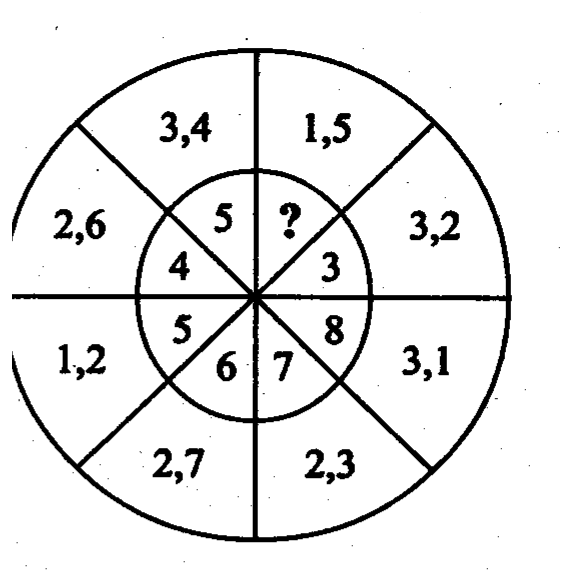
- (a)9
- (b)7
- (c)5
- (d)3
Correct — A, 9. Each inner number is the sum of the outer pair in the sector diametrically opposite it, not the one it sits inside. Check it on the sectors that are fully printed: the outer pair 2,3 sits opposite the inner 5, and 2 + 3 = 5; the outer pair 3,4 sits opposite the inner 7, and 3 + 4 = 7; the outer pair 1,2 sits opposite the inner 3, and 1 + 2 = 3; the outer pair 3,2 sits opposite the inner 5 on the other side, and 3 + 2 = 5; the outer pair 2,6 sits opposite the inner 8, and 2 + 6 = 8; the outer pair 3,1 sits opposite the inner 4, and 3 + 1 = 4. The rule holds on every sector that can be checked. The missing inner number sits opposite the outer pair 2,7, so it is 2 + 7 = 9.
- (b)7 — Seven is the sum of the outer pair 3,4 — the pair in the sector diagonally across the centre from the 2,7 sector rather than opposite the empty cell. It is the answer to the wrong sector.
- (c)5 — Five is what you get by adding the outer pair 1,5 that sits in the same sector as the missing number. That is the natural first guess, and it is exactly the relationship the puzzle does not use — every checkable sector disproves it.
- (d)3 — Three is the difference of the outer pair in the same sector, 5 − 1 + ... no printed sector follows a difference rule; the six checkable sectors all follow the opposite-sector sum.
A figure-based number puzzle where the relationship to be found is positional. The arithmetic is trivial addition; the whole difficulty is deciding which cells the rule connects.
The item is unanswerable from its stem alone — 'What is the value of the missing number?' carries no information — so the figure is the question. It sat unpublished on this site until the diagram was recovered from the printed booklet.
- The rule is opposite-sector, not same-sector: inner value = sum of the outer pair diametrically across the circle.
- Six of the seven filled sectors can be verified independently, which is what makes the rule safe to extend to the eighth.
- The same-sector sum (1 + 5 = 6) matches no printed inner value anywhere in the figure, which is how you rule that reading out.
- Assuming the rule links cells that are physically adjacent — here it links cells that are as far apart as possible.
- Stopping after one sector appears to fit. A rule that explains only one cell is a coincidence, not a rule.
Circle-and-sector puzzles recur in the CAPF reasoning block. The examinable skill is testing a candidate relationship against every filled cell before committing, because these figures usually plant a same-cell reading that fails on the second check.
No directly related past PYQ was found.
- practice — not a real PYQ
In a circle of eight sectors, each inner cell equals the sum of the outer pair opposite it. If the outer pair opposite an empty inner cell reads 4,6, what belongs in that cell?
- (a)2
- (b)10
- (c)24
- (d)46
Answer(b) 10