
Name of first 3d printed humanoid robot in India is
- (a)Mitra
- (b)Manav
- (c)Robcop
- (d)Indro
Correct — B, Manav. Manav is documented as India's first completely indigenous 3D-printed humanoid robot, developed by Diwakar Vaish and his team as Head of Robotics and Research at the A-SET Training and Research Institutes in New Delhi. It was built in late 2014 and early 2015 and unveiled at that season's college technology festivals, and Livemint carried it under the headline 'Meet Manav, India's first 3D-printed humanoid robot' on 28 January 2015. The name itself is the memory hook — manav is Hindi for 'human', which is exactly what a humanoid robot is meant to resemble. Two things about it are worth separating, because the question compresses them. Being 3D-printed means the body was made by additive manufacturing — built up layer by layer in plastic from a digital model — rather than moulded or machined, which is what made a small research humanoid affordable to build in an institute rather than a factory. Being a humanoid means it has a human body plan: a head, a torso and two legs, and Manav was designed to walk, respond to voice commands, and process sound and vision. Its designer's other work runs along the same line — India's first mind-controlled robot, and the world's first production brain-controlled wheelchair, developed in 2016 for patients with locked-in syndrome. Of the other three options only one names a real Indian robot at all.
- (a)Mitra — A genuine Indian humanoid, and the only serious distractor here — Mitra, from the Hindi word for 'friend', was designed and built by the Bengaluru start-up Invento Robotics as a service and reception robot, and it became famous for greeting dignitaries at a global entrepreneurship summit in Hyderabad. But it is a later machine built for customer-facing work, not a 3D-printed research humanoid, and it is not India's first of anything.
- (c)Robcop — Not an Indian robot at all. The name is an obvious echo of RoboCop, the 1987 film character, and that borrowed familiarity is the whole trick — it sounds like a robot because it is the name of a fictional one. India does have police robots, deployed by State forces under their own names, but none of them is called this and none is a 3D-printed humanoid.
- (d)Indro — A manufactured name with no documented Indian robot behind it. It is built to sound plausible by prefixing 'Ind-' for India onto a robot-like ending, which is a common way of padding an option list in a technology question. When two of four options are inventions of this kind, the real discrimination is between the remaining two.
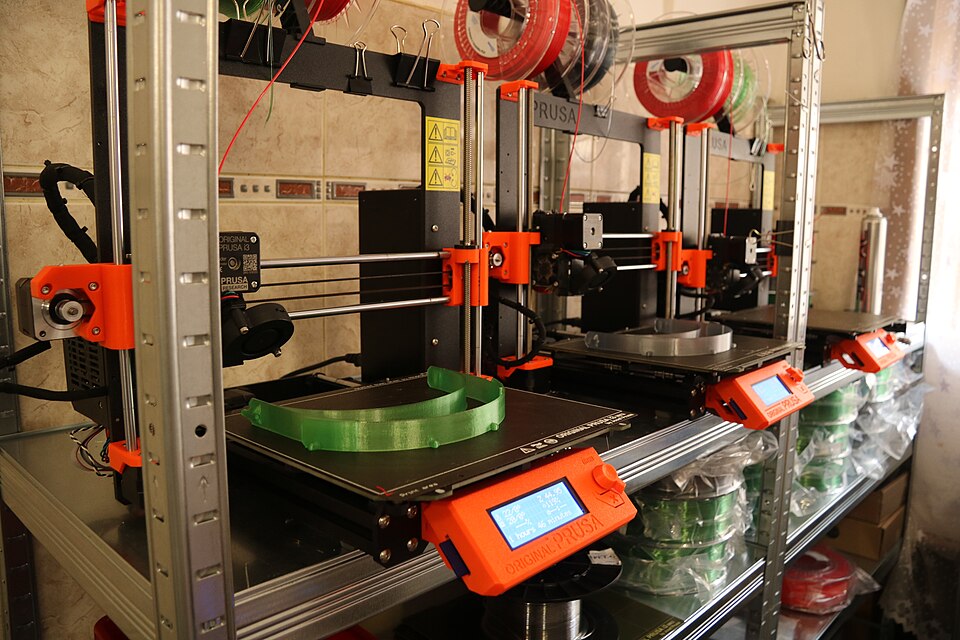
3D printing, more formally additive manufacturing, builds an object by depositing material layer upon layer from a three-dimensional digital model, instead of cutting material away from a block or forcing it into a mould. That reversal has three consequences that matter. Complexity becomes free — an intricate internal structure costs no more to print than a solid one, because the printer simply follows a different path. Tooling disappears — there is no mould to make, so a single prototype is as economical as the thousandth unit, which is why research labs, and a robotics institute in Delhi, can build custom parts that would once have needed a factory. And design iteration collapses from months to days. The technology now runs well beyond plastic prototypes: printed titanium components fly in aero-engines, printed polymer scaffolds are used in tissue engineering, printed concrete has been used for housing, and printed food and printed drug dosage forms are in trials. India's policy interest is formal — the Ministry of Electronics and Information Technology issued a National Strategy on Additive Manufacturing in 2022 — and the technology sits alongside robotics, artificial intelligence and the Internet of Things in the cluster examiners now treat as a single current-affairs area.
Technology current-affairs questions like this one are usually decided by recognising which options are real rather than by knowing the answer outright. Here two of the four names are inventions — one lifted from a film, one assembled from a country prefix — so the question reduces to Mitra against Manav. Between those two, use the qualifier in the stem: it asks for the first *3D-printed* humanoid, and Mitra is known for what it does, greeting and guiding people, not for how it was made. Manav is known precisely for how it was made. A general habit follows: when a stem carries a technical qualifier, treat the qualifier as the discriminator rather than as decoration, because the setter put it there to separate two real candidates. And a caution about firsts — 'first in India' claims should be attached to a date and a place, which here are New Delhi and early 2015; a first without a date is usually somebody's marketing.
- Manav is India's first completely indigenous 3D-printed humanoid robot, developed by Diwakar Vaish at the A-SET Training and Research Institutes, New Delhi, in late 2014 and early 2015.
- Livemint reported it on 28 January 2015 under the headline 'Meet Manav, India's first 3D-printed humanoid robot'; it was launched publicly at college technology festivals that season.
- Its developer also built India's first mind-controlled robot and, in 2016, the world's first production brain-controlled wheelchair, intended for patients with locked-in syndrome.
- Mitra — Hindi for 'friend' — is a separate humanoid service robot designed and developed by the Bengaluru start-up Invento Robotics, not a 3D-printed research machine.
- 3D printing, or additive manufacturing, builds an object layer by layer from a digital model, which removes tooling costs and makes a one-off custom part as economical as a mass-produced one.
- Choosing Mitra because it is the Indian robot most people have seen in the news. Mitra is a service robot from Bengaluru; the 3D-printed first is Manav.
- Being reassured by a name that sounds like a robot. 'Robcop' echoes a film character and 'Indro' is manufactured — recognising invented options is half the work in a technology question.
- Ignoring the technical qualifier in the stem. '3D printed' is what separates the two real candidates, and it refers to how the machine was made, not what it does.
BPSC asks technology current affairs as a name-recall item and pads the option list with invented names, so the practical skill is telling real products from plausible-sounding ones. UPSC does not ask for product names; it asks what a technology is and what it can do — the properties of additive manufacturing, or what a named application area actually involves.
What is the full form of GPT in ChatGPT, recently seen in the news?
- (a) Glutamic Pyruvic Transaminase
- (b) GUID Partition Table
- (c) Grooved Pegboard Test
- (d) Generative Pre-Trained Transformer
Answer(d) Generative Pre-Trained Transformer
The same species of technology current-affairs item — one recently newsworthy name, with an option list padded by real-sounding alternatives drawn from other fields. Both are decided by whether the candidate can tell the genuine term from the plausible one.
- practice — not a real PYQ
Additive manufacturing, commonly called 3D printing, differs from conventional machining chiefly because it
- (a)Removes material from a solid block to produce the shape
- (b)Builds the object layer by layer from a digital model
- (c)Requires a mould to be prepared in advance
- (d)Can only be used with metals
Answer(b) Builds the object layer by layer from a digital model — which is why it needs no tooling or mould and makes a single custom part as economical as a mass-produced one.
- practice — not a real PYQ
Mitra, the humanoid robot that gained attention for greeting visitors at public events in India, was developed by
- (a)A-SET Training and Research Institutes, New Delhi
- (b)Invento Robotics, Bengaluru
- (c)ISRO, Bengaluru
- (d)DRDO, Hyderabad
Answer(b) Invento Robotics, Bengaluru — a start-up building service and reception robots. Manav, India's first 3D-printed humanoid, came from A-SET in New Delhi.