
Which is the Scotland of North-East India ?
- (a)Nagaland
- (b)Meghalaya
- (c)Assam
- (d)Arunachal Pradesh
Correct — B, Meghalaya. The epithet is documented and its origin is specific. Wikipedia's account of Shillong records that 'the rolling hills around the town reminded the British of Scotland. Hence, they would refer to it as the "Scotland of the East"', and the same source notes that during British rule the authorities applied the nickname to Meghalaya itself. The resemblance the officers were reacting to is real: Shillong sits at over 1,400 metres in the East Khasi Hills, surrounded by grassy uplands, pine woods and lakes, with a cool, wet, cloud-heavy climate quite unlike the plains below — and Shillong was the capital of the whole of Assam province from 1874 until 1972, so it was where the British administration of the region actually lived. The state around it was created in stages: an autonomous state within Assam from 2 April 1970 under the Assam Reorganisation (Meghalaya) Act, 1969, and then full statehood on 21 January 1972 under the North-Eastern Areas (Reorganisation) Act, 1971, carved out of the united Khasi and Jaintia Hills and the Garo Hills. Its name, coined by the geographer S. P. Chatterjee in 1936, is Sanskrit for 'the abode of clouds' — which is the second thing everyone knows about it, and the reason the state is also home to the wettest inhabited places on earth. Each of the other three north-eastern states carries a different and equally well-known epithet.
- (a)Nagaland — Nagaland is conventionally the 'Land of Festivals', for the Hornbill Festival held every December at Kisama and for the festival calendar of its sixteen major tribes. Its hills are as green and as high as Meghalaya's, which is what makes it a plausible guess, but the Scotland tag has always belonged to Shillong, where the British actually had their headquarters.
- (c)Assam — Assam's epithets come from its river and its plantations — the 'Land of the Red River and Blue Hills', and the tea garden of India. It is the state from which Meghalaya was carved in 1972, and Shillong was Assam's own capital until then, which is exactly why a candidate can end up attaching a Shillong nickname to Assam. The hill station moved out of Assam with the new state; the nickname went with it.
- (d)Arunachal Pradesh — Arunachal Pradesh is the 'Land of the Dawn-lit Mountains' — a translation of its own name — and is also called the Orchid State of India. It is the easternmost state, the first in the country to see the sunrise, and its terrain is genuinely Himalayan rather than a plateau of rolling hills, so the Scottish comparison was never made about it.
Meghalaya is a plateau state, not a Himalayan one, and that is what gives it both its landscape and its climate. The Khasi, Jaintia and Garo Hills are a detached block of the peninsular shield that stands in the way of the monsoon coming off the Bay of Bengal across the plains of Bangladesh. Warm, saturated air is forced abruptly upward against the southern face of that block, and the result is the heaviest rainfall recorded anywhere in the inhabited world, at Mawsynram and Sohra (Cherrapunji). The same rain has produced the state's most distinctive engineering: living root bridges, grown over decades by training the aerial roots of rubber figs across streams. Meghalaya is also one of the few large societies in India that is matrilineal — descent and inheritance pass through women, and among the Khasi the youngest daughter inherits the ancestral property and cares for the parents. English, Khasi and Garo are its official languages. All of this sits inside the Sixth Schedule framework of autonomous district councils, which governs tribal areas in Assam, Meghalaya, Tripura and Mizoram.
Nickname questions are solved by holding the whole family of epithets rather than the one asked, because the setter's wrong options are always other real nicknames belonging to the same region. For the north-east the working list is short: Meghalaya is the Scotland of the East, Nagaland the Land of Festivals, Arunachal Pradesh the Land of the Dawn-lit Mountains or Orchid State, Assam the Land of the Red River and Blue Hills, Manipur the Jewel of India or Switzerland of the East, Tripura the Land of Fourteen Deities, Sikkim the Valley of Rice. If the list has gone, one indirect route remains: ask where the British actually lived in the region, because these epithets are colonial in origin and were coined about places officers knew. That was Shillong, the capital of Assam province from 1874 and of Meghalaya since 1972, and the answer follows. Note that BPSC asks two nickname questions within twenty places on this same paper — the Playground of Europe and this one — which tells you how reliably the category recurs.
- Shillong's nickname 'Scotland of the East' comes from the rolling hills around the town reminding British officials of Scotland; the British applied the name to Meghalaya as a whole.
- Meghalaya became an autonomous state within Assam on 2 April 1970 under the Assam Reorganisation (Meghalaya) Act, 1969, and attained full statehood on 21 January 1972 under the North-Eastern Areas (Reorganisation) Act, 1971.
- The state was formed from the united Khasi and Jaintia Hills and the Garo Hills; the name, Sanskrit for 'abode of clouds', was coined by the geographer S. P. Chatterjee in 1936.
- Meghalaya covers about 22,429 sq km, has English, Khasi and Garo as official languages, and follows a matrilineal system in which the youngest daughter inherits the ancestral property.
- Mawsynram and Sohra (Cherrapunji) in the Khasi Hills record the heaviest rainfall of any inhabited place on earth, caused by monsoon air forced up against the southern face of the plateau.
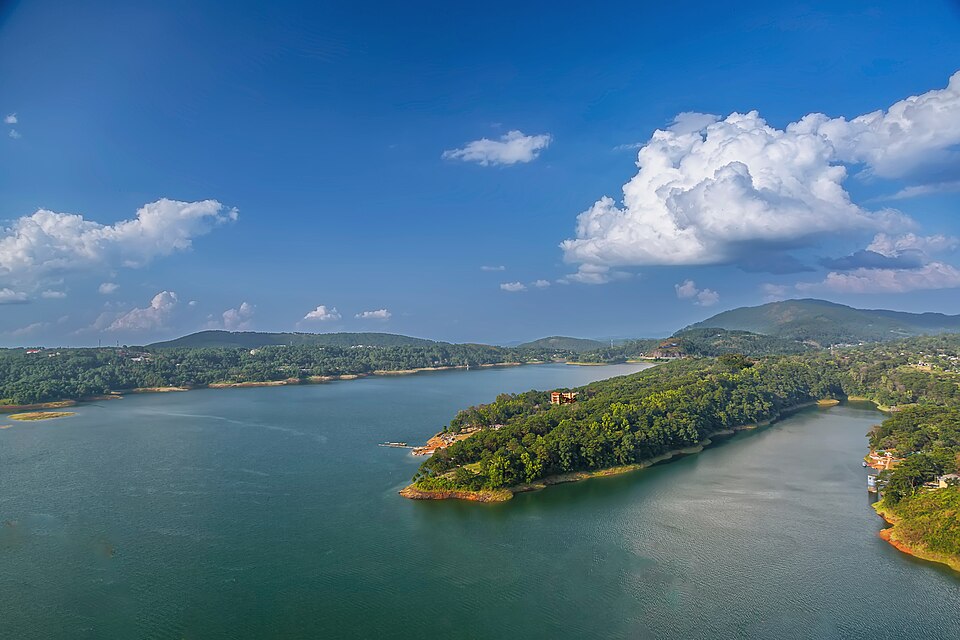
- Choosing Assam because Shillong was Assam's capital until 1972. The town, and the nickname with it, went to Meghalaya when the new state was formed.
- Assuming a hill state must be Himalayan. Meghalaya's hills are a detached block of the peninsular plateau, which is why the terrain rolls rather than soars.
- Guessing on green scenery. Every north-eastern state has green hills; the epithets are colonial conventions attached to particular places, not descriptions to be inferred.
BPSC asks epithets bare and repeatedly, and this paper carries two of them within twenty questions — the Playground of Europe at Q52 and this one — with the wrong options drawn from neighbouring states that carry different nicknames. UPSC does not ask nicknames; where the North-East appears in its papers it is through the Sixth Schedule, autonomous councils, rainfall regimes or boundary questions.
Which one of the following is known as the “Coffee port” of the world?
- (a) Sao Paulo
- (b) Santos
- (c) Rio de Janeiro
- (d) Buenos Aires
Answer(b) Santos
The same species of question — a place named only by the epithet convention has attached to it, with three neighbours from the same region offered beside it. Nothing about Santos can be deduced from geography, and nothing about Shillong can be deduced from scenery; both are conventions to be learned.
- practice — not a real PYQ
Meghalaya attained full statehood in which year ?
- (a)1963
- (b)1970
- (c)1972
- (d)1987
Answer(c) 1972 — full statehood on 21 January 1972 under the North-Eastern Areas (Reorganisation) Act, 1971. It had been an autonomous state within Assam from 2 April 1970; Nagaland became a state in 1963, and Arunachal Pradesh and Mizoram in 1987.
- practice — not a real PYQ
Which State of India is known as the 'Land of the Dawn-lit Mountains' ?
- (a)Sikkim
- (b)Arunachal Pradesh
- (c)Nagaland
- (d)Manipur
Answer(b) Arunachal Pradesh — the phrase translates its own name, and the state is also called the Orchid State of India.