
Choose the odd pair among the following options.
- (a)Thar : India
- (b)Sahara : Africa
- (c)Kalahari : America
- (d)Gobi : Mongolia
Correct — C, Kalahari : America. The relation running through the list is desert-to-place, and three of the four pairs hold while one does not. The Kalahari is not American: it is a large semi-arid sandy savanna in southern Africa covering about 900,000 sq km, taking in much of Botswana together with parts of Namibia and South Africa. Placing it in America is a straightforward error of continent, and it is the only error on the list. Check the other three in turn. The Thar, the Great Indian Desert, covers 264,091 sq km of which 195,091 sq km lie inside India, principally in western Rajasthan, with the remainder in Pakistan — so 'Thar : India' is right, and its being shared with a neighbour does not make it wrong. The Sahara, at about 9.2 million sq km the largest hot desert on earth, spans northern Africa from the Atlantic to the Red Sea, so 'Sahara : Africa' is right. The Gobi, about 1,295,000 sq km of cold desert, lies across southern Mongolia and northern China, so 'Gobi : Mongolia' is right on the same shared-territory reasoning that validates the Thar. The deserts that would have made option (c) true are American ones the setter deliberately left out — the Atacama in Chile, the Sonoran, Mojave and Chihuahuan of North America, the Great Basin, and the Patagonian desert of Argentina. None of them is the Kalahari.
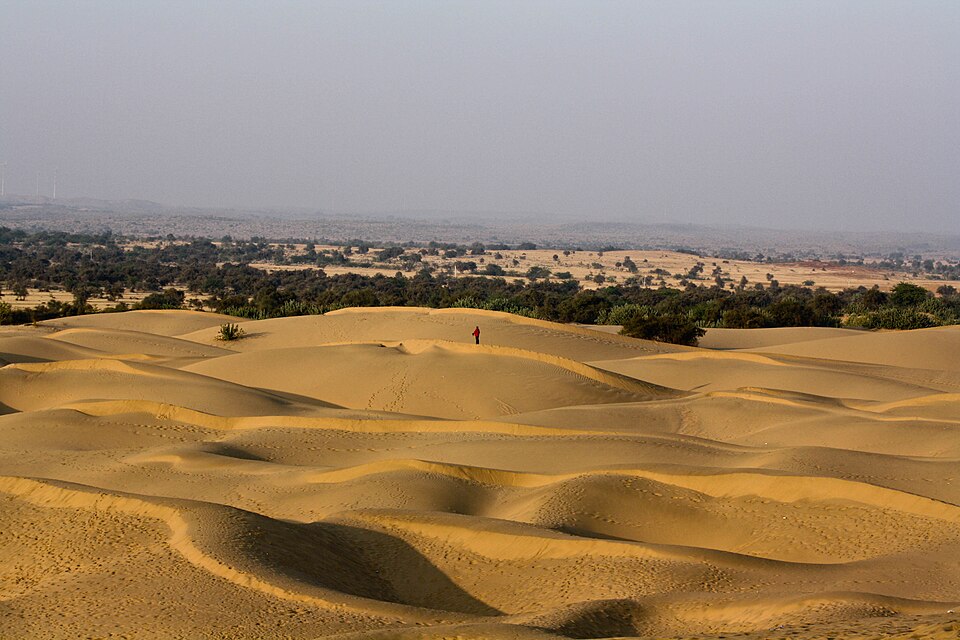
- (a)Thar : India — Correctly matched, so it cannot be the odd one. The Thar covers 264,091 sq km in all, with 195,091 sq km — roughly three-quarters — inside India, spread over western Rajasthan and reaching into Gujarat, Haryana and Punjab, and the rest in Pakistan's Sindh and Punjab. A candidate may hesitate because it is a transboundary desert, but the pair asks where the Thar is, not where it is exclusively.
- (b)Sahara : Africa — Correctly matched and the least disputable pair on the list. The Sahara covers about 9.2 million sq km of northern Africa, making it the largest hot desert in the world and roughly the size of the United States or of China. It is here as a control — an obviously true pair against which the reader is meant to calibrate the others.
- (d)Gobi : Mongolia — Correctly matched. The Gobi covers about 1,295,000 sq km across southern Mongolia and the northern part of China's Inner Mongolia, and it is a cold desert — its aridity comes from the rain shadow of the Himalaya and from sheer distance inland, not from tropical high pressure. The pairing with Mongolia is exactly how it is named and taught.
Deserts are defined by aridity rather than by heat, and the world's major ones fall into three groups by the mechanism that dries them. Tropical or subtropical deserts sit near 20 to 30 degrees latitude in the belt of descending air of the subtropical high, and typically hug the western margins of continents inside the trade-wind belt, where cold offshore currents strengthen the aridity — the Sahara, the Kalahari and Namib, the Australian deserts, the Atacama. Continental or mid-latitude deserts are dry because they lie far from any ocean and behind mountain barriers — the Gobi and the Taklamakan sit in that class, which is why they are cold deserts with freezing winters. Rain-shadow deserts are dried by a mountain wall — Ladakh's cold desert behind the Great Himalaya is India's example. The Thar is a partial exception that is worth understanding rather than memorising: it lies in the monsoon's path, but the moisture-bearing Arabian Sea current runs parallel to the Aravallis instead of being lifted by them, so the rain falls elsewhere.
An odd-pair question is solved by naming the relation first and then testing each pair against it, never by looking for the pair that feels wrong. Here the relation is desert-to-location, so the test is a single question asked four times: is that desert there? Three answers are yes and one is no. Two traps are built into that process. The first is the transboundary desert: both the Thar and the Gobi straddle an international border, which tempts a candidate to call one of them 'odd' for being incompletely described — but a pair that names a real location of the desert is not an error. The second is the continent confusion at the heart of option (c), which trades on Kalahari and Kalahari-sounding names being less familiar than Sahara. Keep a short mental map of deserts by continent: Africa has the Sahara, Kalahari and Namib; Asia the Thar, Gobi, Taklamakan, Karakum, Kyzylkum and Arabian; the Americas the Atacama, Sonoran, Mojave, Chihuahuan, Great Basin and Patagonian; Australia the Great Victoria, Great Sandy, Simpson and Gibson.
- The Kalahari is a semi-arid sandy savanna of southern Africa covering about 900,000 sq km, taking in much of Botswana and parts of Namibia and South Africa.
- The Thar covers 264,091 sq km in all, of which 195,091 sq km lie in India — chiefly western Rajasthan — and the rest in Pakistan.
- The Sahara covers about 9.2 million sq km of northern Africa and is the largest hot desert in the world.
- The Gobi covers about 1,295,000 sq km across southern Mongolia and northern China and is a cold desert, dried by continentality and rain shadow rather than by tropical high pressure.
- The deserts of the Americas are the Atacama in Chile, the Sonoran, Mojave, Chihuahuan and Great Basin of North America, and the Patagonian desert of Argentina — none of which is the Kalahari.
- Calling a transboundary desert an incorrect pair. Both the Thar and the Gobi cross an international border, and naming one of the two countries is not an error.
- Assuming a cold desert cannot be a desert. The Gobi has freezing winters; aridity, not heat, is the defining criterion.
- Solving an odd-pair question by intuition instead of by stating the relation. Name the relation first — here, desert to location — then test all four pairs against it.
BPSC prints odd-pair questions with the identical stem across editions — the 69th CCE of September 2023 used the same wording on a vocabulary set — and fills them with one-line general-knowledge pairs, so the technique matters more than the subject. UPSC does not ask odd-pair items on deserts; it asks why deserts occur where they do, such as whether tropical deserts lie along the western margins of continents in the trade-wind belt.
Consider the following statements : 1. In the world, the tropical deserts occur along the western margins of continents within the trade wind belt. 2. In India, the East Himalayan region gets high rainfall from north-east winds. Which of the statements given above is/are correct ?
- (a) 1 only
- (b) 2 only
- (c) Both 1 and 2
- (d) Neither 1 nor 2
Answer(a) 1 only
The reasoning that lies underneath a desert-location list. Once you know tropical deserts form on the western margins of continents in the trade-wind belt, the Kalahari's position in southern Africa — beside the Namib on the Atlantic coast — stops being a fact to memorise.
Find the odd pair among the following options.
- (a) Millinery : Hats
- (b) Brewery : Alcohol
- (c) Stationery : Paper
- (d) Snobbery : Shoes
Answer(d) Snobbery : Shoes
The 69th CCE of September 2023 used almost this exact stem on a vocabulary set, and the method transfers unchanged: state the relation the pairs are supposed to share — there, place-of-making to product; here, desert to location — and then test all four against it.
- practice — not a real PYQ
The Kalahari Desert lies chiefly in which country ?
- (a)Botswana
- (b)Chile
- (c)Mongolia
- (d)Sudan
Answer(a) Botswana — the Kalahari's roughly 900,000 sq km cover much of Botswana and extend into Namibia and South Africa. Chile has the Atacama, Mongolia the Gobi, and Sudan a share of the Sahara.
- practice — not a real PYQ
Which of the following is a cold desert ?
- (a)Kalahari
- (b)Sahara
- (c)Gobi
- (d)Thar
Answer(c) Gobi — a mid-latitude continental desert across southern Mongolia and northern China with freezing winters, dried by distance from the ocean and by rain shadow rather than by tropical high pressure.