
Besides spreading Malaria, Anopheles mosquito's are also vectors of
- (a)Encephalitis and Filariasis
- (b)Dengue and Filariasis
- (c)Dengue and Encephalitis
- (d)None of the above
Correct — D, None of the above. Only three diseases appear anywhere in the option set, and exactly one of them is genuinely carried by Anopheles. Lymphatic filariasis is caused by the nematodes Wuchereria bancrofti, which accounts for about ninety per cent of cases, Brugia malayi and Brugia timori, and the World Health Organization's own description lists the transmitting mosquitoes as belonging largely to the genera Aedes, Anopheles, Culex and Mansonia — Anopheles is on that list, and is the principal filariasis vector across much of rural Africa, though in India the main vector of bancroftian filariasis is Culex quinquefasciatus. The other two diseases are not Anopheles-borne at all. Dengue is a flavivirus with four serotypes and is transmitted only by Aedes aegypti and Aedes albopictus. Japanese encephalitis is a separate flavivirus transmitted by Culex mosquitoes, principally Culex tritaeniorhynchus, with pigs as amplifying hosts and ardeid water birds as the natural reservoir. Now test each printed pair as printed. Option (a) pairs filariasis, which Anopheles does carry, with encephalitis, which it does not. Option (b) pairs filariasis with dengue, which it does not. Option (c) names dengue and encephalitis, neither of which it carries. Every pair therefore contains at least one disease that Anopheles does not transmit, no pair can be accepted whole, and the answer is 'None of the above'. This is a genuinely close call and honesty requires saying so: option (a) is the near miss, because it is half right where option (c) is entirely wrong, and the item reads like a pairs rewrite of the older single-answer question whose key was simply 'filariasis'. A setter working from that original might have intended (a). We answer as the options are printed, and as printed no pair survives. Note also that the stem prints 'Anopheles mosquito's' with an apostrophe; that is the Commission's own typography, reproduced here unaltered.
- (a)Encephalitis and Filariasis — Half right, and therefore the most dangerous option. Filariasis genuinely belongs on an Anopheles list. Encephalitis does not: Japanese encephalitis is spread by Culex tritaeniorhynchus and related Culex species of the vishnui group, which breed in irrigated rice fields and feed preferentially on cattle. A pair is accepted only if both halves hold, and this one fails on its first half.
- (b)Dengue and Filariasis — Also half right and fails the same test, but at the other end. Dengue is transmitted exclusively by Aedes aegypti and Aedes albopictus — day-biting, container-breeding, urban mosquitoes with white markings on the legs, an entirely different ecology from the night-biting Anopheles of the rural plains. Filariasis is the true half here, dengue the false one.
- (c)Dengue and Encephalitis — The only option in which both halves are wrong. Dengue belongs to Aedes and Japanese encephalitis to Culex, so this pair names two diseases that Anopheles has nothing to do with. It is the option a candidate picks if they have simply memorised 'mosquito-borne diseases' as one undifferentiated list without attaching each to its genus.
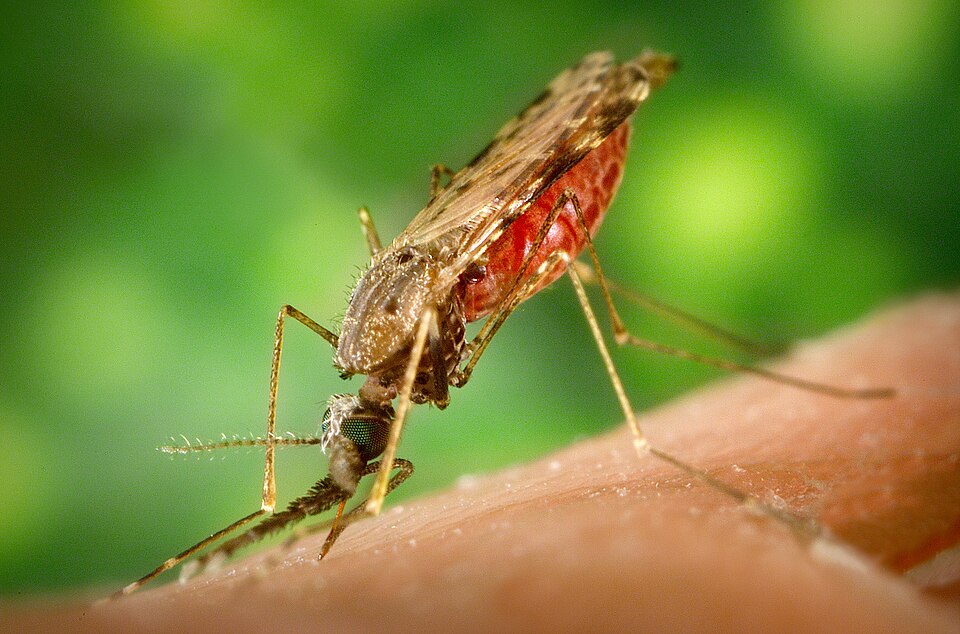
'Mosquito-borne' is not one category but four, and the whole of this topic is the mapping from genus to disease. ANOPHELES — malaria, caused by Plasmodium species and transmitted by the female Anopheles; in India the important vectors include Anopheles culicifacies in the rural plains and Anopheles stephensi in towns. Anopheles also transmits lymphatic filariasis in parts of the world. AEDES — dengue, chikungunya, yellow fever and Zika, all through Aedes aegypti and Aedes albopictus. CULEX — Japanese encephalitis, and in India the bulk of bancroftian filariasis through Culex quinquefasciatus. MANSONIA — brugian filariasis, breeding in water bodies choked with floating plants such as Pistia. The genera are told apart by behaviour as much as by markings: Anopheles rests with its body at an angle to the surface and its palps as long as the proboscis, while Culex and Aedes rest with the body roughly parallel; Anopheles lays its eggs singly with lateral floats, Culex in rafts, Aedes singly on damp surfaces above the water line. India's National Center for Vector Borne Diseases Control runs programmes against malaria, dengue, chikungunya, Japanese encephalitis, lymphatic filariasis and kala-azar — the last of which is not mosquito-borne at all but carried by the sandfly Phlebotomus argentipes, and is heavily concentrated in Bihar.
The reliable method here is to score each option half by half rather than to look for the option that feels most familiar. Write the three diseases down, attach a genus to each — filariasis: Anopheles among others; dengue: Aedes; encephalitis: Culex — then read the options. Any pair containing dengue or encephalitis is out, and once both are out no pair remains. That is what makes the escape option correct: not a hunch about the Commission's habits, but the demonstration that each of the other three fails. The word 'Encephalitis' deserves particular suspicion because it names a clinical syndrome, not a single disease. Bihar's own experience makes the point sharply: the acute encephalitis syndrome outbreaks around Muzaffarpur, locally called Chamki Bukhar, produced 647 cases and 161 deaths between 1 June and 20 September 2019, and the cause of those outbreaks remains disputed — initial testing found little sign of Japanese encephalitis virus, severe hypoglycaemia in undernourished children was the common clinical finding, and a 2017 case-control study in The Lancet Global Health linked toxins in unripe litchi to the syndrome. An 'encephalitis' can therefore be viral, bacterial, or not infectious at all, which is one more reason the word cannot simply be handed to a mosquito genus.
- Lymphatic filariasis is caused by Wuchereria bancrofti (about 90 per cent of cases), Brugia malayi and Brugia timori, and is transmitted by mosquitoes largely of the genera Aedes, Anopheles, Culex and Mansonia.
- In India the principal vector of bancroftian filariasis is Culex quinquefasciatus, not Anopheles; Mansonia species carry brugian filariasis.
- Dengue is transmitted only by Aedes aegypti and Aedes albopictus; Japanese encephalitis only by Culex mosquitoes, principally Culex tritaeniorhynchus, with pigs as amplifying hosts.
- Anopheles is distinguished in the field by resting at an angle to the surface and by palps as long as the proboscis; Culex and Aedes rest roughly parallel to the surface.
- Bihar's recurring acute encephalitis syndrome outbreaks — 647 cases and 161 deaths between 1 June and 20 September 2019, mainly around Muzaffarpur — have a disputed cause, with severe hypoglycaemia in malnourished children the dominant clinical finding rather than a mosquito-borne virus.
- Treating all mosquitoes as interchangeable. Genus determines disease, and the whole question turns on that.
- Accepting a pair because one half is right. Option (a) contains a true statement about filariasis and is still not the answer.
- Assuming Anopheles cannot carry filariasis at all. It can, and does in much of Africa — the reason (a) and (b) fail is the OTHER disease in each pair, not filariasis.
BPSC asks vector-borne disease as one-line matching and is content to make an escape option carry the answer, as it does here. UPSC has preferred statement and pair formats on the same syllabus — whether dengue is protozoan or viral, whether the Zika vector is the same as the dengue vector, whether a disease can be transmitted by a route other than its vector — so the underlying map of genus to pathogen to disease serves both exams.
Consider the following statements: 1. Dengue is a protozoan disease transmitted by mosquitoes. 2. Retro-orbital pain is not a symptom of Dengue. 3. Skin rash and bleeding from nose and gums are some of the symptoms of Dengue. Which one of the following statements is/are correct?
- (a) 1 and 2
- (b) 3 only
- (c) 2 only
- (d) 1 and 3
Answer(b) 3 only
Dengue tested on its own terms. Its first statement is keyed wrong because dengue is viral, and the same precision about what dengue is and which mosquito carries it is what removes options (b) and (c) from this BPSC page.
Consider the following statements: 1. In tropical regions, Zika virus disease is transmitted by the same mosquito that transmits dengue. 2. Sexual transmission of Zika virus disease is possible. Which of the statements given above is/are correct?
- (a) 1 only
- (b) 2 only
- (c) Both 1 and 2
- (d) Neither 1 nor 2
Answer(c) Both 1 and 2
The genus-to-disease mapping asked directly: Zika and dengue share the Aedes vector. Holding that Aedes carries dengue, chikungunya, yellow fever and Zika is the same knowledge that keeps dengue off any Anopheles list.
How do vector vaccines work to provide immunity?
- (a) By introducing a weakened or inactivated virus into the body
- (b) By directly attacking and destroying pathogens in the body
- (c) By placing the virus in a modified version of a different virus
- (d) By entering directly into the cells and enabling them to create spike proteins
Answer(c) By placing the virus in a modified version of a different virus
A warning about the word 'vector', which the Commission uses in both its senses. In the 69th CCE it meant a viral carrier engineered into a vaccine; here it means the insect that carries a pathogen between hosts. Read which sense the stem intends before answering.
- practice — not a real PYQ
Japanese encephalitis is transmitted to humans mainly by which mosquito ?
- (a)Aedes aegypti
- (b)Anopheles stephensi
- (c)Culex tritaeniorhynchus
- (d)Mansonia uniformis
Answer(c) Culex tritaeniorhynchus — the principal vector, breeding in irrigated rice fields, with pigs as amplifying hosts and water birds as the natural reservoir. Aedes aegypti carries dengue and Anopheles carries malaria.
- practice — not a real PYQ
Kala-azar, which is endemic in parts of Bihar, is transmitted by
- (a)The female Anopheles mosquito
- (b)The sandfly Phlebotomus argentipes
- (c)The Aedes mosquito
- (d)Contaminated drinking water
Answer(b) The sandfly Phlebotomus argentipes — visceral leishmaniasis is not mosquito-borne at all, which is why it sits in India's vector-borne disease programme alongside, but separate from, the four mosquito-borne diseases.