
Who is the author of the famous book ‘Gulamgiri’ ?
- (a)B. R. Ambedkar
- (b)Jyotiba Phule
- (c)Ramaswami Naikar Periyar
- (d)More than one of the above
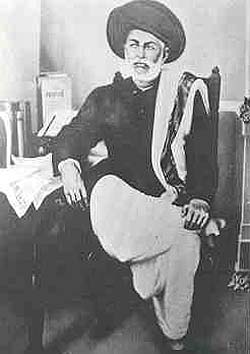
Correct — B, Jyotiba Phule. Gulamgiri was written by Jyotirao Govindrao Phule and published in Marathi in 1873, with a preface in English. Its title means 'slavery', and the book is one of the earliest sustained critiques of the caste system in any Indian language — it has been called the seed text of anti-brahminical consciousness. The year is worth holding for a second reason: 1873 is also the year, on 24 September, that Phule founded the Satyashodhak Samaj, the Society of Truth Seekers, to work for the rights of Shudras, Dalits and women, open to people of all castes and religions, and campaigning against idolatry, priestly mediation and caste itself. Phule (1827–1890) came from Satara district and had begun far earlier: with his wife Savitribai he opened a school for girls in Pune in 1848, and in the same year read Thomas Paine's Rights of Man, which he later said shaped his sense of social justice. His other writings run from Tritiya Ratna in 1855 and Brahmananche Kasab in 1869 to Shetkaryacha Aasud, the Cultivator's Whipcord, on the condition of the peasant. The title Mahatma was conferred on him in 1888. Since a book has one author and only one of the three named men wrote this one, option (d) 'More than one of the above' cannot be right — a 'more than one' option needs two listed choices that are true together, and here they are mutually exclusive.
- (a)B. R. Ambedkar — The best-known anti-caste author in India, which is precisely why the option works, but Gulamgiri predates his birth by nearly twenty years. Ambedkar's own texts are Annihilation of Caste, the undelivered address of 1936, and Who Were the Shudras?, among others — and he named Phule as one of his intellectual gurus, which is the connection that makes the mix-up so easy.
- (c)Ramaswami Naikar Periyar — E. V. Ramasamy, called Periyar, led the Self-Respect Movement and later the Dravidar Kazhagam in the Tamil country, and wrote in Tamil — his best-known text is his reading of the Ramayana. He belongs to the same anti-caste tradition as Phule, a generation later and in another language, which is what puts him on this list.
- (d)More than one of the above — Authorship of a single book is exclusive: if Phule wrote Gulamgiri, then Ambedkar and Periyar did not. The option can only be correct where the stem's claim can hold of several choices at once. Test it before choosing it — name the second option that would also have to be true, and if you cannot, the option is not available.
Gulamgiri belongs to the first generation of the anti-caste movement, and its argument is contained in its title. Writing in 1873, less than a decade after the American Civil War, Phule set the servitude of the lower castes alongside the slavery that abolitionists across the Atlantic had just fought to end, and drew the parallel deliberately rather than decoratively. His programme was practical as much as polemical: schools for girls and for the excluded castes from 1848 onwards, an association — the Satyashodhak Samaj — that performed marriages without priests, and a newspaper, Deenbandhu, to carry its views. The line of descent from that work runs through Shahu Maharaj of Kolhapur to Ambedkar, who counted Phule among his gurus, and sideways to Periyar's Self-Respect Movement in the Tamil country. What distinguishes Phule within that lineage is that he wrote at the very beginning, in Marathi, for a readership that had almost no printed anti-caste literature to draw on.
Book-and-author questions are answered by holding a short table of the canonical texts of each reform tradition, and by dating the author before dating the book. Here the dates alone settle it: Gulamgiri appeared in 1873, when Ambedkar had not been born and Periyar was an infant. Store the anti-caste canon as author, language, decade and one title each — Phule, Marathi, 1870s, Gulamgiri; Ambedkar, English, 1930s and 1940s, Annihilation of Caste and Who Were the Shudras?; Periyar, Tamil, from the 1920s, the Self-Respect writings. Then attach the organisations, because the Commission asks those too: Satyashodhak Samaj 1873, Bahishkrit Hitakarini Sabha, Dravidar Kazhagam. And keep applying the escape-option test — on any question of authorship, a first, or a founding, 'more than one of the above' is structurally unavailable, and recognising that costs nothing and saves a third of a mark.
- Gulamgiri ('Slavery') was published in Marathi in 1873, with a preface in English, and is regarded as one of the earliest critiques of the caste system
- Jyotirao Phule (1827–1890) was born in Satara district; with Savitribai Phule he opened a school for girls at Pune in 1848, the year he also read Thomas Paine's Rights of Man
- He founded the Satyashodhak Samaj on 24 September 1873 for the rights of Shudras, Dalits and women; it opposed idolatry and the necessity of priests, and its views were carried by the Pune newspaper Deenbandhu
- His other works include Tritiya Ratna (1855), Brahmananche Kasab (1869) and Shetkaryacha Aasud, the Cultivator's Whipcord
- The title Mahatma was conferred on Phule in 1888, two years before his death
- B. R. Ambedkar, who wrote Annihilation of Caste and Who Were the Shudras?, named Phule among his intellectual gurus
- Assigning any anti-caste text to Ambedkar; Gulamgiri was published in 1873, decades before he wrote
- Confusing the Satyashodhak Samaj with the Prarthana Samaj or the Arya Samaj, all of which belong to the same decades
- Selecting 'More than one of the above' on a question of authorship, where the choices are mutually exclusive by construction
BPSC asks author-to-book in one line and adds the escape option, so the mark turns on a memorised pairing plus the discipline to test 'more than one'. UPSC prefers the reverse or the oblique route — a descriptive passage about a reformer whom you must identify, or a matched-pairs question in which one association is deliberately wrong — so the same names have to be held with their organisations and their causes attached.
100. Which one of the following pairs is not correctly matched?
- (a) Jamnalal Bajaj — Satyagraha Ashram at Wardha
- (b) Dadabhai Naoroji — Bombay Association
- (c) Lala Lajpat Rai — National School at Lahore
- (d) Bal Gangadhar Tilak — Satya Shodhak Sabha
Answer(d) Bal Gangadhar Tilak — Satya Shodhak Sabha
The mispaired option is Phule's own organisation, attached to the wrong man. The Satyashodhak Samaj and Gulamgiri belong to the same year, 1873, and to the same person — which is why knowing one of them answers a question about the other.
His ‘principal forte was social and religious reform. He relied upon legislation to do away with social ills and worked unceasingly for the eradication of child marriage, the purdah system …… To encourage consideration of social problems on a national scale, he inaugurated the Indian National Social Conference, which for many years met for its annual sessions alongside the Indian National Congress.’ The reference in this passage is to
- (a) Ishwar Chandra Vidyasagar
- (b) Behramji Merwanji Malabari
- (c) Mahadev Govind Ranade
- (d) B. R. Ambedkar
Answer(c) Mahadev Govind Ranade
Phule's contemporary in the same city, working the other side of the reform question — legislation and elite persuasion rather than a movement of the excluded castes. Holding the Maharashtra reformers of the 1870s and 1880s apart is what both questions require.
The book critical of the British Policies Gharib Hindustan was banned in Bihar in 1930 by the British was written by
- (a) Mohd. Wali Hassan
- (b) Ali Mohd. Shad
- (c) Shaikh Mian Jaan
- (d) Badrul Hassan
Answer(a) Mohd. Wali Hassan
The 70th CCE paper of December 2024 set the identical book-to-author item, with a Bihar subject. The Commission asks this form regularly, which makes a short list of titles with their authors and years one of the cheapest pieces of preparation available.
- practice — not a real PYQ
The Satyashodhak Samaj was founded in 1873 by
- (a)Mahadev Govind Ranade
- (b)Jyotirao Phule
- (c)Gopal Ganesh Agarkar
- (d)B. R. Ambedkar
Answer(b) Jyotirao Phule — founded on 24 September 1873, the same year Gulamgiri was published, to work for the rights of Shudras, Dalits and women.
- practice — not a real PYQ
'Annihilation of Caste' was written by
- (a)Jyotirao Phule
- (b)Periyar E. V. Ramasamy
- (c)B. R. Ambedkar
- (d)Narayana Guru
Answer(c) B. R. Ambedkar — an address written in 1936 that was never delivered and was published by its author; Phule's corresponding text, six decades earlier, is Gulamgiri.