
UPSC Preparation Strategy: Neil Sir's Full Session Notes
Neil Sir's full UPSC strategy session written up: Prelims decision-making, Mains muscle memory, Essay, Optional, study hours and process. Free PDF.
Download the full PDF
UPSC Preparation Strategy — structured session notes, 8 pages(237 KB)
 Full size
 Full size
 Full size
 Full size
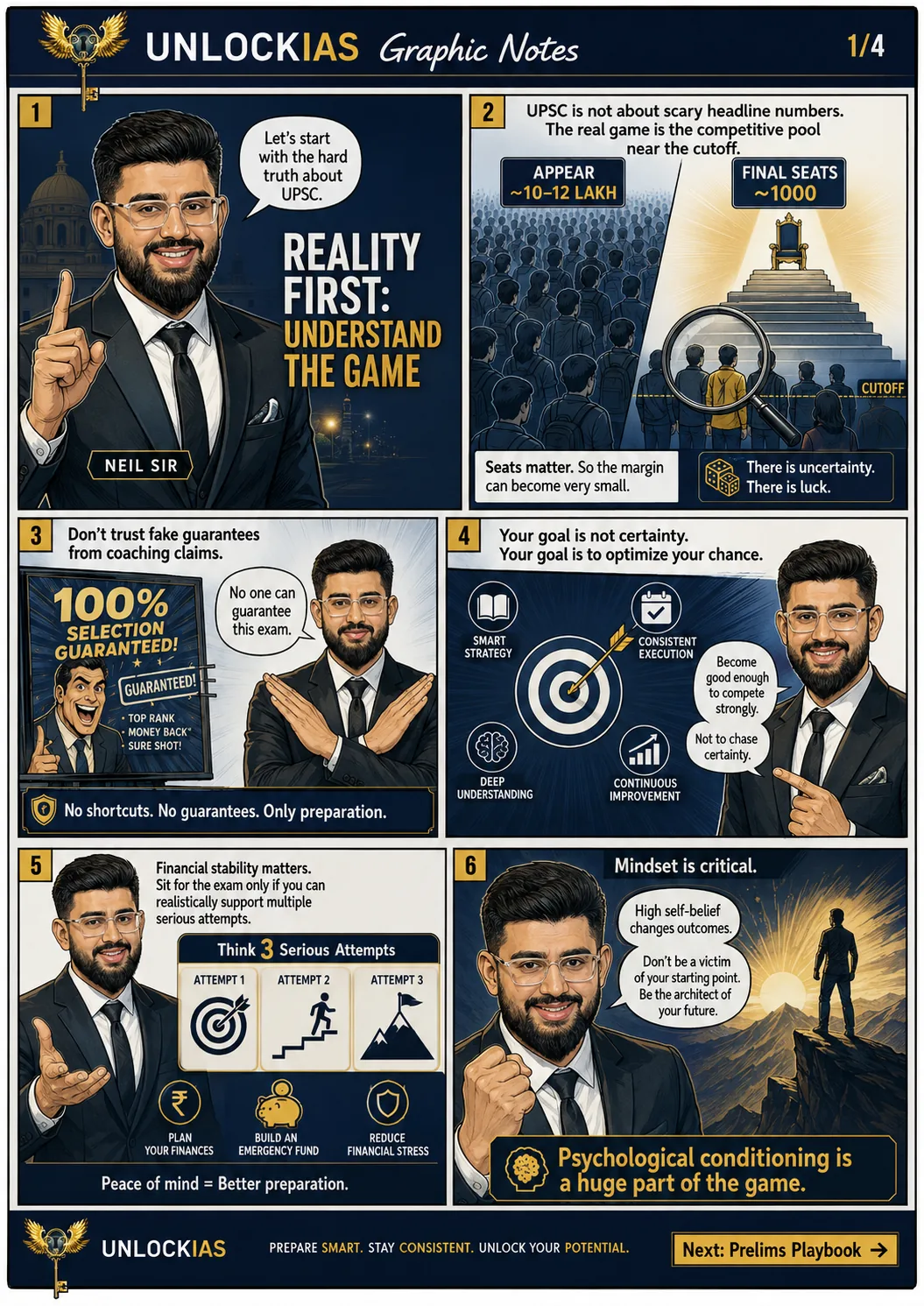
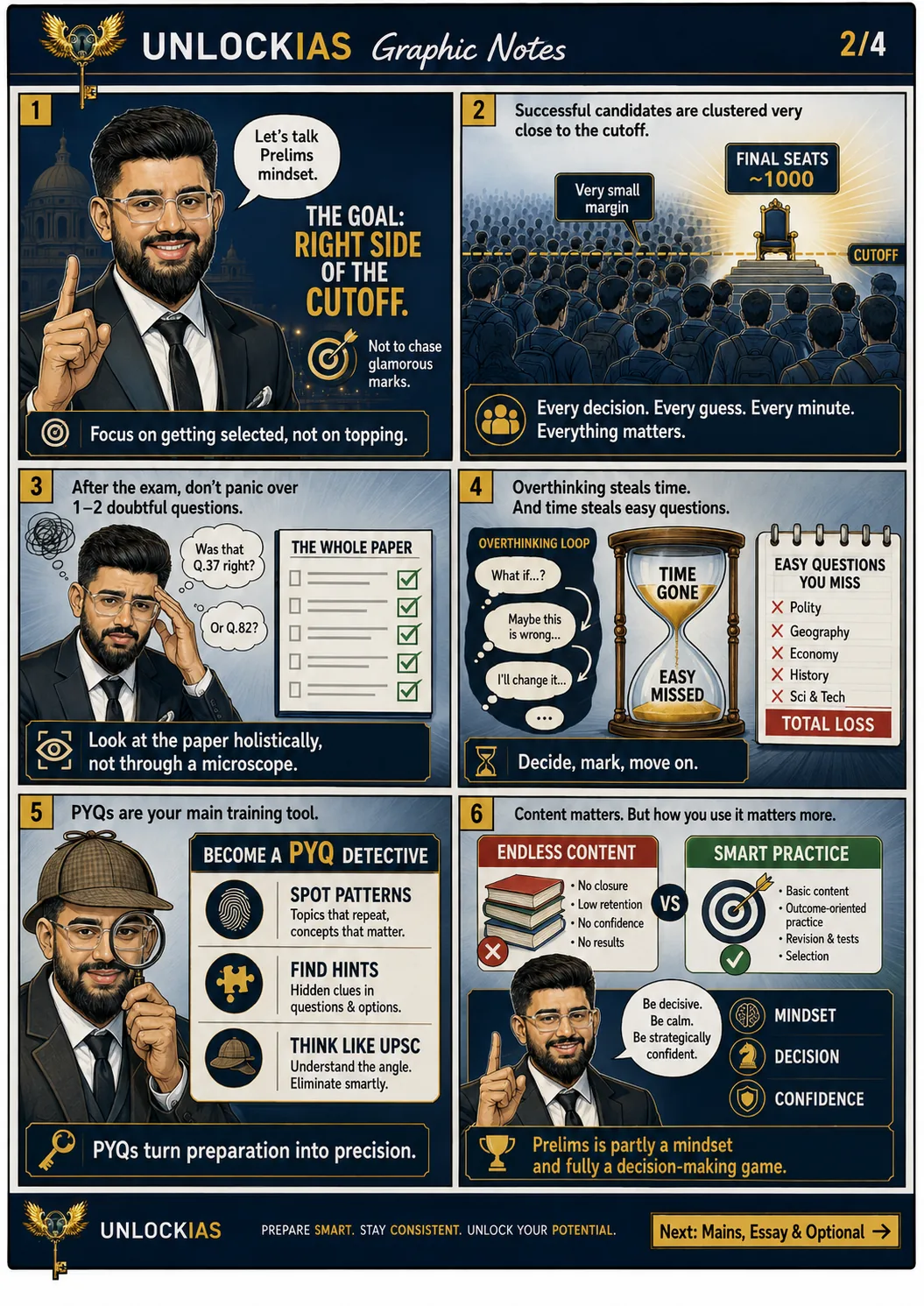
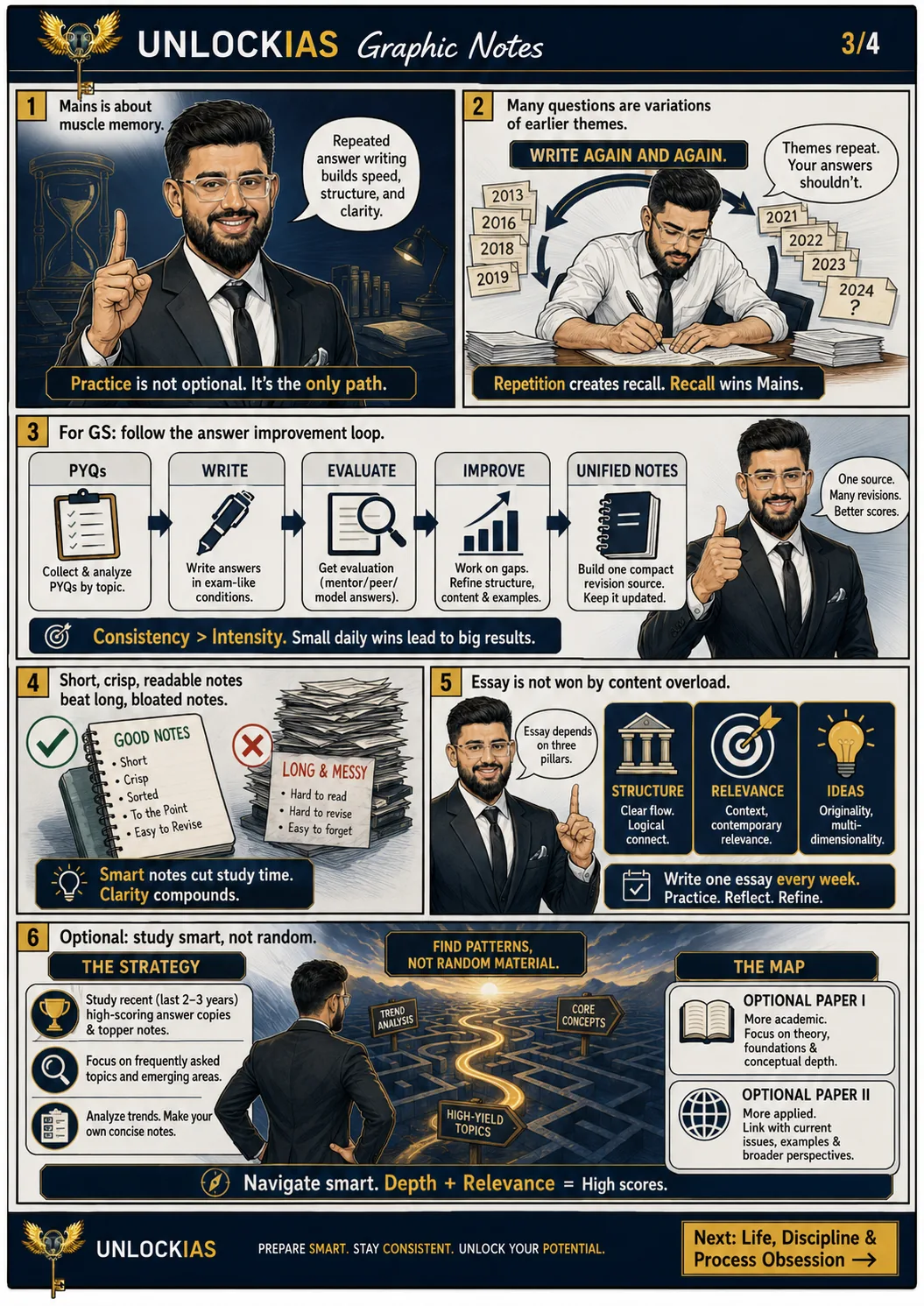
Tap any panel to open it full size. The same material is written out in full below.
On 9 August 2026, Neelkanth Bhardwaj (Neil Sir) took a live session on how to actually prepare for the UPSC Civil Services Examination — not the motivational version, but the working version: what the exam rewards, where candidates lose marks they had already earned, and how to build a week that survives contact with real life.
What follows is the full structured write-up of that session, reproduced as it was delivered. The four graphic-notes panels below summarise it visually; the complete text follows underneath, and the whole thing is available as an 8-page PDF you can print and keep on your desk.
One framing note before you start. The exam contains uncertainty. The candidate's job is to make the controllable part of preparation as reliable as possible.
Executive takeaways
The entire session in ten points.
- Treat UPSC as a probability and execution problem. Preparation can improve your odds; it cannot remove uncertainty.
- For Prelims, the objective is to cross the cutoff. Do not build strategy around glamorous scores or a handful of doubtful questions.
- PYQs should shape preparation. They reveal recurring themes, question design, useful distinctions and the level of precision UPSC expects.
- Prelims performance depends on knowledge plus decision-making. Overthinking can cost time and easier questions.
- Mains requires output. Repeated answer writing creates the speed, structure and recall needed under time pressure.
- Build notes around use. Short, revisable and answer-ready material is more valuable than large collections that cannot be recalled.
- Essay depends heavily on structure, relevance and idea generation. Regular writing is more useful than waiting for content to feel complete.
- Optional preparation should be evidence-led. Study recent high-scoring copies, recent notes and the distinct demands of each paper.
- Separate long-term planning from daily execution. Decide carefully at review points, then stop reopening the same decision every day.
- Protect the process. Financial stability, realistic study hours, distraction management and acceptance of some chaos are part of preparation.
One question to keep asking: What specific ability does this stage of the exam demand, and is my current study activity improving that ability?
How to use these notes
- Read the relevant section before planning a study block or review cycle.
- Use the final checklist to convert broad advice into weekly actions.
- Treat numerical study-hour and attempt suggestions as session benchmarks, not universal rules. Adjust them to your circumstances.
Understand the game before you optimise it
Before optimising anything, be clear about what the exam actually is: a competition decided by a narrow margin near the cutoff, containing real uncertainty that no amount of preparation removes. That is why financial runway and self-belief belong inside exam strategy rather than beside it.
Competition, uncertainty, financial runway and self-belief.
A. The real problem statement
- Headline application numbers are less useful than understanding the competitive pool near the cutoff.
- Vacancies affect how narrow the margin becomes. The candidate cannot control seats, paper difficulty, the cutoff or other candidates.
- Serious preparation can place you in a strong competitive position. Beyond that point, some uncertainty remains.
- Any promise of certainty should be treated cautiously. The useful objective is to improve the probability of success repeatedly.
Session phrase: "Optimise your chance."
B. Financial stability is part of exam strategy
- The session advised entering the attempt cycle only with enough financial stability to sustain multiple serious attempts where possible.
- The idea is not to assume that three attempts are mandatory. The point is to avoid making one uncertain result carry the entire weight of your finances and identity.
- A stable backup, job, upskilling route or another examination can reduce pressure without automatically replacing UPSC as the primary goal.
C. Mindset is not a substitute for content, but it affects execution
- Aspirants should acknowledge their starting point without converting background disadvantages into a permanent victim narrative.
- Self-belief matters because a candidate who habitually doubts every decision can lose marks even with adequate knowledge.
- Psychological conditioning develops through repeated evidence: practice, familiarity, correction of mistakes and controlled exposure to exam pressure.
Practical reading: Confidence here means trained decisiveness, not blind optimism. Knowledge remains the foundation; mindset determines how well that knowledge is used under pressure.
The Prelims playbook
In UPSC Prelims the objective is to finish on the right side of the cutoff, not to maximise marks — Prelims scores do not carry into the final merit list. That single fact should govern how you spend time, how you use PYQs, and how you handle every borderline decision in the hall.
Cutoff orientation, time management, PYQs and decision quality.
A. Define the outcome correctly
- The goal is to finish on the right side of the cutoff. Prelims marks do not add to the final merit score.
- Do not let a target score become more important than the actual task of selecting enough correct options under time pressure.
- After the exam, avoid reducing the entire paper to one or two disputed questions. Analyse the whole paper.
Four questions worth asking after every mock test:
| Useful review question | Useful review question |
|---|---|
| Which easy or moderate questions did I miss, and why? | Where did I spend time without improving the decision? |
| Which mistakes came from weak content? | Which mistakes came from hesitation, panic or unnecessary answer changes? |
B. Overthinking has a double cost
- Time spent repeatedly revisiting one difficult question is taken away from later questions that may be easier.
- A candidate can therefore lose twice: the hard question may still be wrong, and solvable questions may be rushed or missed.
- Mock tests should measure decision behaviour as well as marks: when to move on, when elimination is strong enough, and when uncertainty is too high.
Exam habit: Process the information, decide, mark, move. Return only if time remains and there is a genuine reason to reconsider.
C. PYQs should drive preparation
- Use PYQs before, during and after topic study, not merely as a final revision exercise.
- Look for recurring themes, wording patterns, option design, factual precision and the kinds of distinctions UPSC repeatedly tests.
- The session used a "Sherlock" analogy: the same clues are visible to everyone, but trained attention notices what others overlook.
- Basic content remains essential. The shift is from endless content accumulation to content that improves actual question-solving.
Prelims test of a resource: After using this source, am I better at identifying the correct option in a UPSC-style question? If not, the resource may not deserve more time.
Mains: build muscle memory through output
UPSC Mains rewards what you can produce under time pressure, not what you have read. Repeated answer writing is the mechanism that converts knowledge into a relevant, structured answer inside the time available — which is why the session treats output, not input, as the core of Mains preparation.
Answer writing, evaluation and iterative improvement.
A. The core requirement
- Mains asks you to produce relevant, structured answers under a strict time limit. Reading alone cannot train this sufficiently.
- Repeated writing makes common structures, arguments, examples and introductions easier to retrieve under pressure.
- Many questions are variations of themes that have appeared before. Familiarity frees thinking time for genuinely new parts of the paper.
Session phrase: "Mains is about muscle memory."
B. The answer-improvement loop
| Step | What it means |
|---|---|
| 1. Analyse PYQs | Understand what UPSC has actually asked and what the question demands. |
| 2. Write | Attempt the answer rather than only reading a model response. |
| 3. Evaluate | Check relevance, structure, dimensions, examples, balance and presentation. |
| 4. Improve | Correct the weakness that the answer exposed. |
| 5. Consolidate | Add the best points to a compact revision source. |
| 6. Re-write | Test whether the improvement appears in the next answer. |
This is exactly the loop Daily Answer Writing is built around, and toppers' answer copies are useful mainly as evidence of what a finished version of step 3 looks like.
C. Quality before speed
- Timed writing naturally reduces quality. First build a strong untimed answer, then train to preserve as much quality as possible under time pressure.
- Do not use full-length timed tests as a substitute for fixing weak structure or weak content.
- A sensible progression is: strong untimed answers → shorter time limits → section-level practice → full-paper consistency.
If you are still deciding when to start answer writing, the answer implied here is earlier than most aspirants think — because the first version is meant to be untimed and imperfect.
D. Build one usable revision source
- Good preparation should reduce fragmentation over time.
- Evaluation should feed into notes so that mistakes do not remain separate from revision material.
- The objective is a compact, revisable source that can be repeatedly updated, not ten disconnected PDFs for the same topic.
GS, Essay, notes and CSAT
Different components, one common principle: practise the task that will be evaluated.
A. GS
- Use PYQs to define the boundaries of a topic and the recurring dimensions UPSC rewards.
- Develop reusable frameworks, examples and issue linkages, then test them through answer writing.
- Do not become obsessed with a single GS paper score. Build a balanced, repeatable system across papers.
B. Essay
- The session placed greater emphasis on structure, relevance and idea generation than on raw content volume.
- A good essay should interpret the topic clearly, build a logical sequence, connect dimensions and use examples in service of the argument.
- Once the basics are understood, regular writing is essential. The session recommended a weekly essay practice rhythm.
| Structure | Relevance |
|---|---|
| Does the essay have a clear progression rather than a collection of loosely related points? | Does each paragraph answer the topic rather than display unrelated knowledge? |
| Ideas | Review |
| Can you generate multiple useful dimensions without losing the central argument? | After writing, identify where the essay became generic, repetitive or disconnected. |
C. Notes
- Page count is not a meaningful quality metric.
- Short, crisp notes are useful because they can be read, retained and revised repeatedly.
- For many GS themes, keep reusable ideas or frameworks stable and update examples separately.
Test of a note: Can I revise it quickly and convert it into an answer under exam conditions?
If you are still unsure whether to make notes at all, that test is the deciding question — and how you revise them matters more than how many you have.
D. CSAT
- Do not keep adding sources before properly using the material already chosen.
- Watch actively: pause, attempt, resume, understand the method, record genuine doubts, and return to doubt sessions.
- Since evaluation happens through objective questions and OMR, solving practice must remain central. Reading should support it, not replace it.
That last point is the whole of clearing CSAT without a maths background: the qualifying bar is cleared by solving, not by reading about solving.
Optional: map the maze
Optional preparation should be led by recent evidence — high-scoring answer copies, recent notes and the subject's own PYQs from roughly the last two to three cycles — rather than by whatever material happens to be available. The job is to find what is stable in the paper and what is changing.
Use recent evidence, not random material accumulation.
A. Start with recent high-scoring evidence
- Identify strong performers from roughly the last two to three examination cycles.
- Study recent answer copies and notes where available. Look at depth, structure, examples, thinkers, diagrams and question selection.
- Older material may still be useful, but it should not automatically be treated as the current benchmark.
B. Look for patterns
- Treat Optional preparation like mapping a changing maze. Repeatedly compare PYQs, recent high-scoring copies and your own answers.
- Find what is stable: core concepts, recurring themes, standard thinkers and common analytical demands.
- Also identify what changes: recent issues, examples, preferred presentation styles and emerging topics.
C. Paper I and Paper II may need different treatment
| Paper I | Paper II |
|---|---|
| Typically more academic. Prioritise disciplinary concepts, theory, thinkers, foundations and conceptual depth. | Often more applied. Link the subject to current issues, examples, governance and broader analytical dimensions where the syllabus supports it. |
The exact Paper I / Paper II balance varies by Optional. Use your subject's PYQs and recent high-scoring copies as the final reference point. If you have not settled this yet, work through how to choose a UPSC Optional subject first.
Optional rule: Recent evidence + PYQs + repeated writing should determine the preparation system. Do not let the availability of material determine the system.
Plan deliberately, then execute
Long-term planning and daily execution are two different jobs, and running both at once is what produces decision fatigue. Decide at deliberate review points, then execute for a defined period without reopening the decision every morning.
Planner vs executor, career alternatives and widening the net.
A. Separate the planner from the executor
| Planner | Executor |
|---|---|
| Reviews attempts, finances, family constraints, career options, timelines and long-term goals. The planner is allowed to reconsider assumptions. | Carries out the decision for a defined period. The executor does not reopen the entire strategy every morning because of anxiety. |
- Major decisions can be revised, but at deliberate review points rather than continuously.
- This reduces decision fatigue and gives the chosen strategy enough time to produce evidence.
Session idea: Decide with the long-term mind. Execute with the short-term mind.
B. Action should precede the perfect plan
- Aspirants often intellectualise preparation and wait for certainty before starting.
- A useful process usually becomes clearer after doing the work: solve PYQs, write answers, observe gaps, then refine the plan.
- Planning without action creates no feedback loop.
C. Jobs, upskilling and other exams can widen the net
- Alternative opportunities can provide income, confidence, experience and a safer financial runway.
- The hierarchy must remain clear: is UPSC still primary, has the strategy shifted, or are multiple options being pursued for a defined period?
- Trying to treat every path as equally urgent can dilute execution across all of them.
Risk principle: Do not remove every alternative merely to prove commitment. Build a life structure in which one uncertain result does not collapse the entire plan.
This is the same reasoning behind an honest answer to "is one year enough for UPSC" — the question is not only about syllabus coverage, it is about runway.
Protect time and attention
Study time is protected in weekly blocks rather than found daily, and distraction is beaten by replacement rather than suppression. Both working and full-time aspirants are judged by focused output, not by hours logged.
Working aspirants, full-time preparation, distraction and the diary.
A. Working aspirants: think weekly
- For the participant working roughly 6:00 AM to 3:00 PM with weekends available, the session suggested protecting about 35-40 study hours per week where realistically possible.
- The useful principle is the weekly protected block, not the exact number. Energy, commute, health and family responsibilities still matter.
- Because time is constrained, low-value content consumption becomes more expensive. Prioritise PYQs, writing, revision and direct weaknesses.
A concrete version of this is laid out in the UPSC study plan for working professionals.
B. Full-time aspirants: treat preparation like serious work
- The session suggested roughly 7-9 productive hours a day for about five and a half days a week as a serious full-time benchmark.
- This is not a universal quota. Focused output matters more than a large hour count that is mainly passive or distracted.
- A full-time preparation period carries opportunity cost, so the available time should be used deliberately.
For what that actually looks like hour by hour, see the UPSC daily routine of toppers.
C. Reverse law of focus
- Repeatedly telling yourself not to think about a distraction can keep the distraction mentally active.
- Replace rather than merely suppress. Shift attention to a specific constructive task: solve, write, revise, exercise, organise, or rest deliberately.
- Environmental controls still help, but avoidance itself should not become the centre of attention.
This is the mechanism behind stopping social media during preparation: substitution works where suppression does not.
D. Use a diary as an external mind
| Tasks | Decisions |
|---|---|
| What needs to be done next? Keep the list concrete enough to execute. | What has already been decided, and when will it be reviewed again? |
| Distractions | Learning |
| What repeatedly stole attention this week? | What worked, what failed, and what one change will be made in the next cycle? |
The diary is useful when it reduces mental repetition. It should not become another elaborate productivity project.
Accept some chaos, stay obsessed with the process
Preparation has to work inside an imperfect life. The realistic objective is to reduce avoidable chaos, accept the rest, and stay consistent long enough for the process to produce a result.
Personal decisions, opportunity cost and consistency over time.
A. Chaos will not disappear completely
- Preparation cannot depend on a perfectly controlled life. Unexpected events, difficult weeks and emotional noise are part of the human experience.
- The realistic objective is to reduce avoidable chaos and improve your ability to function with the remainder.
- Self-control behaves like a trained capacity. Routines become more reliable through repeated use, not through one dramatic decision.
If the difficult weeks are becoming the norm rather than the exception, UPSC preparation and mental health is the more important read.
B. Every choice has an opportunity cost
- Choosing full-time preparation may cost income and professional experience.
- Choosing a demanding job may reduce study time.
- Preparing simultaneously for too many unrelated examinations may reduce depth and focus.
- Refusing to decide is also a decision because time continues to pass.
Personal question: What am I willing to give up in exchange for this outcome, and for how long?
C. Simplify where possible
- Not every strategy video, topper interview, cutoff prediction, rumour or coaching claim requires a response.
- Know the exam, know your plan, know your constraints, and know the next task.
- Critical thinking includes questioning mentors. Advice should be checked against PYQs, recent evidence and your own performance.
Final message: Be obsessed with the process: show up, practise the task that will be evaluated, review mistakes, improve the system and continue. The goal is not to feel certain about the result. The goal is to reduce avoidable failure.
The action checklist
Convert the session into a weekly operating system.
This week
- Map your current preparation to PYQs for each active subject or paper.
- Identify one content source that can be removed because it does not improve exam output.
- Write and evaluate at least a small set of Mains answers instead of only reading.
- Create or update one compact revision sheet from the weaknesses revealed by writing.
- Schedule the next essay practice and define what you will review after writing it.
- For Optional, shortlist recent high-scoring copies and notes from the last 2-3 cycles.
- For CSAT, solve actively and list genuine doubts instead of adding another resource.
- Set a realistic weekly study-hour target based on your actual work and energy constraints.
- Create one deliberate decision-review date so that major strategy questions are not reopened daily.
- Use a simple diary page for tasks, decisions, distractions and one weekly improvement.
Monthly review questions
- Am I getting better at selecting the right option in Prelims-style questions?
- Can I write common Mains themes faster and with better structure than one month ago?
- Are my notes becoming smaller and more useful, or larger and harder to revise?
- What errors are repeating despite repeated tests or answer writing?
- Is my current timetable financially, physically and psychologically sustainable?
- Which decision needs a deliberate review, and which one only needs better execution?
Bottom line: Clarity on the outcome. PYQs as evidence. Repeated output. Compact revision. Deliberate decisions. Protected time. Consistency long enough for the process to work.
About the session. These are the structured notes from Neelkanth Bhardwaj's session held on 9 August 2026, prepared from the full session transcript and meeting minutes. Neil Sir cleared HCS in 2021 with Rank 93 and teaches the Sherlocking methodology at UnlockIAS.
The study-hour and attempt figures above are the benchmarks discussed in that session for the participants present. They are not universal rules — adjust them to your own work, health and family constraints, as the notes themselves advise.
Next steps: put the answer-improvement loop into practice with Daily Answer Writing, train Prelims decision-making on the UPSC Prelims test series (upcoming), or start with the previous year question bank. If you are building a plan from scratch, the complete UPSC preparation guide covers syllabus, books and timeline.
Download the full PDF
UPSC Preparation Strategy — structured session notes, 8 pages(237 KB)
Frequently asked questions
What is the single most important idea in Neil Sir's UPSC strategy session?
That UPSC is a probability and execution problem rather than a certainty. Preparation can improve your odds; it cannot remove uncertainty. The session's working objective is to make the controllable part of preparation as reliable as possible, and to keep improving the probability of success rather than chasing a guarantee. The phrase used in the session was simply: optimise your chance.
How should a UPSC aspirant use previous year questions?
Use PYQs before, during and after topic study rather than only as a final revision exercise. They reveal recurring themes, wording patterns, option design, factual precision and the kinds of distinctions UPSC repeatedly tests. The session's test of any resource is direct: after using this source, are you better at identifying the correct option in a UPSC-style question? If not, the resource may not deserve more time.
Why does overthinking cost marks in UPSC Prelims?
Because it has a double cost. Time spent repeatedly revisiting one difficult question is taken away from later questions that may be easier, so a candidate can lose twice — the hard question may still be wrong, and solvable questions may be rushed or missed. The exam habit recommended in the session is to process the information, decide, mark and move, returning only if time remains and there is a genuine reason to reconsider.
How much should you write to prepare for UPSC Mains?
Mains asks you to produce relevant, structured answers under a strict time limit, and reading alone cannot train this sufficiently. Repeated writing makes common structures, arguments, examples and introductions easier to retrieve under pressure. The session's progression is to build a strong untimed answer first, then move to shorter time limits, then section-level practice, and finally full-paper consistency — quality before speed.
How many hours a week should a working UPSC aspirant study?
For a participant working roughly 6:00 AM to 3:00 PM with weekends available, the session suggested protecting about 35 to 40 study hours per week where realistically possible. The useful principle is the weekly protected block rather than the exact number, because energy, commute, health and family responsibilities still matter. Treat it as a session benchmark and adjust it to your circumstances.
How should you choose and prepare an Optional subject for UPSC?
Preparation should be evidence-led. Identify strong performers from roughly the last two to three examination cycles and study recent high-scoring answer copies and notes where available, looking at depth, structure, examples, thinkers, diagrams and question selection. Find what is stable — core concepts, recurring themes, standard thinkers — and what changes, such as recent issues, examples and emerging topics. Recent evidence plus PYQs plus repeated writing should determine the system.
What is the difference between the planner and the executor in UPSC preparation?
The planner reviews attempts, finances, family constraints, career options, timelines and long-term goals, and is allowed to reconsider assumptions. The executor carries out the decision for a defined period and does not reopen the entire strategy every morning because of anxiety. Major decisions can be revised, but at deliberate review points rather than continuously, which reduces decision fatigue and gives the chosen strategy enough time to produce evidence.
What is the reverse law of focus, and how do you handle distractions?
Repeatedly telling yourself not to think about a distraction can keep that distraction mentally active. The session's advice is to replace rather than merely suppress: shift attention to a specific constructive task such as solving, writing, revising, exercising, organising or resting deliberately. Environmental controls still help, but avoidance itself should not become the centre of your attention.

Neil Sir shows how PYQ mapping reveals what UPSC actually rewards in Mains — the decode step behind the whole Sprint — on Telegram.
Join @UPSCneil to see moreReady to practice?
Apply what you learned with the UnlockIAS test series and Daily Answer Writing.
Related posts
UPSC & State PCS Doubts Answered by Neil Sir on Air
HCS 2021 Rank 93 holder Neil Sir answers key UPSC and State PCS doubts on All India Radio: syllabus, PYQs, the Sherlocking method, failure and focus.
How to Cope With UPSC Result Failure: An Honest Guide
Didn't get the UPSC interview call? Neil Sir shares an honest, experience-backed guide to coping with UPSC result failure and finding a way forward.